.png)
 1 month ago
40
1 month ago
40
There were some Ireland fans who even said they would not begrudge Scotland victory, the triple crown, and, potentially, a first Six Nations title. There was a sense Gregor Townsend’s side had earned their day in the sun, somehow, especially after the glorious fourth-round triumph against France. And this Ireland team have certainly had their share of vitamin D against Scotland.
Ireland’s players, it soon became clear, did not see it that way. They were visibly keen to remind Scotland that no one is owed anything in elite sport. This was meant to be a transitional season for them, but the quality of this performance penned a depressingly familiar script from a Scottish perspective.
Ireland’s defensive strategy and shape was outstanding throughout, not to mention their work-rate, and in no aspect of the contest did the visitors, hard as they tried, gain the ascendancy.
Scotland gave it every ounce of effort, and played some lovely rugby on the way: but leaving Ireland’s excellence aside, Scotland were repeatedly – and all too familiarly – guilty of inaccuracy at key moments.
With the final play of the first half, as Scotland trailed 19-7, they won a free-kick at a scrum, tapped it and went quickly. A try before the break would have been perfectly timed. But with Ireland for once a little out of shape, a careless Huw Jones pass hit the turf rather than find the grateful hands of a teammate.
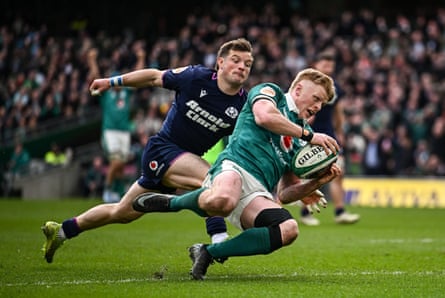
Jones erred again in the final quarter, after Rory Darge’s high-class score had made it a five-point game. There was a valuable opportunity to turn up the heat, with Ireland starting to look a little flustered in the face of a determined revival. But the outside-centre knocked on the restart, gifting Ireland field position for Tommy O’Brien to score the first of his two tries.
Right at the end, with the game gone, Sione Tuipulotu fumbled a Finn Russell pass in the Scotland half, Stuart McCloskey pounced and with a basketball-style offload, unfussily sent O’Brien steaming over in the corner to apply the coup de grace.
It made no difference to the result. But it felt significant that Scotland’s captain had coughed up another basic error, with the previously unheralded McCloskey, perhaps the player of the tournament, the one to capitalise.
Is any of this Townsend’s fault? Arguably not, but then again, it was abundantly clear which team was better coached in defending as a unit, in using manpower efficiently and applying power intelligently. Green energy was the story of the day.
Scotland mostly had little answer, as has consistently been the case, to the breakdown dynamism and astuteness of players such as Tadhg Beirne and Caelan Doris.
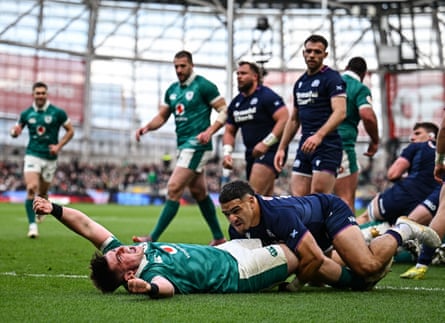
Russell, like everyone else, did his best for Scotland and showed customary touches of class – often scintillating with his distribution, brave with his touch-finding kicks and constantly alert to the existence of a gap. But such was Ireland’s refusal to over-commit when Russell was on the ball, there were not many of those.
The Bath fly-half applied a supreme finish soon after half-time, sparking Scotland’s second-half resurgence, busting through an attempted double-tackle by Dan Sheehan and Jamison Gibson-Park to dive over. Scotland had their moments: but the early signs had been worrying to say the least.
Ireland’s first try was borne of brutal simplicity: a scrum penalty, a kick for the corner, a ruthlessly executed strike play that sent Jamie Osborne scuttling under the posts unchallenged after just three minutes. A bespectacled Farrell sat soberly up in the coaching box, scribbling notes, his remarkable rugby brain whirring.
Scotland’s response to Ireland’s early score was impressive and immediate – but it said a lot that they needed 19 phases to break down the green wall, Darcy Graham applying the finish. Grant Gilchrist’s offload for Darge’s try, Scotland’s third, was also class. But ultimately it was not enough.
“A couple of errors let them in,” Townsend told ITV. “They were excellent in their attack today.”
Will Scotland feel pride or regret, overall, after this championship? “It will be both those emotions,” Townsend said. “We threw everything at Ireland, we just needed to not give them those chances, because they were very accurate today and they made the most of them.”
Inconveniently for Townsend’s detractors his players have mostly acquitted themselves well in his ninth Six Nations in post. That said, and for all Scotland’s effort, Ireland almost always had them at arm’s length, and looked the better coached side. After Ireland thrashed England at Twickenham in round three, Farrell modestly said it had not been a tactical victory for the coaching team but one mostly based on his players’ desire. The truth then, as it was here, was somewhere in the middle.
There was plenty of talent and heart from Scotland – and this time they really made Ireland work – but Townsend, yet again, is left to reflect on what might have been.