.png)
 1 month ago
103
1 month ago
103
For 10 seasons, few have earned the right to comment on English cricket more than Simon Harmer. Because for 10 seasons, no one has taken more County Championship wickets than the South African off-spinner who arrived at Essex in 2017 on a six-month contract, his international career stalled and his options narrowing fast.
He has since become one of the great imports of the English game: 522 first-class wickets and counting for Essex, two County Championship titles, a Bob Willis Trophy, a return to South Africa’s Test side and, perhaps most importantly, contentment. “My journey has been bumpy,” Harmer says from a sun-drenched beer garden near the Oval. “I can say now that I’m at peace with it.”
When he arrived at Chelmsford on a Kolpak deal, Harmer had drifted out of the South Africa picture after only five Tests. Within months, he had gone from first-choice spinner to playing backup for Keshav Maharaj and Dane Piedt. Harmer could read the room. “I’m not dumb,” he says. “I know when I’m not wanted.” Essex, newly promoted to Division One, needed a spinner. Harmer needed a stage.
He was an instant success. He bagged 72 wickets at 19.19 in his first season as Essex claimed their first title in 25 years. He finished that campaign, and the six that followed, as the most prolific spinner in the country. In three of those seasons, he topped the overall wicket-taking charts. Rumours of an England call-up followed, though he insists there was never a serious chance.

When reminded of the scale of it, he shrugs. “It’s my job,” he says. “I just want to make sure that when I call it a day, I can say I was the best version of Simon Harmer that I could have been.”
There’s an edge that runs through him. He is less interested in talking about the flight and turn of a cricket ball than the psychological battle between batter and bowler. He talks about the embarrassment he felt when he was dropped by the Proteas and how he turned that into a weapon.“Everybody is going to face that shit,” he says. “How do you deal with it? Do you fade, or do you prove the fuckers wrong?”
But he is not just a scrapper. Harmer is a craftsman, one of the great problem-solvers of the modern county game. “I love working out [a batter],” he says. “That’s what gets me going. What’s he looking to do, where is he looking to score, what’s easy, what’s difficult, what field will get me a wicket? I love all that. That is the art for me.”
It is why his view on England carries weight. He has spent a decade studying their domestic batters up close. And on the Test team’s aggressive philosophy, Harmer is intrigued but unconvinced by some of the thinking behind it.
“I do feel selection has gone away from scoring a thousand runs in the County Championship for a couple of years, to ‘it’s not how many you score, it’s how you score,’” he says. “If it’s easy on the eye, it’ll get you in the side.”
England, he insists, remain dangerous. “Root is like the only traditional Test cricketer in there but he’s still reverse-ramping Pat Cummins.” But he is not sure the approach bends the format as easily as some believe. Test cricket still rewards control and consistency over time, and he senses a disconnect between what Rob Key and Brendon McCullum are chasing, and what the format demands.
On English spinners, Harmer is more sympathetic. Conditions, he says, often reduce them to support acts. “In England, generally your spinners are a bit of an afterthought.” He admires Liam Dawson (“a hell of a cricketer”) and Jack Leach (“very accurate, very wily”) but questions the system around them.
“It’s not a lack of resources, you’ve got 18 counties,” he says. “But how many have a spin-bowling coach? Probably two or three.” Talent is not the issue. “Somebody can have all the skills in the world, but when it hits, if they run for the hills, it doesn’t matter how good they are. I think English cricketers don’t always have that fight in them.”
He points a finger at the county circuit. “With 18 teams, there’s definitely a place for mediocrity. There are loads of guys just plodding along, doing enough to keep their average contracts.”
Harmer is just as blunt on the global game. South Africa’s World Test Championship triumph last year has not shifted the balance of power. “Because of their commercial power, they have all of the power,” he says of India. “The BCCI control the ICC. But what can we do? As a player you just control the controllables. The only thing that changes the narrative is winning trophies.”
That is why he so admires the current South Africa side under Shukri Conrad and Temba Bavuma, which is “more than the sum of their parts with only a couple of superstars”. Conrad, in particular, suits him. “If he thinks you’re shit, he’ll tell you straight. I rate that. I’ve not always had that.”
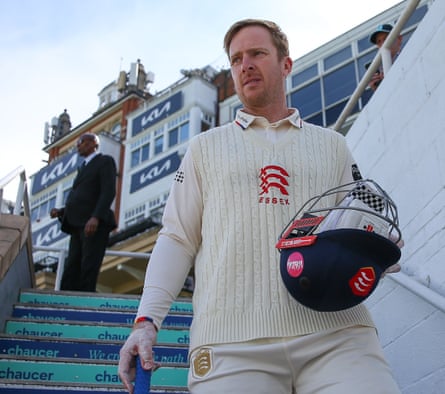
Harmer has mellowed; a combination of his security with the Proteas and becoming a father nine months ago. “I don’t think I was a good person on the field when I was younger. I didn’t know any different.” These days he has little time for “dumb abuse”, though county cricket still has its irritants. Somerset remain natural rivals. Sussex, he says, “strut around like they’ve won three Championships in a row”.
The end is coming into view. Harmer reckons he has “two more seasons” left. After that, a move to law. He is finishing a degree and wants to become a barrister. “I have to be brave enough to go and be shit at something for the first time again.”
Before that, there are still moments to savour. His favourite wicket? Steven Finn, lbw late on to beat defending champions Middlesex in 2017, his ninth scalp in the innings. Best teammate? “Sir Alastair Cook. Not just as a cricketer, as a person,” with Ryan ten Doeschate the standout leader. The best player he’s played against? “The master, Kumar Sangakkara. I had him caught at first slip once.”
For now, though, he is still here, still spinning, still fighting, still proof that one short contract can birth a legacy. “Stop waiting around for the perfect situation,” he suggests. “Get on a plane and go. That’s all it took for me.”