.png)
 4 hours ago
1
4 hours ago
1
The Tour de France Femmes is facing pressure to reroute part of its key stage to the summit of Mont Ventoux next Friday because of the wildfires threat in Provence.
The women’s Tour, which begins in Lausanne on Saturday, is expected to keep the famous climb to the top of the “Giant of Provence”, but the current routing of the stage through the Ventoux’s foothills could be affected.
In a statement on its website, the Vaucluse prefecture said: “At a time when forest areas are at a peak risk of fire, the prefecture has asked the organisers of the Tour to consider an alternative route. Following a fire risk assessment on Tuesday 4 August, an alternative route will be implemented should the wildfire risk be considered extreme.”
Three stages of the men’s Tour de France, which finished in Paris last Sunday, were disrupted by wildfires, extreme heat and the deployment of French emergency services to assist with the wildfire crisis in the country’s south-west.
“We are in constant touch with the prefecture and we will adapt, just as the men’s Tour de France did,” said Marion Rousse, the Tour de France Femmes race director.
“We have to deal with the real world – this is a bike race and the real world always takes priority. There will still be a climb of the Ventoux, but we have several options. We are ready to work with the emergency services and the government.”
Few things demonstrate the fast‑track growth of women’s racing more than the inclusion of Mont Ventoux on the route for this year’s race. “There is no mountain that is too difficult for women,” Rousse said. “The level is now more and more consistent and they ride faster each time. Each year the progress is huge.”

The legendary climb is the standout stage in a race route that is bolder and bigger than it has been since the race was reintroduced in 2022 as a tentative bolt-on to the end of the men’s Tour de France.
Over nine stages, including an individual time trial and stages through the Jura, Massif Central and Provence Alps, 147 riders will wend their way to the Côte d’Azur for a testing finale in the hills inland from Nice.
Pauline Ferrand-Prévot, the defending champion, was a no-show at the top riders press conference on Friday afternoon, with her highly rated French teammate Marion Bunel, third overall in this year’s Vuelta Femenina, surprisingly taking her place.
Ferrand-Prévot was said to have already fulfilled plenty of media obligations, but her absence from a top table that included past winners and her main rivals, Demi Vollering and Kasia Niewiadoma, did not go unnoticed.
Ferrand-Prévot’s success last July was hailed in France, but she faces more rivals this year than she did 12 months ago, with the 23-year-old Spanish rider Paula Blasi, who sealed victory in the Vuelta on the brutal climb of the Angliru, a leading contender.
Elsewhere there are signs that others too, as Rousse suggested, have upped their game. The Swiss rider Marlen Reusser, who said she has had a “love-hate” relationship with the Tour Femmes in the past, is expected to shine in the individual time trial on stage four, while the long climb to the Ventoux is likely to feature the 2023 winner, Vollering, and the defending champion, Ferrand-Prévot, going head to head.
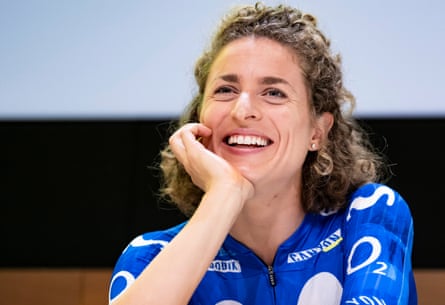
Reusser, the world time trial champion, has had a series of false starts in the French race. “This is the first year that I’m here and feel healthy and good,” she said. “It’s special to finally be here in that way.”
Ferrand-Prévot’s victory in last year’s race made her a household name in France and, after a long wait to see a home rider win the yellow jersey, drew crowds to the roadside in their thousands.
“Now women’s cycling in France is doing well and men’s cycling in France is also doing very well,” Rousse, said by way of tribute to Ferrand-Prévot’s success.
“We felt a real sense of patriotism with Pauline’s victory. Whether it was in the men’s or the women’s race, it’s been some time that we’ve been waiting for a French winner.
“Pauline gives a lot. To the public, her charisma has done cycling a lot of good. All those little girls who dream one day of becoming like Pauline. People are interested in her because she is so likable.”
Rousse is confident that Ferrand‑Prévot, despite a muted spring, will put up a staunch defence of her title. “There will be a great rivalry between her and Vollering,” she said. “I think that Pauline has increased her level in comparison to last year – she’s really gone up.”
Elsewhere, the upward trajectory of the race continues. The number of women riding the amateur Étape du Tour Femmes is higher than those who rode the Étape du Tour, on Alpe d’Huez, with 27% of all participants in the Étape Femmes being female.
“It shows that women put a lot less obstacles in their way than before, especially since the creation of the Tour de France Femmes,” Rousse said.
Saturday’s opening 138km stage in Switzerland features a hilly loop based on Lausanne, through the Cantons of Vaud and Fribourg, leading to a steep uphill finish on the Côte Saint-François, while on Sunday the peloton follows the northern shore of Lake Geneva before a lakeside finish, and a possible sprint, in Geneva.