.png)
 9 hours ago
5
9 hours ago
5
There are very few players who become bywords for their position, who enjoy universal acclaim. But for anybody who watched football in the late 80s or early 90s, Franco Baresi was the central defender. He was unsurpassed, obviously the best in his position in the world, the definition of the art of the defending. The oddity is, he really wasn’t like very many other defenders at all.
Baresi had just turned 19 when he won his first scudetto at Milan under Nils Liedholm. It was 1979 and Italian football was still dominated by the ideals of catenaccio. Most defences comprised a libero, two man-markers and, if you were lucky, an attacking left-back. But not Liedholm’s. The Swede was a pioneer in Serie A of zonal marking, and the idea that the game was not a series of physical battles but a question of space. Baresi was only 5ft 9in and a teenager. More traditional coaches may not have trusted him. But Liedholm saw an impeccable reader of the game, even at that age. Baresi was an ever-present, not only in the league but in the Coppa Italia and Uefa Cup as well.
That turned out to be a traumatic season for the club, with players arrested on the pitch after the final game of the season as part of the Totonero betting scandal, for which Milan were ultimately relegated. With the club in financial chaos, promotion was followed by another relegation and, although they were promoted again, the future seemed bleak before Silvio Berlusconi took over in 1986. Baresi remained loyal throughout. His parents died before he turned 16 and Milan became a sort of surrogate family.
He never played for any other club, amassing 719 appearances in all competitions over 20 years. And yet, he could easily have been an Inter player. Baresi’s brother Giuseppe, two years his elder, was already at Inter when Franco was offered a trial at the age of 14. Inter wondered if he was big enough to make it and asked him to come back the following year. So Franco went for a trial at Milan – which he insisted had always been his club – and was taken on.
Berlusconi was an outsider, determined to disrupt the establishment. In Arrigo Sacchi, who was appointed in 1987, he found a coach in the same vein: a radical who followed Liedholm’s tentative steps into the world of zonal marking with a giant leap into a full-blown flat back four and hard pressing. In the Serie A of the age it was almost unthinkably revolutionary. Conservatives were sceptical and, when Milan lost their second game of the season 2-0 at home to Fiorentina, and followed that up with defeat to Espanyol in the Uefa Cup and a disappointing draw against Cesena, the joke was that Berlusconi’s new messiah would not make All Saints’ Day, which is 1 November.
Form began to turn around, but Sacchi worried he had pushed the players too hard and eased back on training, at which point Baresi made a decisive intervention. He begged Sacchi to push the players even harder. It was vital, he said, that the players didn’t forget, that they came to learn the new way of playing, of working out their position not according to preset formulas but through constantly evolving reference to the opponent, their teammates, the ball and the space, to internalise the processes until they became instinctive.
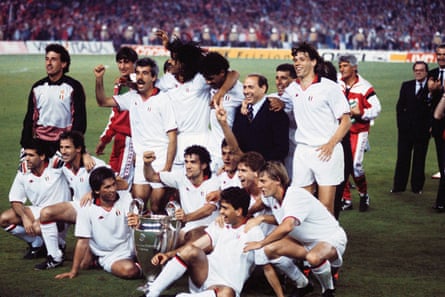
For Sacchi, it was a huge moment. Baresi was not only the captain, but the moral heart of the team. If he was on board with the revolution, Sacchi realised, the squad would follow. Milan, with their ultra-modern style, won the scudetto in 1988 and backed it up with consecutive European Cup wins, playing some of the most memorable football ever witnessed. Baresi was central to it, not only snuffing out opposing forwards but constantly analysing and organising, and also beginning initiating counterattacks. The clipped forward pass became a trademark, but his greatest skill was his pass selection. He just didn’t give the ball away.
His icons were all creative players, plus Ruud Krol, but Baresi was also tough. Gianfranco Zola called him the best defender he ever played against but observed that afterwards “your feet need loads of ice and anti-inflammatories”. Baresi dished it out, as defenders in Serie A in those days had to, but he could also take it. He played more than an hour of a Milan derby in 1989 with a broken arm, helping keep a clean sheet, and, at the 1994 World Cup, managed to recover from knee surgery required after tearing his cartilage in the second group game in time to play in the final. Again, he oversaw a clean sheet but, cruelly, failed from the spot in the shootout as Italy lost to Brazil.
after newsletter promotion
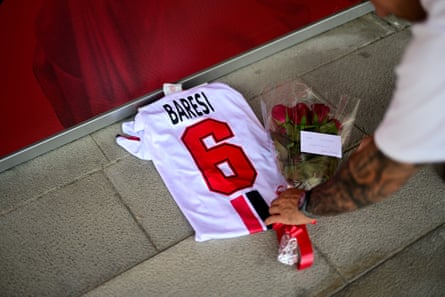
International football never quite gave Baresi the highs the club game did. He was part of the World Cup-winning squad in 1982 but didn’t play a minute, and was part of squads that got to the last four of Euro 88 and Italia ‘90, but he never achieved the same glory with Italy that he did with Milan.
And so the memory of him will always be in the red-and-black shirt, anticipating the game, stepping implacably in front of an opponent, shrugging him off and clipping a perfectly weighted ball in to a forward’s feet, the defining image of Italy’s new era of defending.