.png)
 12 hours ago
5
12 hours ago
5
“You could compare and contrast if you so desired,” says England Over-70s manager Chris Lowe, offering the straightest of bats to my shameless prod. “You’re the journalist, so you probably will.”
It would be professional negligence not to. So let us duly look at the fate that befell Brendon McCullum’s England team over the winter, alongside that of their England Over-70s counterparts, whose itinerary bore a startling resemblance to their junior brethren.
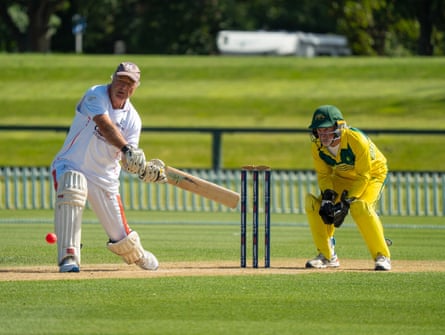
For both it began in Australia where Ben Stokes’s side succumbed to a bruising 4-1 Ashes defeat, weeks before the Over-70s swept to a 3-0 triumph in the wonderfully named Silver Ashes.
Under pressure to keep his job, McCullum then reconvened his England troops for the T20 World Cup, where their involvement ended at the semi-final stage against the eventual winners India. By coincidence, on the same March day that Jacob Bethell’s century proved in vain in Mumbai, India, the Over-70s successfully defended their own World Cup crown, seeing off Australia in the final in Christchurch, New Zealand.
That victory marked the culmination of a five-week tour for their 16-strong contingent, who packed in 15 matches and returned with the two most prestigious pieces of silverware available.
Notably the first three of those fixtures were warm-up games against local opposition – a strategy that a devious Spin writer might point out was in contrast to the woefully undercooked England senior team that played a solitary intra-squad match in Australia before losing the opening Ashes Test inside two days.
“I’m not going to teach the England senior side anything,” says Lowe, deflecting the issue respectfully. “But we felt it was necessary. It was very good because when we came to play the international games we were ready to fire.”
Let’s put it down to the benefit of experience – an attribute the Over-70s possess in abundance.
Lowe’s side represent the finest from an ever-increasing crop of late-age cricketers that he suggests is “growing exponentially”. There are 135 teams from 36 counties playing over-60s and over-70s cricket on a regular basis. Such is the demand that a new regional over-65s competition will launch this summer, while there is a dedicated “Silver Stumps” podcast devoted purely to the English veteran cricket scene.
Although endorsed by the England and Wales Cricket Board, the national over-60s and over-70s teams receive no funding from the governing body, with players on the recent Ashes and World Cup tour paying about £8,000 each depending on their chosen class of air travel.
“Dip into your bank balance and explain to your kids that their inheritance might not be as big as it could be,” laughs the England Over-70s captain John Evans, who has now captained his country to Ashes and World Cup glory twice apiece.
Like most of the team, Evans was a strong club cricketer in his youth, captaining Frocester for 15 years, before stepping up to play for Gloucestershire at over-50, over-60 and over-70 level. The last of those age groups was the first time he represented his country and, turning 75 this summer, he is an impressive anomaly to be still going at international level.
While there is no upper age limit, Lowe says most tend to struggle for the required physical fitness by the time they reach 73. “You can have a great time, but only for a short time,” he says.
Players are expected to be able to run a couple of threes an over while they were confronted with temperatures of up to 36C in Australia, where playing regulations require all batters to wear helmets – something few of the English contingent had done during careers that have spanned more than six decades.
“There’s always people who say: ‘You can’t do that at this age,’” says Lowe. “But these guys keep themselves very fit. They have got ambition. They are quite extraordinary people in the sense that they keep wanting to do things that people think they shouldn’t be doing.”
A few in the squad represented minor counties in their youth but it is rare for former first-class players to continue at such an age, with Lowe suggesting they “tend not to enjoy it any more. Generally they’ve had enough in their 50s. I do know one or two, but they are a rarity.”
Slow physical decline can prove decisive. “Some guys who hit 70 are as fit as they were when they were 60,” says Lowe. “They can actually float to the top and become international-quality players. It’s a strange thing, some just don’t drop off like others do.”
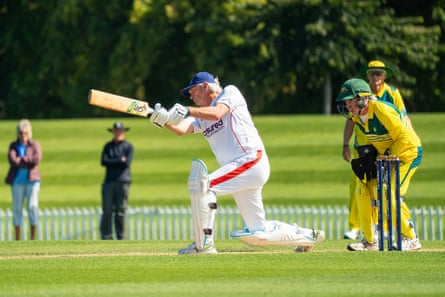
For those that make the grade, the pride is as strong as those felt by members of Stokes’s Test team. “It’s no small achievement to get selected,” says Evans, who was relieved to lose the toss before the Over-70s World Cup final and be put into bat. The 183-run opening partnership that followed between Jim Phillips (118) and Chris Evans (79) laid the groundwork for England’s 15-run victory.
“I don’t want to just play golf yet,” says the captain. “I’ve got a lot of golfing mates, but there’s nothing like playing cricket.
“If you’ve been a team player all your life, like I have, there’s nothing like the dressing room and team spirit. I think it keeps you young as well. I have a few aches and pains, but I’m still getting out there and I’d recommend anybody in any sport to keep going as long as you can, because it’s so good for you. It was a tiring tour, but it was fun tiring.”
And not a single nightclub incident in sight, although it would be impertinent to mention.
-
This is an extract from the Guardian’s weekly cricket email, The Spin. To subscribe, just visit this page and follow the instructions