.png)
 4 hours ago
3
4 hours ago
3
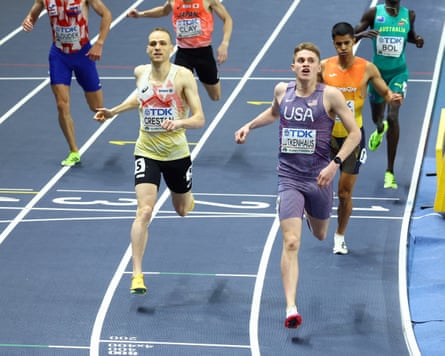
Fire on the boards. Slack jaws off it. Last week, I was fortunate enough to be yards away from the 17-year-old American high school student Cooper Lutkenhaus when he powered away from a strong 800m field in Torun to become the youngest world champion in track and field history. But no sooner had the applause died down that the search for superlatives began.
“He’s like David Rudisha,” said Eliott Crestan, the Belgian who took world indoor championship silver behind Lutkenhaus. “In 10 or 20 years’ time, I’ll be able to say that I ran against him.” An hour or so later, I spoke to Trevor Painter and Jenny Meadows, the coaches of Keely Hodgkinson, who were just as effusive. “He’s phenomenal,” Painter said. “You look at things like that and you think: ‘Wow. I’d love to know what he’s done at his age to do that.’”
Leaving the arena I bumped into Lutkenhaus, who was heading to McDonald’s with his parents, George and Tricia, and all three of them couldn’t have been more humble. George later told me that Cooper had barely eaten and so celebrated with a Big Mac, large fries and shake “and then he ate basically half of mine and half of his mother’s”.
It was a reminder that Lutkenhaus is, for all his preternatural brilliance, also a normal teenager. But Painter’s comments had also planted the seed of an idea. What might explain the American’s extraordinary talent, which has already led to him running 1:42:27sec for the 800m at 16, just 1.36sec behind Rudisha’s 800m world record? And helped him to become a professional Nike athlete and a world champion at 17?
A couple of days later I am on the phone to Lutkenhaus’s coach, Chris Capeau, and his dad, George, who is the athletic director at Northwest High School in Texas, where Cooper studies. The first thing I learn? Having won the gold medal on Sunday night Cooper arrived home in Texas at 6.30pm on Monday and was training early on Tuesday morning on an exercise bike with his teammates.
According to Cadeau, Lutkenhaus’s talents are largely down to “God’s gifts, his mum and dad’s genetics, and his upbringing”. As he points out, George and Tricia were both talented college runners. But Cooper is something else: before Torun he had sessions that suggested he was in shape to run a 44sec 400m and would be a real challenger for gold over 800m. However there was luck involved too, as Cooper avoided a sickness bug that afflicted his teammates just before he flew to Poland.
But Capeau then adds something else: “Cooper is just built in a different way then most people – he always shows up, good or bad. The day after he ran 1:42 at the US Nationals in Oregon last year he was back at practice the next morning having flown all the way to Texas. He has this intense focus to detail. And he’s ruthless about figuring out how to maximise his potential. That’s probably why Michael Jordan is Michael Jordan, Kobe Bryant is Kobe Bryant and Cooper is Cooper. We just had spring break and more than half my team were out of town and not running. But Cooper never misses.”
“This is a blue collar town with honest people doing honest work. That’s the old school way of life: you get up, you put your boots on and you go to work.”
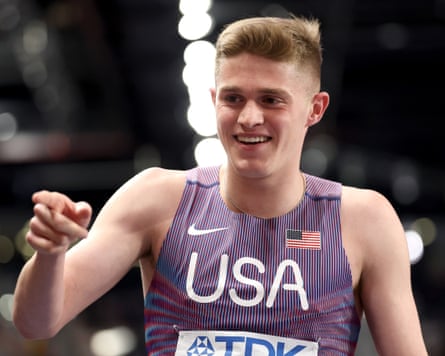
But Capeau wants to stress something else: Cooper is just as excited when his teammates succeed. “You wouldn’t think it, because when it’s time to a race that guy is a monster. But he wants everyone else to look good too. Whether it’s his family, community, or his teammates. One of our guys ran 4:19 in the 1,600m a few weeks ago and Cooper’s out there losing his mind with excitement.”
George, meanwhile, says that while his son excelled athletically in middle school across multiple sports – including wrestling, American football, basketball and athletics – the two huge jumps he took, aged 14 when he ran 1:48.7 for the 800m at the Nike Outdoors and again at 16 when he went 1:42 at the US trials – made them realise that their son was something special.
“We were like: ‘Oh my goodness, what are we going to do with this?’ This was not territory that we necessarily prepared for. And you just don’t want to screw things up for the kid.
“I’m a big proponent of wanting them to play as many things as they can, as long as they can. He’s probably one of the most competitive individuals I’ve ever seen and he was a natural kind of go-getter in every sport he played. But in that eighth grade year, I was like: ‘My goodness, he can fly.’”
However, while George is a well-regarded coach himself, he made the decision that he wasn’t the best person to guide his son’s athletics career. “It can be a great relationship builder. But I’ve also seen the other side, where it is a strain on father and son. That was always a big fear of mine. I’m a pretty headstrong individual and I could see my kids coming up were very similar.
“Of course we talk. But the workouts all come from coach Capeau and he does a wonderful job. And that allowed us to be father and son, versus me screaming at him and him screaming back at me, because that would happen.”
George knows that Cooper’s achievements also make him one of the most talked about teenagers before the LA Olympics. He will also be an undoubted attraction at the Eugene and Stockholm Diamond League this summer. But for now George just wants his son to enjoy the moment. “He’s definitely a one-off,” he says. “I tell people all the time you can’t discount the talent that’s there. But he’s still 17. We’ve got a long way to go, we hope.”
And for track and field fans, that might just be the most exciting part of all.