.png)
 1 month ago
40
1 month ago
40
Their forward was once suspended when her head scarf slipped off during a goal celebration. Their youngest player is just 18. Another once worked as a personal trainer overseas. These are the women of the Iran football team, who are at the centre of an international diplomatic incident, even as the US and Israel rain missiles down on their family back home.
The team remains in a hotel on the Gold Coast, where they played their third and final match of the Women’s Asian Cup on Sunday. Their departure from Australia is imminent, even if it’s not clear whether they want to go.
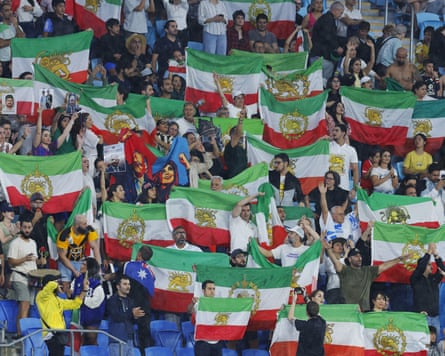
They came to Australia to play football, but from here they cannot win. Fears are held for their safety if they were to return. The players were dubbed “wartime traitors” by a state-linked commentator, who called for them to be “dealt with more severely”, after they failed to sing the national anthem in their first Asian Cup game. In subsequent matches not only have the players sung – or at least mouthed the anthem’s words – they have saluted.
Were they to stay in Australia, they face cutting off ties from their family and friends, who may be then vulnerable living under a regime that has already killed tens of thousands. Backlash might extend to teammates, other footballers, and out through community networks still living in Iran.
It is a torrid choice, but one the players may have for only hours more. Daniel Ghezelbash, director of the Kaldor Centre for International Refugee Law at UNSW, said now the team’s matches had finished, time was of the essence. “The Iranian officials accompanying the team would be wanting to get them out of Australia as quickly as possible,” he said. “And that does create a sense of urgency.”
Protestors briefly blocked the team bus leaving the stadium on Sunday, waving the international sign for help at the players – a fist closed with thumb underneath the four fingers, then opened again. Some appeared to return the gesture. But in truth, nobody outside the team knows what each of them wants, nor the status and vulnerability of family and friends still in Iran.
The president of players union Fifpro for Asia, Beau Busch, said on Monday his organisation is in communication with the Australian government, Fifa and the Asian Football Confederation “to ensure that every bit of pressure is applied” to protect the players’ human rights.
Busch said they must have “agency around what happens next” – including whether to stay in Australia or leave – and they must remain safe both now and if they do return to Iran. “That’s going to be really difficult, but Fifa has a statutory obligation in relation to human rights to ensure that they exert that leverage, and we expect them to do so,” he said.
The issue has been taken up by the Liberal opposition in Australia. Shadow attorney general Julian Leeser called on the Labor government to provide asylum if the players want it, and “not turn a blind eye to the danger these women face”.
What officials can actually do however is uncertain. Human rights experts have told the Guardian there is a clear obligation on Australia under the Refugee Convention it ratified in the 1950s to protect the players from returning to countries where they face persecution. “That obligation flows regardless of whether a person has had the opportunity to raise those concerns,” Ghezelbash said.
But he added that claims to asylum have traditionally only been considered when they have been formally lodged. “In practice, and not just in Australia, all around the world, the procedures are set up in a way that to initiate that assessment, the applicant needs to raise concerns about being sent back home. But we’re in a position now where it appears the women are being monitored and controlled, and they’re unable to do that.”
A separate offence is also being considered by local legal experts. Exit trafficking, one pillar of anti-slavery legislation, is part of the federal criminal code. It prohibits facilitating the exit of people from Australia, or their proposed exit, through coercive, deceptive, or threatening means.
Jennifer Burn, director of Anti-Slavery Australia as part of the UTS Faculty of Law, said traditionally there would need to be a claim made by a person affected under this legislation, but a simple call for help might be enough to trigger an obligation for Australian law enforcement. “If there is a reasonable belief that an offence is taking place, arguably there could be a duty to inquire,” she said, but warned these are difficult legal questions with uncertainty over the jurisdiction of the AFP. “We have no information from the footballers about what they want.”
That hasn’t slowed support for the players in Australia and beyond. A petition for the government to offer protection topped 60,000 signatures on Monday. The Iranian-Australian community has called for local officials to speak directly to the players. Reza Pahlavi, son of the last shah of Iran and a political exile living in the US, called on the Australian government “to ensure their safety” in a social media post to his more than 2m followers.
The Asian Cup organising committee issued a statement over the weekend saying “all participating teams are supported by the AFC, the local organising committee and relevant authorities to ensure a safe and secure environment throughout the competition”.
Busch wants the government to “proactively work” for the players, and said the Asian Cup organisers should have seen it coming. A human rights impact assessment was completed for the 2023 Women’s World Cup, but none had been undertaken for this tournament. “It should have been,” Busch said.