.png)
 1 month ago
45
1 month ago
45
With the prospect of National Rugby League investment in Super League – however that may look, and with whatever level of control the Australian authorities want to overhaul the British game – now at boiling point, there has been a lot of discussion lately about what Super League does, and perhaps does not, need.
That debate will rage in the coming weeks but what is surely beyond doubt is that, for the competition to be at its most appealing, it needs its strongest clubs to thrive. Underdog stories are compelling, and we have had plenty of those in the past few years; they create great sporting drama and fresh narratives for the powerbrokers to sell.
But what will drive Super League forward – with or without NRL investment – is the might of its heavyweight sides. Few fit that billing quite like Leeds who, after a fairly tepid few seasons, are beginning to show they could be in a position to reclaim their spot at the summit of the British game, both on and off the field.
For more than 10 years Leeds were the team to beat. Having won eight Super League titles in 13 years, however, around the turn of the decade their influence began to wane. But with Super League going through a set of rule changes in the off-season, with quicker and better policed rucks designed to make for a faster, free‑flowing game, it looks to be Leeds and Wigan who are flourishing the most, illustrated best by the Rhinos’ dismantling of the champions, Hull KR, in Las Vegas last week.
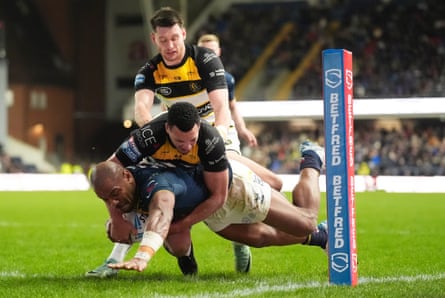
The game on Sunday was not at the same heights as the match at Allegiant Stadium, as Leeds muscled their way past a spirited Castleford thanks largely to a hat-trick from Maika Sivo. There was undoubtedly an element of Vegas fatigue in this performance but, under Brad Arthur, Leeds have the hallmark of a side ready to compete for silverware again.
Last season was a year of progression; having missed the playoffs in each of the previous two seasons, Leeds returned to the top four before a surprise home defeat by St Helens in the opening round of the road to Old Trafford. But there is already strong early evidence Arthur has assembled a squad that is steelier and stronger than last season, with three wins from their first four matches.
Super League is at a critical crossroads this summer, too, with its broadcast rights up for renegotiation. That means, in truth, the competition has to look as attractive as possible to either Sky Sports or potential new broadcasters for 2027 and beyond.
Leeds continue to lead the way off the field in that regard, with more than 15,000 at Headingley – which has now been redeveloped into one of the premier rugby league venues in the country – to watch them defeat Castleford. Those sorts of attendance figures are what Super League will hang its hat on when it goes to market.
Clubs such as Leeds, Wigan and St Helens can shift the dial in a way others simply cannot, and if they are winning games on the field, Super League is surely moving in the right direction in terms of its value to any broadcaster.
Super League may or may not need the NRL. But the competition, and the game in this country, needs a strong Leeds. The early evidence suggests that after a period in the wilderness, one of the game’s great sides are ready to step up once again.