.png)
 1 month ago
37
1 month ago
37
US midfielder Diego Luna rocked back and forth, a wide smile plastered across his face. With even wider eyes, Juventus attacker Weston McKennie looked on like a child on Christmas Day, broke out into applause and shrieked with glee. Timothy Weah rubbed his hands together in anticipation.
The US men’s national team had gathered for a team meeting in a hotel conference room in Austin, Texas, with a friendly against Ecuador days away. The get-together had nothing to do with tactics. Rather, they were about to see the kits they’d be wearing at the 2026 World Cup, the first tournament in three decades to be played on home soil.
Designers love explanations, and the meeting started with the usual blend of marketing babble and explainer graphics.
“We wanted to make sure we found something that was undeniably American,” said Jordy Romick, a Nike executive, when addressing the group. “The answer for us was staring us right in the face.”
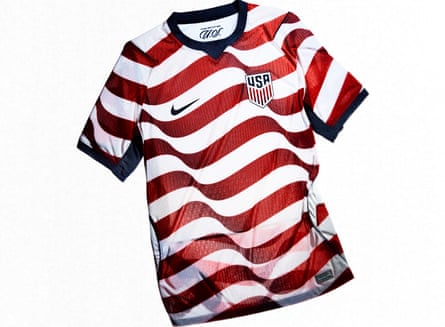
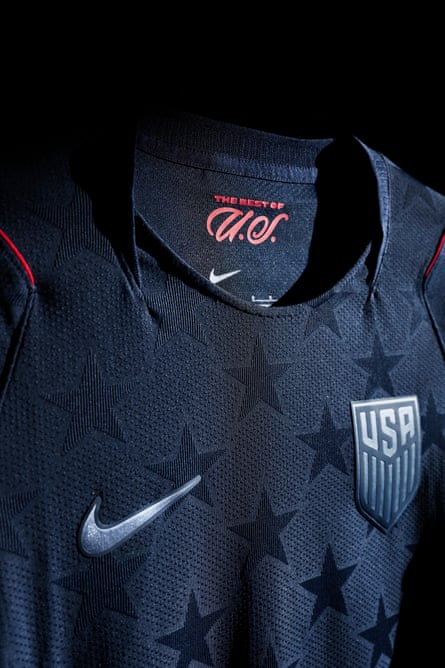
With that, Romick revealed a pair of mannequins sporting the new uniforms, which the federation is dubbing the stars kit and stripes kit. Cue the reaction.
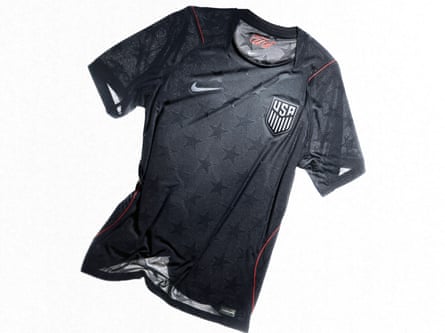
Gone were the stale, plain-colored shirts of recent tournaments. Even the goalkeeper kit had been replaced with something that feels a lot closer to Jorge Campos at the 1994 World Cup, a green and red getup that hits you right between the eyes.
The celebratory mood in Austin was in stark contrast to the reaction that many of these same players had in 2022, when Nike rolled out the US kits for the World Cup in Qatar. The design giant was thrilled with their work – an unimaginative white shirt and an “ice-dyed” blue kit – and went so far as to tout the input they’d gotten from actual athletes during the design process. USMNT midfielder Tyler Adams was there.
“[They consulted] the wrong athletes,” said Adams.
The two kits were almost universally loathed by USMNT fans, but the team’s players somehow hated them even more. The reveal started a minor revolt of sorts, with players drawing straws to see who would be photographed in them, and some refusing to be photographed at all. The group eventually relented, but they did so conditionally: they would need to be involved – very involved – in the design cycle for 2026.
“Nike were probably on edge about that,” said Adams. “There was definitely a sense that they were very very uncomfortable with the situation, especially when you have 20, 25 guys on a team saying they all hate the jerseys they’re about to play in … But they welcomed the criticism and they brought us right into the loop to start the design process for the next one.”
The two kits Nike and the US men created together aren’t just better than their failed attempt in 2022. They may just be the best pair of kits the US has ever sported at a World Cup.
It usually takes a kit manufacturer a year or two to craft a design, which allows ample time to manufacture it and develop a marketing plan. The design process for the current US kits stretched out much further, starting not long after the USMNT raged at the 2022 designs.
Nike met with US players ahead of the side’s Nations League matches in November of 2023. Devin Barclay, the former MLS player and Ohio State placekicker and then-Nike executive, did the talking, laying out their design approach.
“This is the start of the work in the buildup to 2026,” he said, “to make sure that you guys feel heard and represented, that you guys feel that the kits we create for the World Cup, in the biggest moment of your careers, represents who you guys are and the identity you want as a group.”
“The difference is that we met them in person multiple times,” Nike designer Yaz Rosette told the Guardian. “A lot of it was ‘How do you feel and what do you want?’ The best thing [the players] could do is just give us that rawness. They’re not the ones designing the kits, that’s our job. But we take everything into consideration and then we put it through this filter. This machine. And then, we checked on them, we made sure that they were happy with it and felt it. It was so cool to see that reaction.”
The process started with player interviews, where they were asked about what they’d like the shirt to represent. McKennie spoke of creating a legacy, about tradition, and about eliciting a reaction like “yo, that’s sick.” Defender Sergiño Dest talked about being “free [and] without limits.”
This current generation of US players has, at varying points in time, been fairly or unfairly referred to as a “golden generation,” something McKennie acknowledged during the design process, in his own way.
“I feel like this group in general is different from the other groups that we’ve had in the past,” McKennie told a Nike designer. “If there’s a moment to … I’m not saying change tradition, but to put our own twist on it? In 20 years, it will be a new generation as well. [With these kits], at least we can look back and say ‘that’s what made this group special. Those were our jerseys.’”
Nike’s initial approach to the USMNT also included polling players on their favorite US kits of old. Almost without exception, the first mentioned was the Denim Kit, the design worn by the US at the 1994 World Cup.
That design, too, was polarizing. The shirt was designed by Peter Moore at Adidas, the man responsible for the first Air Jordan sneaker and a host of other pieces of iconic apparel. He set a field of elongated, warped stars over a denim background to craft an undeniably American look for the US, a polarizing design that many players and fans loathed instantly.
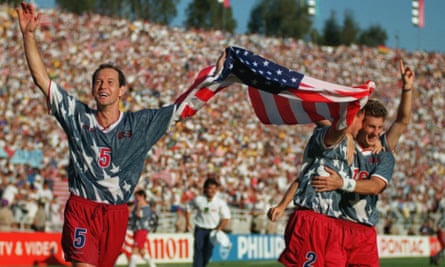
When the 1994 USMNT saw the kit for the first time, they burst out laughing, assuming that Adidas was playing a joke on them.
“The guys were just like, ‘Come on man, are you kidding me?’” recalled US midfielder Desmond Armstrong. “Am I supposed to wear my Lee jeans with these, playing in a game?’”
It took a few decades, but many now view the Denim Kit as the apex of USMNT jersey design, not the nadir. It is beloved by most US fans, in no small part because of what that national team did in it, surprising most observers with a run to the round of 16 and a narrow loss to eventual champions Brazil. Just last week, the German manufacturer rereleased the denim kit, alongside an entire line of apparel inspired by the shirt.
The 14 players involved in the current design cycle also cited the “Candycanes,” as McKennie puts it, more commonly referred to as the “Waldos,” worn by the US between 2012 and 2014. That shirt was never loathed in the first place. The influence of the Waldos and the Denim Kit is not hard to see in this current cycle.
“It’s pretty straightforward,” said Adams. “[We have] to have stars and stripes of some sort on our kit, right? They represent us perfectly. Everyone loves the candy cane jerseys, I don’t think there’s any argument about that, so we wanted some iteration of that. And then I think the stars are the most unique ones. So we decided to go navy blue with silver stars, which I think represents us perfectly. I think that’s just going to be an all-time classic jersey.”
Nike circled back with the players twice between their initial approach and the reveal. In March, ahead of the Nations League final against Mexico, they brought dozens of potential colors and patterns in for review. Some were garish – a red-and-white, lightning-bolt pattern evoking “energy,” according to forward Ricardo Pepi – and others were more reasonable.
“[There were many] iterations that we went through of the stripes, specifically,” said Adams. “How dark the gradient effect was, how wavy does it look, does it represent a waving American flag? Vertical, horizontal, the list goes on and on. I didn’t know they could come up with so many designs of things. When it got to the point where we could just pick one, I was like that’s the one. Let’s just do it. I don’t know how many more conversations we could have.”
McKennie, Adams recalled, had some of the most outlandish ideas, at one point gravitating towards a green color that felt way off the beaten path.
“I was like ‘get out of the room, what are we doing here?’” Adams said, laughing. “You know what I mean? But it’s all good, we came to the right spot.”
The US did well to avoid a green shirt, but if they’d have made a deep run in it, even that kit would’ve likely proved iconic. In most cases, shirts become memorable because of what teams did in them, not on design alone.
Even during the 1994 tournament itself, players warmed up to the Denim Kit. When Fifa told the US they couldn’t wear the garish designs in their round of 16 matchup against Brazil, many players were incensed.
“It was weird how fast those jerseys grew on us,” remembered US forward Eric Wynalda. “At first we were like, ‘Holy shit, we have to wear this thing?’. And then we got to the biggest game of our lives and we were like, ‘Hey, can we wear the blue uniforms please?’”
Adams and his teammates have yet to make any memories in their new kits. Speaking with them, though, it feels clear they feel well-equipped to try and write their own, improbable story this summer.
“I feel more pride,” said Adams. “I feel this finally represents us and what we’re trying to achieve. I think to kind of be able to see fans in the stands where you can really spot that that’s the US kit, that’s home support, it’s gonna be great to see hundreds of thousands of people flooding streets and stadiums with stars and stripes. That represents us.”
“The moments a player makes in a jersey are what makes a kit iconic,” added USMNT attacker Falorin Balogun.
“At the same time,” Balogun then said. “If a kit is ugly … it’s ugly.”