.png)
 1 month ago
99
1 month ago
99
With this summer’s World Cup already mired in controversy over politicisation, potential travel bans and rows over ticket prices, fans were dealt another piece of sad news this week: the tournament’s much-loved Panini sticker album will be discontinued after 2030.
Guardian writers recall their Panini memories from years gone by.

International correspondent
The last time the World Cup was held in the US it was the sunny summer of 1994 and the tournament sparkled with stars of the global game: the Bulgarian Hristo Stoichkov, the Brazilians Romário and Bebeto, the “Maradona of the Carpathians” Gheorghe Hagi, and even the real Diego Maradona – albeit at the end of his career.
But the most desired, most sought-after, most prestigious Panini sticker – the one that collectors considered worth its weight in gold – was that of Italy’s best player, perhaps the most iconic in the country’s history: the Divine Ponytail, Roberto Baggio, who the previous year had won the Ballon d’Or.
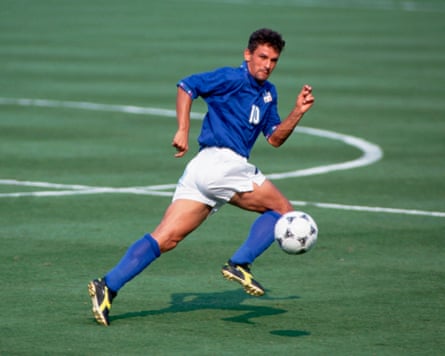
As a fan of Juventus, where Baggio played in those years, I had a lifesize poster of him hanging on my bedroom door. I found his sticker shortly before the World Cup began, on 17 June. My album was incomplete, with dozens of duplicates, and never did get finished. But who cared: I had Baggio! And his sticker was worth the price of the whole album, literally – today it costs about €30 on eBay.
At that time, in my small home town in Sicily, stickers were exchanged among friends or played for in games. One of the most popular games involved placing a small pile of stickers on the floor and then, with a sharp slap of the hand next to the pile, trying to “win” all the stickers that were flipped over. Obviously nobody would have risked using the Baggio sticker for that game; losing it would have been a catastrophe.
For quite a while I carried his sticker in my pocket like a trophy. Partly because of the cultural superstition among us Sicilians, I feared that sticking it into the album would bring bad luck to Italy. In the end I convinced myself to paste it in. And I paid the price: Baggio missed the penalty in the final that Italy lost against Brazil, and for years I shared the sense of guilt for that defeat with him.

Transport correspondent
When I finally cleared out my childhood home, too long after bereavement, some things were painful to let go, others barely merited a second glance. But the Panini sticker books stored in the loft were easy; they came with me.
Those musty albums now occupy a plastic crate on the floor of our bedroom, much to the annoyance of my partner. I point out the hundreds of pounds we could sell them for on eBay. (That won’t happen.)
Among them is the World Cup album Mexico 86, replete with the good, the bad and the ugly – a cherubic Gary Lineker, Maradona ready to do the “Hand of God”, and a charmless spread of Mexico’s empty stadiums. Painstakingly completed, but not my prize Panini possession: that’s the Football 83 Arthur Albiston sticker with Kevin Moran’s face, a mind-blowing find at primary school.
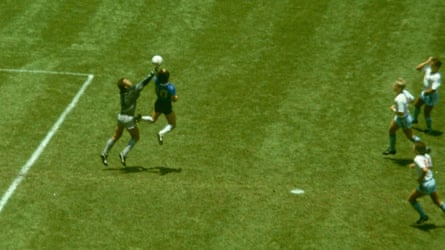
Forty years on, flicking through the 1986 album brings home how globalised football has since become. Overseas players were still a relative novelty and many stickers really were new faces: Poland’s players still mainly looked to me like Lech Wałęsa, while African and Asian teams were doubled up, two players to a sticker. And an ageing, bearded but receding Canadian defender I never noticed back then now seems to leap out at me. How did he still manage it?

Sketch writer and columnist
As with so many things, I had no idea what I was getting myself into. It was the summer of 1970 and I was football obsessed. I imagined England would win the World Cup just as it had four years earlier when I had watched the final at home on our black and white TV while Dad took my sisters out for the afternoon. Only this time I was going to be better prepared. So when I saw a Mexico 70 sticker book in the newsagent, I had no idea it was the first of its kind. I simply nagged Mum to get it for me. And she gave in. Partly to stop me annoying her and partly because it only cost 2/- (that’s 10p to those who have only known a post-decimal world). Little did she realise that was only the beginning; soon I was pestering her to buy me packs of stickers. I say stickers, but almost all were actually cards that needed to be glued in. The stickers were just the flags and specials.
I still have the album, having finally managed to complete it about 12 years ago when the last card I needed appeared on eBay. It’s now a piece of football history. Not just because most of the players have long since died, but because it speaks to another age – when football was less commercialised and there were only 16 teams in the final. For a start, there was no Fifa branding on the cover; it’s possible Panini never even needed to buy the rights.
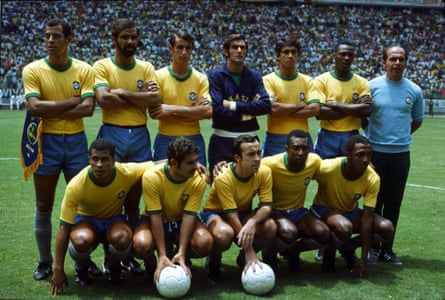
Nor do I imagine that any of the players got any money for the use of their images. Not that all the players were featured. The bigger teams got 14 player cards and a team photo. The Brazil team is a roll-call of honour: Pelé, Jairzinho, Carlos Alberto, Tostāo, Gérson, Edu, Rivelino … I could go on. Lesser teams, such as Czechoslovakia, had to make do with just 11 players and a team photo. The Mexico 70 Panini album literally wrote some footballers out of history, remembered only by their families and a handful of fans.

Associate culture editor
We have a tendency to think that everything was better when we were kids. But as a child, collecting Panini could be a frustrating experience, one heavily reliant on how successful you were at badgering your parents for more money to buy yet another packet of stickers that you inevitably already owned. Let’s not pretend we don’t all remember the twerp in the playground charging a premium for the shiny Österreich crest everyone needed, despite the fact he had somehow amassed seven of them.
No, the peak of my Panini love came not as a kid, but in 2014, when I decided to give sticker collecting a go as an adult. Friends gradually got on board, as did colleagues: people who had initially shown no interest in the whole thing were meeting strangers in pubs and car parks to exchange tiny images of the right back from Colombia.
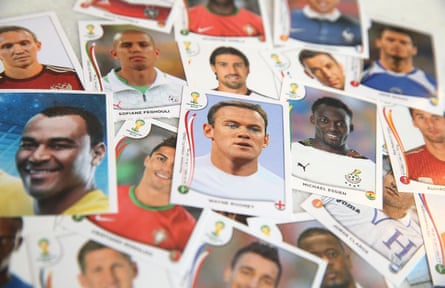
One day I persuaded the writer Hadley Freeman to start collecting, and she became instantly hooked. When we both found ourselves out in São Paulo covering events around the tournament, she returned the favour in style: she had blagged an invitation to the Panini factory itself on the outskirts of the city and did I want to tag along? Umm, yes!
What a thrill it was to see the stickers being produced. And not in some hi-tech fashion but on noisy machines fed by real people. In this surprisingly small building, women (it was mainly women) still cut the sheets of stickers by hand, sorted them into packets and looked after sending out spares.
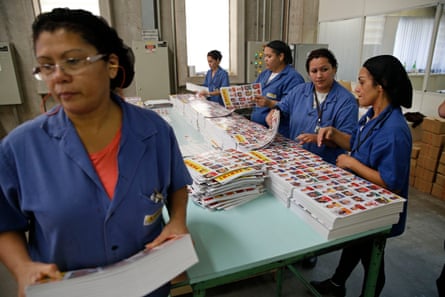
Yes, sending out spares! Because one thing I learned from Mr Panini (José Eduardo Severo Martins, the then chief executive of Panini Brasil) was that the company had always run a scheme in which, were you still missing a sticker or three at the end of a campaign, you could simply send off for them instead. My mind flashed back to the almost-finished albums of my childhood … all that heartache and I could have simply ordered the Österreich crest in the post!

Global technology editor
It was my white whale, my golden ticket. In the world of football stickers, anyway. In my childhood, the rarest prize among the panoply of outcomes offered by a Panini packet was the club crest, printed on the kind of partly metallic paper that wouldn’t be wasted on the second-choice left back. And if you got the badge of your actual team then, well, you had truly gained entry to Wonka’s factory.
So that was broadly how I felt one day in the mid-80s when I tore open a pouch on Ilford High Road and a West Ham crest stuck out among the (then perfectly acceptable) mullets. It went straight into the West Ham section – which was, typically, sparsely populated.
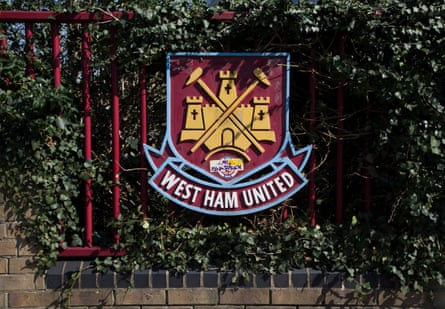
I was never a completist, for financial and willpower reasons. But it felt like the kind of local derby victory that made your season worthwhile, whatever the outcome of the rest of it. I never encountered another West Ham Panini crest, but by that stage I already knew that emotional highs and my favourite football team would not be in lockstep often.