.png)
 1 month ago
39
1 month ago
39
In some ways, history is repeating itself. In 1982 Chelsea and Wrexham met in the FA Cup after they had beaten Hull City and Nottingham Forest, respectively, in previous rounds. The same has happened in 2026; but this is where the similarities end.
When the clubs met 44 years ago they were both in the second tier and had huge debts. With Chelsea reportedly £1.6m in the red, the future of Stamford Bridge was in doubt as property developers hovered. Relegation-threatened Wrexham spent the majority of the 1980s merely trying to survive.
On top of inconsistent league form and financial woe, Chelsea also had problems with their supporters. After trouble at Derby in November 1981, the FA banned Chelsea fans from away matches. However, policing the ban proved almost impossible. Chelsea fans continued to travel and make their way into the home ends of various grounds. The ban was lifted after a few months but the episode did little for the club’s reputation.
The 1981-82 league season was not so good for Wrexham – they were relegated to the third tier – but their FA Cup run brought some positivity. The club pulled off a big shock in the third round, beating Brian Clough’s Nottingham Forest 3-1 at the City Ground. They went behind in the second minute but three goals in 12 minutes from Steve Dowman, Mick Vinter and Dixie McNeil handed Wrexham a richly deserved win.
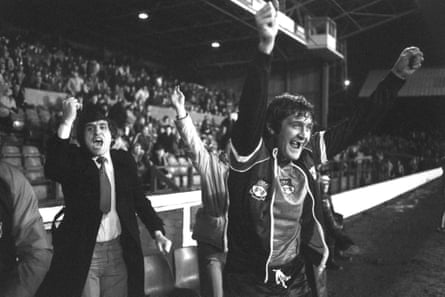
Chelsea needed a replay to beat fourth-tier Hull City and reach the fourth round. After a goalless draw at Stamford Bridge, the teams met at Boothferry Park, where late goals from Alan Mayes and John Bumstead edged them through. The win brought relief to a team that had been knocked out of the League Cup by fourth-tier Wigan.
The tie in Wales was a romantic one for the Chelsea manager, John Neal, who had enjoyed nine productive years in charge of Wrexham from 1968 to 1977. His spell took in a promotion, two Welsh Cups and a run to the quarter-finals of the Cup Winners’ Cup, where they were beaten by the eventual champions Anderlecht.
When Neal departed his assistant, Arfon Griffiths, carried on the good work. They were heady days for Wrexham supporters. In 1977-78 the club earned promotion to the second tier for the first time, won the Welsh Cup, and reached the quarter-finals of the FA Cup and League Cup.
When Griffiths left in 1981 after a dispute with the board, Wrexham hoped their history of promoting from within would prove successful again. But Griffiths’ assistant Mel Sutton inherited a declining teamand, with no money available to improve the squad, they slid towards relegation.
With so many postponements due to a cold winter in 1981-82, the last thing Chelsea needed was a marathon cup tie against Wrexham. But in the end they needed three matches to reach the fifth round. The first game, a dull goalless draw at Stamford Bridge on 23 January, was Chelsea’s fourth in eight days. Understandably, Neal cut his players some slack. “A few of our players were still carrying knocks from earlier in the week,” he said. “I was not sure if some of them would complete the tie.” Neal praised his 17-year-old goalkeeper, Steve Francis, who played despite suffering facial injuries when a brick was thrown through a window of the Chelsea team bus in Hull.
The tie took on added interest when the players discovered that the winners would host Bob Paisley’s all-conquering Liverpool in the next round. For Wrexham defender Joey Jones, the chance to play against his former club loomed. “I have been waiting years for that game,” he said.
When the teams met at the Racecourse Ground three days later, both started quickly, hitting the woodwork in the first half. Wrexham legend McNeil scored in the 66th minute to edge his team closer to a glamour tie. But, with just six minutes remaining, Mayes bundled home a cross from Peter Rhoades-Brown to the delight of the 500 or so Chelsea fans defying the FA ban. Both keepers made decent saves in extra time and the teams could not be separated. They would have to meet for another replay six days later; Sutton won the toss so Wrexham had home advantage.
The trilogy concluded on Monday 1 February. It was Chelsea’s seventh match in 17 days. Chelsea captain Micky Droy took centre stage in the first half, giving his team the lead with a flicked header and then getting booked after a clash with Wrexham players Wayne Cegielski and Steve Jones, whose nose continued to bleed throughout the second half.
An injury to Vinter hardly helped Wrexham’s cause. They had already made a substitution – only one was permitted then – so the forward had to limp around with an injured hamstring for most of the match. Effectively playing against 10 men, Chelsea took advantage. Mayes fired home in the the 66th minute for a 2-0 lead.
The visitors had a brief scare when the hobbling Vinter pulled a goal back with four minutes remaining. But, after 300 minutes of action, Chelsea had finally made it to the fifth round. “We deserved it,” said Neal. “We took a gamble. I knew we had to get some goals, so I played 4-2-4 and it worked. This was a battle again but we took our chances and our lads were just that bit better than them.”
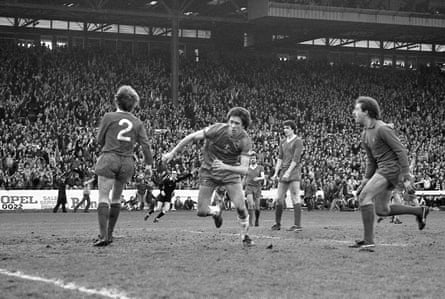
“We were punished for what we did wrong,” said Sutton. “But we battled well. I was pleased with some of the performances.” Missing the chance to play Liverpool was bad enough but it would get worse. Come the end of the season Wrexham were relegated and Sutton sacked. Another relegation followed in 1982-83. The glory days soon became a distant memory, although they did pull off an incredible upset when they knocked Porto out of the Cup Winners’ Cup in 1984.
Chelsea had needed three matches to see off Wrexham but were more efficient in the next round, defeating Liverpool 2-0 at Anfield to set up a quarter-final against Tottenham. The dream ended with a 3-2 defeat by Spurs, the eventual champions. A year later Chelsea were scrapping to stay in the second tier.
What a difference a few decades make. Chelsea’s history changed when Roman Abramovich arrived in 2003, and Wrexham’s rise through the divisions has been well documented (and filmed) since the arrival of Ryan Reynolds and Rob McElhenney. Neither is what you might call a fairytale. But try telling that to any Chelsea and Wrexham fans old enough to remember when the very existence of their clubs was in doubt.
This article is by Steven Pye for That 1980s Sports Blog