.png)
 1 month ago
37
1 month ago
37
Caroline HawleyWorld affairs correspondent

 Getty Images
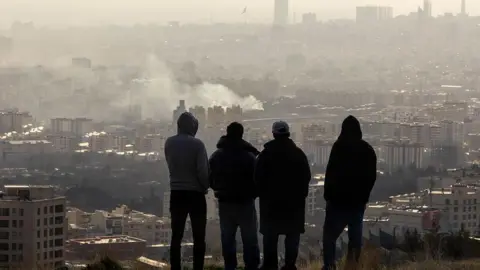
On Monday, three days into the war, men in Tehran watched from a hillside as a plume of smoke rose after an explosion
When Hamid heard news of the death of Iran's Supreme Leader Ayatollah Ali Khamenei a week ago today, he felt a wave of euphoria and took his wife and daughter into the street outside his home in Tehran to celebrate.
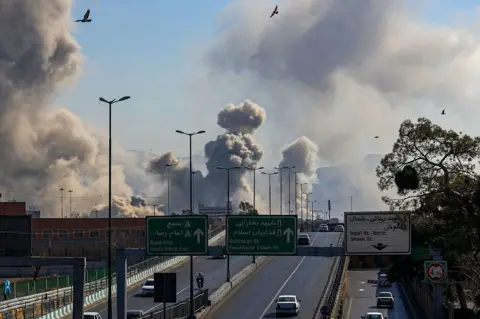
For the next few days, as US and Israeli bombs slammed into buildings across the capital, the family went onto the roof of the house to watch the airstrikes coming in, cheering every time a regime target was hit.
"Try to find anywhere else on this earth where the population would be happy with an external attack on their country," he told me, via a cousin in the UK.
"But we now have hope that the regime will soon be gone. We are happy."
Hamid - not his real name - is not alone.
Alongside colleagues from BBC Persian, we have been hearing from people inside and outside Iran on a momentous week for them, for the future of their country and for the entire region.
BBC Persian is the Persian language service of BBC News, used by 24 million people around the world - the majority in Iran - despite being blocked and routinely jammed by Iranian authorities.
In a police state under bombardment, with severe internet restrictions in place, it is impossible to fully gauge the mood across a vast nation of 90 million people.
Residents of Tehran have received messages warning: "If your connection to the internet continues in the coming days, your line will be blocked and you will be referred to judicial authorities."
 AFP via Getty Images
The regime still instils fear and no one who voices any opposition to it is willing to give their name for fear of the repercussions on them or their family.
But a week on, while some people are still celebrating every strike on the regime, others are increasingly frightened, questioning the motives and endgame of the war.
"The goal of this war isn't to bring about freedom or democracy for the Iranian people," Ali told us.
"It's for the geopolitical benefit of Israel, the US and Arab countries in the region."
Mohammad, who is in his 30s and lives in Tehran, said that he had wanted a deal between the US and Iran that would have avoided the war.
"Deep down, I always hoped an agreement would be made," he said.
He had thought that he would be happy at Khamenei's death, but in the end "felt nothing".
He told my colleague Soroush Pakzad that he is now filled with uncertainty about the future - and, with regime checkpoints everywhere on the ground and bombardments from the sky, he is afraid.
Others Iranians speak of feeling a mix of fear, stress and hope.
One woman told me that I would have to live in Iran for 40 years to understand the complexity of what she and other Iranians are now feeling.
"We laugh and are happy when the regime is hit, but when children die and our infrastructure is destroyed, we worry about the future of our country," she said.
There are no opinion polls in Iran but most Iranians appear to despise a regime that has brought such immense suffering to them.
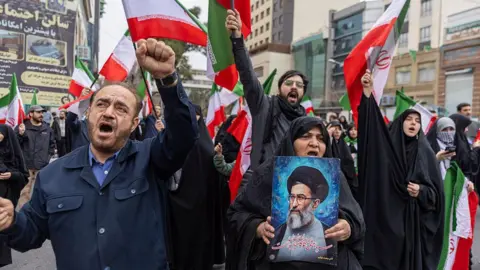
While it still has large numbers of die-hard supporters, its many opponents are split between those cheering on the US and Israel, and those who are deeply suspicious.
 Getty Images
Saeed told us: "Trump's government – from top to bottom – they're all lying. They had no reason to attack Iran. Other than Israel wanted them to."
Aside from pronouncements from the regime itself, we are hearing far fewer voices from its supporters.
Nor have we heard from those who have suffered the most - the parents of the children killed on 28 February in a strike on an elementary school in the southern town of Minab.
It was the deadliest known attack of the war so far.
But several Iranians have told the BBC that after 47 years of the Islamic Republic, they are so desperate to see the back of it that the current war is their only hope of freedom.
Hamid's cousin in the UK - who is one of several million Iranians living in exile now - encapsulated the conflicted feelings of many in a Whatsapp message to the BBC last Saturday.
"I hate wars, I don't want a single innocent human being killed or harmed no matter which side they are on, but I'm jumping for joy at the news of the attacks this morning.
"I know, it's contradictory and mad but it's the truth. The thought that the dream of freedom from the murderous Ayatollahs might finally be turning into a reality is making me giddy with joy."
As the week ended, we asked for her help getting back in touch with Hamid. His cousin was not able to get through.
"Please don't judge me," she said. "But I think the strikes must continue. They have to finish the job."
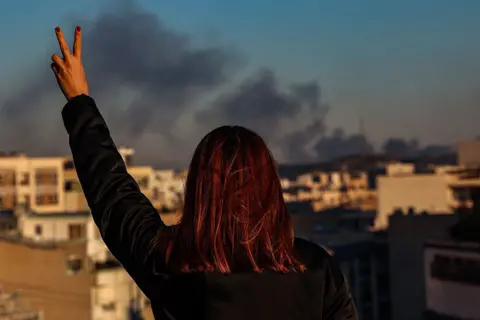 Getty Images
Hamid had told her that the airstrikes were mostly well-targeted against the "bad" people.
But we are also hearing of a growing list of civilian casualties, including many children, in a country where there are no bomb shelters or sirens.
According to the US-based Human Rights Activists News Agency (HRANA), more than 1,000 civilians have been killed so far, including nearly 200 children.
When the war began, HRANA was still trying to identify thousands of protesters killed in the regime's crackdown on a nationwide uprising in January.
Iranians remain traumatised by the scale of the bloodshed when the regime's security forces opened fire on unarmed demonstrators.
Saman, not his real name, from Isfahan, personally knew six people who were gunned down on the streets of the central city at that time - and now two of his relatives have been killed by separate airstrikes in Tehran.
He messaged Soroush Pakzad from BBC Persian at the end of the week saying that the situation in Isfahan was "truly terrifying", with body parts on the street around one target.
He described himself as being in shock and anger, saying: "I never imagined in my worst dreams that we would become this war-stricken."
My colleague Ghoncheh Habibiazad, who has been collecting voices from inside the country, says the views of some people have changed as the war has continued, as they did not expect it to go on after Khamenei was killed.
A young woman in her 20s in Tehran, who said she was "over the moon" when they targeted the supreme leader, told Ghoncheh six days later: "I'm neither happy nor sad now - just tired."