.png)
 1 month ago
85
1 month ago
85
12 minutes ago
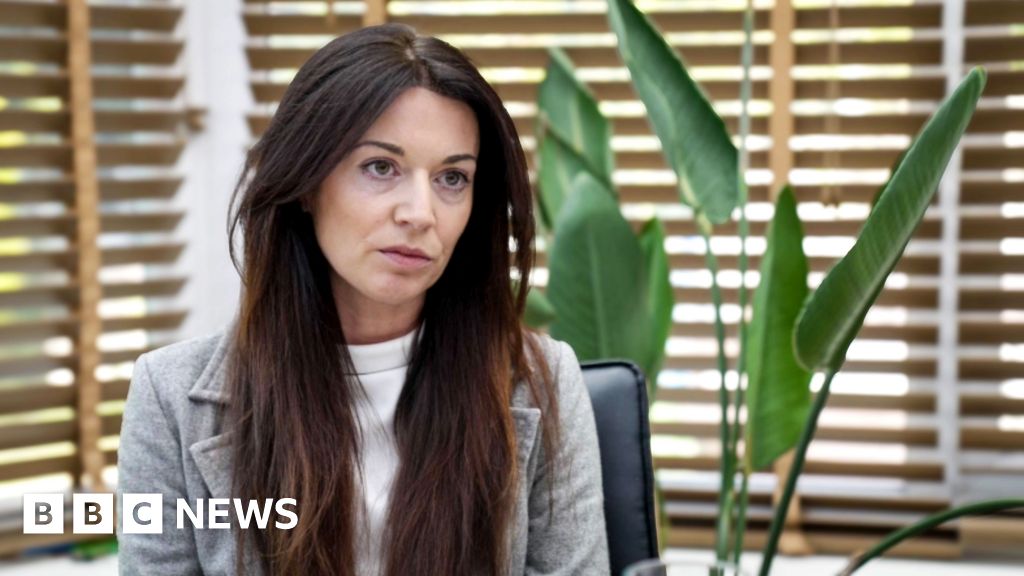
Sarah RainsfordEastern Europe correspondent, Kharkiv

 BBC
BBC
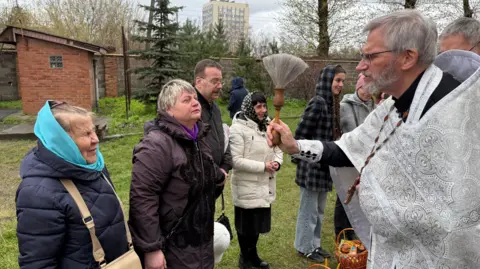
People line up to be doused in holy water by a priest in Kharkiv
An Orthodox Easter truce agreed by Russia and Ukraine came into force on Saturday afternoon but 38 minutes later we heard air raid sirens in Kharkiv region, northeastern Ukraine.
Since then, officials and military have recorded multiple ceasefire violations along the frontline, although no long-range missile or drone strikes.
The pause in fighting is supposed to last until Easter Monday to give people a much-needed rest, more than four years after Russia launched its full-scale invasion.
"Easter should be a time of safety, a time of peace," Ukraine's President Volodymyr Zelensky wrote on X, warning that Ukrainian forces would respond "strictly in kind" to any actions by Moscow.
Expectations and trust are very low here.
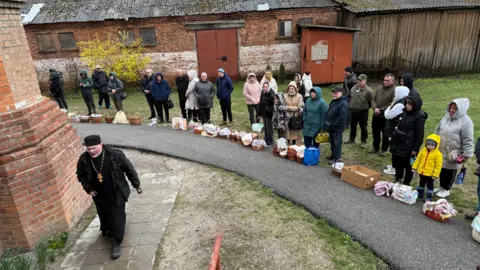
Shortly before the 16:00 (14:00 BST) start time for the truce, families brought baskets full of iced Easter cakes, painted eggs and sausage to St John the Theologian Church for a blessing.
They formed a line around the building to be doused with holy water by the parish priest.
The service is traditionally held just before midnight, with a procession around the church, but it was mid-afternoon this year because of the curfew.
"Do you believe them?" Fr Viktor wanted to know, when I asked about the significance of a Russian ceasefire.
St John's church itself was damaged at the start of the full-scale war and its windows on one side are still boarded up.
"Maybe there will be a pause," one parishioner called Larisa suggested. "But then Russia will only launch even more intense attacks. We've seen that before."

Baskets full of iced Easter cakes, painted eggs and sausage
At a military training ground about 12 miles from the Russian border, members of Yasni Ochi strike UAV unit, part of Khartia corps, are spending the weekend testing new kit for the frontline.
They load new kamikaze drones with explosive, then practise diving at targets.
Their commander, Heorhiy, has ordered his troops to sit tight during the 32-hour ceasefire unless they're attacked. But he is sure that will happen.
"Russia says one thing, then does the other. So you have to be ready."
In the meantime, those on rotation have been dropping Easter cake and alcohol-free wine to their friends at the front by drone.
The village the unit uses for training was occupied in 2022 by Russian forces, then retaken by Ukraine.
The houses all around have been left as rubble.
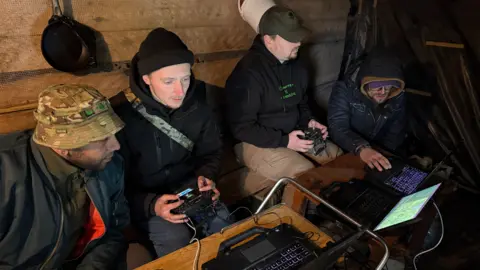
Members of a drone unit test their new kit
No-one talks seriously about returning swathes of territory anymore, like the Donbas region just south of here.
But Heorhiy thinks Ukraine can't afford to stop fighting until it can demand better conditions from its allies in negotiations with Russia.
"We need real peace talks," the commander says.
He has been buoyed up by the fact that war in the Middle East has seen countries turn to Ukraine for drone technology and expertise, both of which it can offer in abundance.
But the peace process, launched by the US, has since stalled, with President Donald Trump's envoys diverted to their own war with Iran.
Ukraine is still pushing for strong security guarantees, too, from its allies: specifically, what the US would do if Russia were to invade again in the future.
"It's not our choice. I don't like war, my guys don't like it. We used to have good civilian life," Heorhiy says - and I'm reminded that several of his unit were DJs before the war, part of an underground electronic music scene in Dnipro.
"Now we do what we need to do."
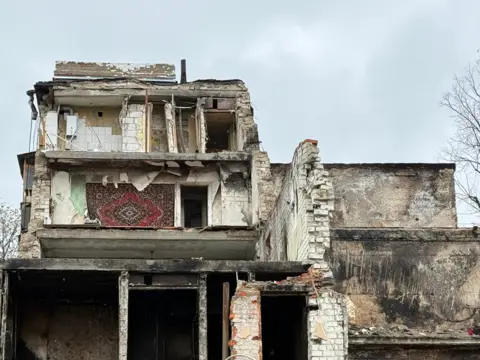
Many buildings are heavily damaged in Kharkiv region after Russian attacks
Heading back into Kharkiv, we take the ring road that's now being covered in netting. It's designed to trap and entangle Russian drones and stop them hitting the vehicles beneath.
But there's little to prevent missiles slamming into people's houses up here. Russia is so close, there is barely time for air defences to react.
In one Kharkiv suburb, several five-storey blocks of flats have been smashed to pieces. Others all around are boarded up and uninhabitable.
Last month, 11 people were killed when a missile hit in the early hours and wiped out an entire section of their building. Among the ruins, there's still one red rug pinned firmly to a living-room wall. On the ground nearby are photographs of two of the dead.
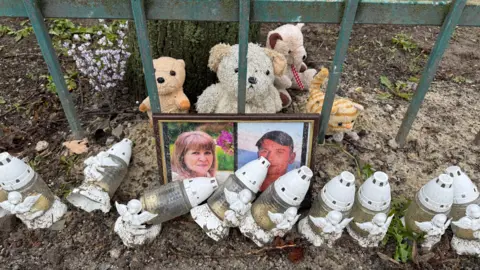
A memorial for missile strike victims in Kharkiv
Their neighbour, Olha, describes how she sheltered in a corridor that night with her elderly mother.
She showed me video on her phone: the building opposite consumed by orange flames and her own flat in pieces.
No wonder Olha is desperate for any let-up in the fighting,
"This truce is only 1.5 days. But at least we can rest a bit, because here, you expect to die every second," she says. "We really want peace. Not for 1.5 days. For good."
In quiet, angry tears she tells me the last sliver of the Donetsk region still in Ukrainian hands is not worth the lives of so many people.
"There were children killed in that strike, wonderful people. Will it ever stop?" she wants to know.
Zelensky has offered to make this temporary truce, however flawed, into a lasting ceasefire, and then continue talks with Russia towards securing a proper peace.
But the Kremlin has already rejected that, saying its attacks will resume in full on Monday.
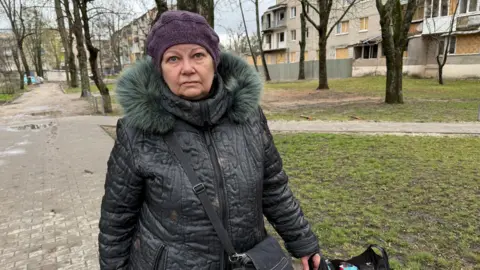
Olha sheltered in a corridor with her elderly mother when her building was blasted by a missile