.png)
 1 month ago
39
1 month ago
39
Vanessa Pearce,West Midlandsand Kathryn Stanczyszyn,Birmingham political reporter

 BBC
BBC
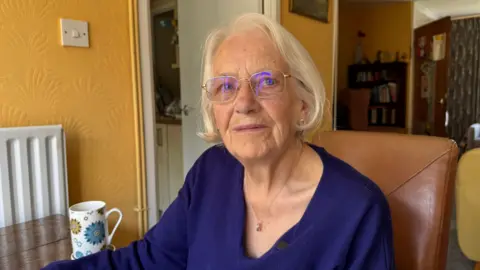
Lorraine Boyce, in her 80s, lives with her recycling in her Kings Norton home as she refuses to mix it with general waste
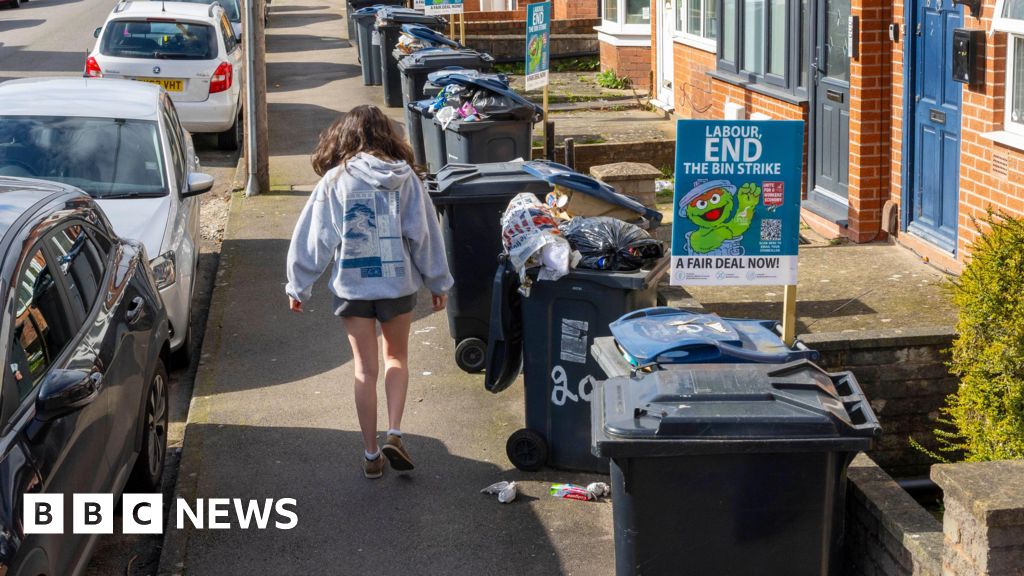
It has been exactly a year since bin workers in Birmingham staged an all-out strike, with no current negotiations or seeming end in sight.
What started as a series of one-day strikes on 6 January 2025 over a few positions on Birmingham City Council's waste team has turned into one of the longest running and most "intractable" industrial disputes of modern times.
Residents from across the city have spoken to the BBC about how it has affected them, detailing issues including dealing with rats, fly-tipping, and being unable to access recycling centres.
The council has taken on agency staff to carry out general waste collections in many parts of the city, but recycling services have been suspended for more than a year.
Lorraine Boyce previously spoke to BBC News about how she had been storing clean recycling in her Birmingham home, as she refused to mix it in with her general waste.
Six months on, very little has changed.
In her 80s and living without a car, she is unable to take it to the tip herself and boxes and bottles sit in her hall next to her mobility vehicle, although a friendly local resident had been making some trips for her.
"It begins to get dangerous, I can't always put things immediately in the right place," she said.
"On a really bad day, if the weather's bad and I'm feeling depressed anyway, I think 'oh why don't I just put it all in the household bin and be done with it?'
"But I prefer not to. I'm sure I'm not the only one."
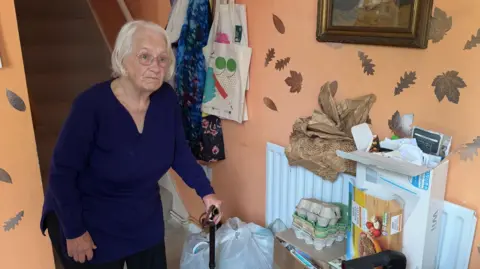
Boyce said she believed in recycling and refused to put it in with general waste
Fly-tipping was also a problem, she explained, with vans pulling up and "furtively unloading" rubbish on to nearby grassland.
"And you multiply this by what's happening all over Birmingham and there are some very fed-up people, and I can understand people who say they're not going to pay their council tax," she said.
"There are two words the council don't understand, and they seem to be negotiate and compromise.
"My aunt was a Labour councillor in the city in the 1950s, and also the first female lord mayor.
"I keep saying: 'Marjorie would not have stood for this'. She'd have done something by now."
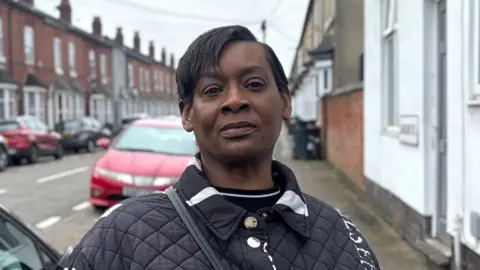
Dorothy Gerald said she believed residents should consider withholding their council tax
Dorothy Gerald said residents of the city "deserved better".
"No-one's speaking to us - the council are not talking, we're not having any regular updates on what's going on," the Aston resident said.
She called for the council to "get around a negotiating table and sort this out for the people of Birmingham once and for all".
A lack of communication added to their sense of frustration, she said, adding that the people of Birmingham needed "to have a voice".
After a year of the strike "with sporadic bin collections, and rubbish left on the streets", people were tired, she said.
"There is a proposal on the table, and if that's not done, residents withhold your council tax because you're not getting the service."
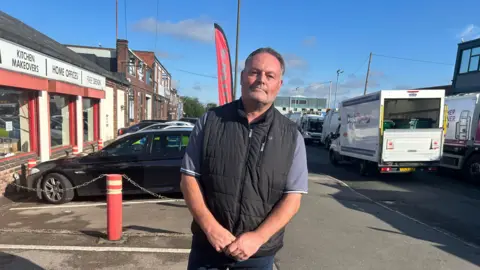
Former bin worker Derek Roberts said he was "left with no other choice" than to take voluntary redundancy
Former council worker Derek Roberts said he spent "33 years giving my heart and soul to a job that I loved", but felt he had been left with no other choice than to take voluntary redundancy.
He had worked as a driver team leader and was told at the beginning of the dispute his position and pay were not under threat.
"But after an evaluation process, I was told I was potentially going to lose £8,000."
It left him feeling "absolutely gutted", he said.
"I took great pride in my work and always went above and beyond to provide an excellent service," he said, earning him commendations on local community sites.
"Myself and many other equally hard working long-service drivers have now left the service after being scapegoated for the chronic mismanagement of a once excellent service."
The dispute initially centred on the council's decision to remove Waste Recycling and Collection Officer posts.
The Unite union said the role was important to retain on safety grounds, but the council said it simply did not exist in other areas.
Equal pay has also been cited by the council as a reason for its position, saying maintaining the status quo could open it to further claims on top of the millions of pounds already paid out in settlements.
Speaking to BBC Radio WM, the leader of the council John Cotton said an evaluation of job roles had highlighted some that had "clearly been not graded correctly under previous arrangements".
"We know that that drove some of the equal pay liability that we've had to address over the last couple of years," he said.
He added the council had known some workers would be negatively affected by the changes, but had sought to offer alternative roles, training and the option of voluntary redundancy".
Unite's national lead officer Onay Kasab said the union's "absolute focus" was its members and getting the dispute resolved.
"As in with any dispute that's gone on this long, there are number of side issues," he told the Today programme on BBC Radio 4.
"But the thing that's going to get it over the line, is some kind of financial settlement that mitigates the loss."
All disputes get resolved eventually with a compromise, according to Press Association industrial correspondent Alan Jones, but he said "since it began there hasn't really been any real sign of a breakthrough".
Even "skilled negotiators" from Acas had failed to find a negotiated settlement, he said.
"As far as I know the two sides haven't met together for months, which is incredible given the seriousness of the dispute and the impact it's having on the public, the council and the union. The impact it's having on the city."
May's local elections could be a turning point, he said.
"Maybe the residents will take it out on the Labour councillors and we will have a different political make-up of the council.
"But it's very hard to see how the Tories or Reform could do anything to resolve this," he added.
"I've covered loads of disputes, but this is way up there as, certainly now, one of the longest and one of the strangest and one of the most intractable disputes I think I've ever covered."
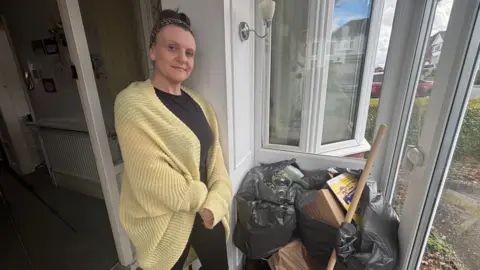
Tonia Dunn said one of her children was having nightmares about rats
Mum-of-five Tonia Dunn remembers having to double bag waste that had been left in dustbins at the beginning of the dispute, and transporting them by car to the tip, "which was quite unpleasant".
"It was around that time we got the rat problem."
After seeing them in the garden "one came in the bathroom window," and died next to the tap, she said.
"So I stopped opening the windows," she explained, describing how one had also been found dead on her patio.
Despite telling the council it was causing one of her children to have nightmares about rats, "they didn't do anything about it".
They were now receiving weekly general waste collections in Sutton Coldfield, but Dunn said she was aware elsewhere in the city others were having to cope with more fly-tipping and more disrupted services.
"There shouldn't be any inequality of experience for the citizens of Birmingham," she added.
"I can't help but wonder the amount of money that's been spent on this strike, not to mention the negative image of Birmingham City Council that's been created, not just locally but nationally."
 University of Birmingham
John Munro said people in the city without cars were treated "as very second class"
John Munro, from Ladywood, said the strike had "shone a light" on several inequalities in the city.
Not only had the "burdens of the strike not been borne equally by the different neighbourhoods," he said, "but for me personally it also has shed light on this other huge injustice, in the ways that people without cars are treated in the city as very second class".
More than half of households in his constituency do not have access to a car or van, and for the city as a whole the figure is just over one third, he said.
The service was "paid for by taxes from everybody in the city, so it just seemed like a really unfair aspect of it," he said.
Munro added the last year had been a struggle, but he sympathised with the striking workers.
"People don't do that lightly," he said, "and they certainly wouldn't be out for a year.
"That must be very difficult for those workers."
 Sadia Khan
Sadia Khan said the bin strike had exacerbated a litter and fly-tipping problem
Sadia Khan, chairwoman of The Friends of Spark Green Park, said it had been left to residents to clean up "shocking" amounts of fly-tipped rubbish.
The Sparkbrook group was set up before the strike started, but said the action had "exacerbated" an existing litter and fly-tipping problem in the city.
Previously the group would collect three or four bags of litter "at most".
"And that has increased tenfold, now we have up to 50 bags of litter in just one park session," she said.
She added she had witnessed fly-tipping, "like you've never seen before, on such a big scale".
"You get beds and fridge-freezers thrown into the park, and on the grass verges," she explained, "and it's not possible for our pickers to remove this kind of waste.
"We are really trying to look after our green spaces, but it just feels quite demotivating."
Members of the group had started trying to help educate people about composting kitchen scraps, as a way of cutting down on general waste, she added.
"It will be especially valuable in summer, and then they'll learn how to properly get rid of food and waste and avoid rats and mice infestations."