.png)
 1 month ago
37
1 month ago
37
Nick TriggleHealth correspondent

 PA Media
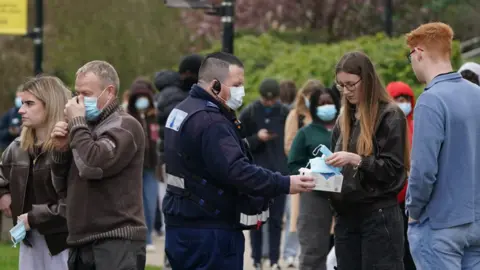
Long queues for antibiotics formed at the University of Kent in Canterbury
Some parents and students have accused health authorities of being too slow to react to the outbreak of meningitis in Kent which has seen two young people die and 13 treated in hospital, but the health secretary has said the UK Health Security Agency (UKHSA) acted as quickly and comprehensively as possible.
On Friday night medics at East Kent Hospitals NHS Trust alerted the local branch of the UKHSA that they had a case of invasive meningitis.
It did not raise any particular sense of alarm among staff at the agency responsible for managing outbreaks.
Meningococcal septicaemia, where patients become seriously ill with blood poisoning and inflammation of the brain, is classed as an urgent notifiable disease. Hospitals are duty bound to inform the health protection authorities when they have a suspected case - and UKHSA receives hundreds of these each year.
What normally triggers a reg flag is when there are more than one. A second report came in on Saturday morning – but this time from France after an exchange student fell ill after returning home.
Even then the alarm was not raised. The explanation given was that the students had lived at different private addresses and so no direct link could be made.
What was not known to UKHSA staff was that there were more young people in Kent who were deteriorating.
Was valuable time lost in trying to contain this outbreak - one that is being described as "unprecedented" by experts?
One public health source involved in the outbreak told me that it was clear there was a cluster developing before the weekend and that something seems to have gone wrong with the process. "We have to ask if the measures being taken now to contain the spread and hand out preventative antibiotics should have started sooner."
But it's not just that response was delayed. An alert could have been cascaded to local GPs to be on the look out for cases as well as other local hospitals.
East Kent Hospitals NHS Trust, which runs the two hospitals where most of the young people were taken to, has not responded to questions about when patients were first admitted and whether they raised the alarm immediately.
An UKHSA official said they were now aware of some delays in the hospital notifying them. One suggestion is that they were waiting for test results to come back to confirm meningitis.
But if that is the case, the hospital would have gone against the guidance.
Prof Paul Hunter, an expert in infectious disease at the University of East Anglia, says: "Suspected cases should be notified immediately – that's been standard process for years. You don't delay. Even with one case you report it. If there is two or more it's a red flag. I've not known an outbreak like this in my 40 years working in the field. It's very concerning."
By Saturday evening it was clear something very unusual and extremely worrying was happening. The local ambulance service rushed three University of Kent students to hospital after desperate 999 calls were made. The hospital notified UKHSA they had more cases and by Sunday morning UKHSA had stood up a full scale response.
Hospital staff, local council leaders and UKHSA officials were in regular contact and preparations were made to distribute antibiotics to university students and close contacts of the school children who had been infected.
By this stage panic had set in. Around 40 999 calls were made by university students on Sunday afternoon and evening, according to sources, as people became worried about the outbreak. Several more cases were identified, but most turned out not to be meningitis.
Students have complained about the lack of communication, as have local GPs. And it was not until late on Sunday evening that UKHSA went public with the news of the cases.
Dr Pandora Frost, who works from a practice in north Kent, says she is dealing with a family of a close contact of one of the young people diagnosed with meningitis and describes it as a "shambles".
"There should be clear guidance – at the moment we're not sure if we should be advising contacts to be off school or to isolate. We're totally in the dark."
But UKHSA has defended itself. Dr Gayatri Amirthalingam, a deputy director at the agency, says her teams have been working rapidly and tirelessly over the weekend and continue to do so.
"Many of these individuals are seriously unwell, so it is quite difficult to ascertain detailed timelines of exactly where they've been and who they've been in close contact with."
But questions keep being asked. Health Secretary Wes Streeting was drawn into it when he made a statement in the House of Commons on Tuesday. He said he believes the response has been quick and competent.
However, he says once the outbreak is contained he would be asking questions. "Once we are through this, we will obviously look at the handling of the UKHSA's response since there is always more to learn."
Additional reporting Alex Emery
More on the meningitis outbreak