.png)
 4 hours ago
7
4 hours ago
7
38 minutes ago
Mark Poynting,Climate researcherand Justin Rowlatt,Climate editor

 Getty Images
UK temperatures hit 40C for the first time on record in July 2022 but scientists warn that even more extreme heat is now possible
The UK should introduce a maximum temperature for workplaces to protect people as heatwaves intensify due to climate change, the government's adviser has said.
The Climate Change Committee (CCC) said that rolling out air conditioning and other cooling technologies in schools and hospitals should be one of the government's highest priorities.
It warned that increasingly extreme heatwaves, droughts and floods were threatening the British "way of life", from sports matches to music festivals.
The government said it would carefully consider and respond to the committee's advice, adding it was already investing in flood defences.
But Baroness Brown, chair of the CCC's Adaptation Committee, criticised the "woeful" performance of successive governments in tackling the present and future threats facing the UK from climate change.
"We need to recognise that there are aspects of our British way of life which are now really under threat from climate," she said.
"It's not rocket science - we know what to do [… but] we haven't yet seen a government that's prepared to prioritise adapting to the change of climate [... and] protecting the people and the places that we love," she added.
The CCC warned that the "UK was built for a climate that no longer exists today", adding that it is now inarguable that climate change is reshaping our weather.
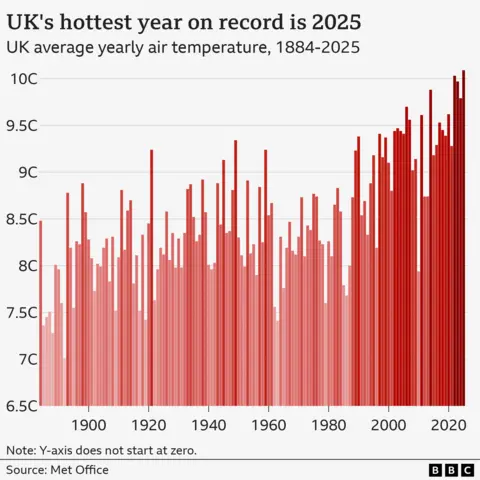
The world has already warmed by about 1.4C compared with pre-industrial times - before humans started burning large amounts of fossil fuels - and global efforts to keep warming to well below 2C remain off track.
The CCC points to the twin threats of winter flooding and summer droughts, with increasingly wet winters and dry summers expected on average with further climate change.
By the middle of the century, peak river flows in some catchments could be up to 45% higher during periods of very heavy rain, it warned.
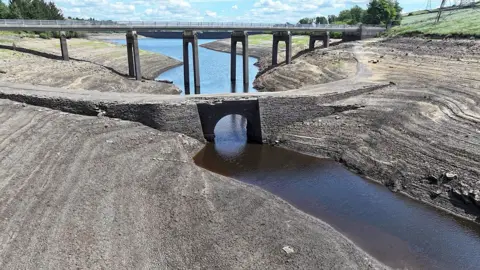 Getty Images
Several regions of the UK were hit by drought in 2025
But the committee's strongest words are for the threat of extreme heat, which it says is the greatest health risk from climate change facing the UK.
More than 90% of existing homes could overheat during more extreme heatwaves, the committee warned.
The CCC wants the government to introduce maximum temperature rules for workplaces to help protect workers' health.
"It's a very sensible thing to do because we know that productivity drops very significantly when the weather gets very hot and we know that people become more prone to making mistakes and to having accidents," said Baroness Brown.
The committee hopes that such a rule would incentivise businesses to deploy technologies to keep workplaces cool, such as air conditioning, heat pumps - some of which can cool as well as heat - and green shading.
The CCC does not suggest a maximum temperature but points to the example of Spain, where the maximum legal working temperature indoors is 27C for sedentary work and 25C for light physical work.
Baroness Brown also repeated her suggestion of changing the school year so that children would not have to sit exams during the height of summer.
Adapting to a changing climate comes at a price - roughly £11bn per year, the committee estimates, split between the public and private sectors.
The committee acknowledges the cost and cautions that it may underestimate the cash required to get the UK ready for a warmer climate.
But it is very confident that the up-front investment would save the UK money in the long run, potentially tens of billions of pounds per year.
"It's very good value compared to the cost of the impacts of the climate that we're already seeing," said Baroness Brown.
In response to the CCC's advice, Environment Secretary Emma Reynolds said: "We are acting to protect people and places from the impacts of climate change that are already being felt across the UK - from flooding to extreme heat and drought.
"Robust, independent science is essential and we will carefully consider the Climate Change Committee's latest recommendations to drive further action."