.png)
 4 hours ago
1
4 hours ago
1
There are three Lord’s in London. The first is six feet under Dorset Square next to Marylebone station, where these days a square foot of a single-bed flat will set you back a thousand pounds. The second is buried beneath the Lisson Grove moorings on the Regents canal, where the canal boaters grow tomatoes along the towpath. And the third, the current world-famous ground, is two blocks over on the Wellington Road, on a patch rented in the 19th century from the Eyre family, who made their money in wine and slavery. So long as there are ravens in the Tower, it always will be.
This week, Lord’s holds its 150th Test. It was a late starter. Tests were played at Melbourne, Sydney, the Oval and Old Trafford before it held its first in July 1884, but it will become the first ground in the world to reach this sesquicentenary. The MCG comes next, with 118. But then, much to the gall of every other corner of the country where they play Test cricket, Lord’s has had the advantage of holding two games a year every year this century. And because this is England, they’ve managed to make the rest of us think it’s us who are privileged by it.
Because everyone wants to play at Lord’s. Even with its stuffy air, supercilious staff and stodgy pitches, its eye-wateringly expensive Test tickets, its stifling rules and its serried sorts popping corks in the posh seats around the back of the pavilion, it is, still, almost impossible for anyone who loves the game to walk into the place when a game is on without feeling a thrill of childish excitement about the day ahead. Every other Test is most often known by where it falls in the series, first, second or third; only the Lord’s game invariably goes by the name of the ground.
It is the history that makes it, I think, the sense that much as it’s all changed, Lord’s is a space where people have loved the same game you do now for the last 200-and-some years. At Lord’s, you don’t just share the game with the thousands of people around you, but the hundreds of thousands who sat and watched the great players of their day long before you were even born. Their heroes’ names are on the honours boards, their bats are in the museum, their books are in the library, their flags fly from the stands, and their feats are listed on the plaques around the grounds.
In its earliest years, Lord’s was a more precarious proposition than this air of permanence makes you believe. It took entrepreneurship to make the place into a going concern and, in its early years, back when there was a running track around the ground, it held almost as many pony races and stone-picking contests as it did cricket matches. And it took money and influence to secure their corner in perpetuity. More than once, the MCC had to be bailed out by its wealthier members. Thomas Lord himself threatened to build houses on the outfield, until he was bought off for £5,000.
Later in the century they had to forcibly relocate a girl’s orphanage as part of a deal that allowed the Manchester & Sheffield railway to tunnel under the Nursery. Those old red brick walls around the ground were built to guard from the encroachment of the city that surrounds them. Only a few years ago the MCC were fighting off a developer who wanted to sell those same tunnels out from under them.

They call it the home of cricket, but it isn’t really, unless you’re one of the few who pays dues. There are older grounds, the Honourable Artillery Company runs one just six stops along the Metropolitan line, and there are easier grounds: Surrey have one just the other side of the river. It is the home of the MCC, fiercely defended, for 211 years, against female members, staunch defenders, at different times in their history, against the inclusion of non-white players, proud home, even now, of the annual fixture between Eton and Harrow.
Like Augusta National, it is the fiefdom of a private club which runs a publicly beloved event. And for most of the 20th century it ran pretty much everything else, too. The sport’s old headquarters would be a more accurate description of its role in the history of cricket. When, thank God, that role was finally taken away from them in 1993, the MCC lost an empire. Three decades later, it still feels like they are looking for a role.
The executive leadership, who tend to be in a running battle with some of their members, have been trying to find one. They have an excellent Charitable Foundation, they host the Army v Navy match, the Village Cup final, and this year, for the very first time, a state school cricket competition, the Knight-Stokes Cup, while the England and Wales Cricket Board are based in an office in the far corner. They run tours for curious tourists. They even have their own professional team in the London Spirit.
And they are the custodians of this grand old ground, on 17 acres of the city set aside for our summer sport, open, again this week, to anyone lucky enough to be able to afford it.
Five of the most memorable Tests at Lord’s
England v Australia, 1896. England won by six wickets
WG Grace’s last Test at Lord’s. The crowd were packed so close that they spilled on to the playing field, Joe Darling unable to catch Stanley Jackson in the deep because the spectators were in the way. Australia were skittled for 53 in just 75 minutes on the first morning, but then made 347 in their second innings to leave England needing 109 on a tricky pitch, sticky after overnight rain. Wisden described their eventual victory as “sensational” and “bewildering”.
England v Australia, 1930. Australia won by seven wickets
Don Bradman’s first Test at Lord’s. He scored 254, which he later described as “the best innings of my life”. England managed 800 across two innings themselves, and still lost with a day to spare after Australia scored 729 for six declared. Twenty-five years later the Guardian’s Neville Cardus picked it as the one game he most wished he could watch all over again: “This game could be laid in heaven, the platonic idea of cricket in perfection.”
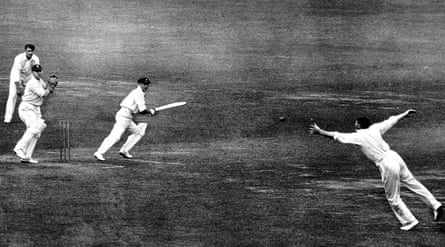
England v West Indies 1963. Match drawn
Best remembered as Colin Cowdrey’s match, though it may as well have belonged to Basil Butcher, who made the game’s only century, or Wes Hall, who bowled one of the great spells from the Pavilion End on the last afternoon. All four results were possible before the last ball, and England finished nine down with six needed to win, with Cowdrey, his broken arm pressed against his chest, watching from the non-striker’s end.
England v West Indies, 2000. England won by two wickets
Lord’s 100th Test, and a turning point for two teams. The West Indies took a 133-run lead in the first innings but collapsed to 54 all out when 21 wickets fell on the second day. England only needed 188 but they had to do it against Curtly Ambrose and Courtney Walsh. It all came down to an unlikely eight-wicket stand between Dominic Cork and Darren Gough, who put on 31 together to win one of the narrowest victories in the history of the ground.
England v Australia, 2023. Australia won by 43 runs
Four days’ play that could fill thousands of words. Steve Smith peeled off a hundred, Australia bounced England out, and Nathan Lyon came out to bat even though he could barely walk because he had torn a calf. Then Alex Carey stumped Jonny Bairstow as he wandered out of his ground and all hell broke loose. A scrap broke out in the Long Room while Stuart Broad openly ridiculed the Australians out in the middle and Ben Stokes clobbered an incandescent 155.