.png)
 5 hours ago
3
5 hours ago
3
Key events
Shnaider 3-6, 1-2 Sabalenka* (* Denotes next server). A gem of a whipped crosscourt forehand gets Sabalenka away before Shnaider profits from a wayward attempted winner to go 30-15 up, and the Russian proceeds to hold serve comfortably. It’s no classic but nor does playing in this wind look much fun.
Shnaider * 3-6, 0-2 Sabalenka (* Denotes next server). Errors are creeping back into the left-handed Shnaider’s game and in the blink of an eye Sabalenka is 40-0 up on her serve before skewing a backhand wide. An absolute slugfest of a rally ensues but it’s when Sabalenka attempts a spot of subtlety, she sends her dropshot into the net for 40-30 but an unanswerable backhand down the line from the favourite seals the game.
Shnaider 3-6, 0-1 Sabalenka*
* Denotes next server
Thanks Katy. The wind continues to ask questions of both players, and after clawing back to deuce, Sabalenka breaks in the opening game of the second set.
With that, I’m going to grab some lunch. Tom Davies is here to guide you through the second set …
Sabalenka wins the first set 6-3
“Step back and rip the return,” is the advice to Shnaider from her coach Sascha Bajin, who was Serena Williams’s long-time hitting partner and also coached Osaka to two slam titles. It does the trick as Shnaider skips to 15-30, but she then undoes her good work by missing a routine rally ball. 30-all. Now it’s Sabalenka’s turn to err, as she bashes a backhand into the net to offer up a break point. She slams a ball into the clay in frustration, and she’s let off the hook when Shnaider’s forehand whistles wide. Deuce, advantage Sabalenka, game and set Sabalenka, as she finally gets the better of the wind – and Shnaider – with a winner that lands on the line. Highway to Hell is played at the changeover. Which just about sums up the conditions facing both players in this quarter-final.
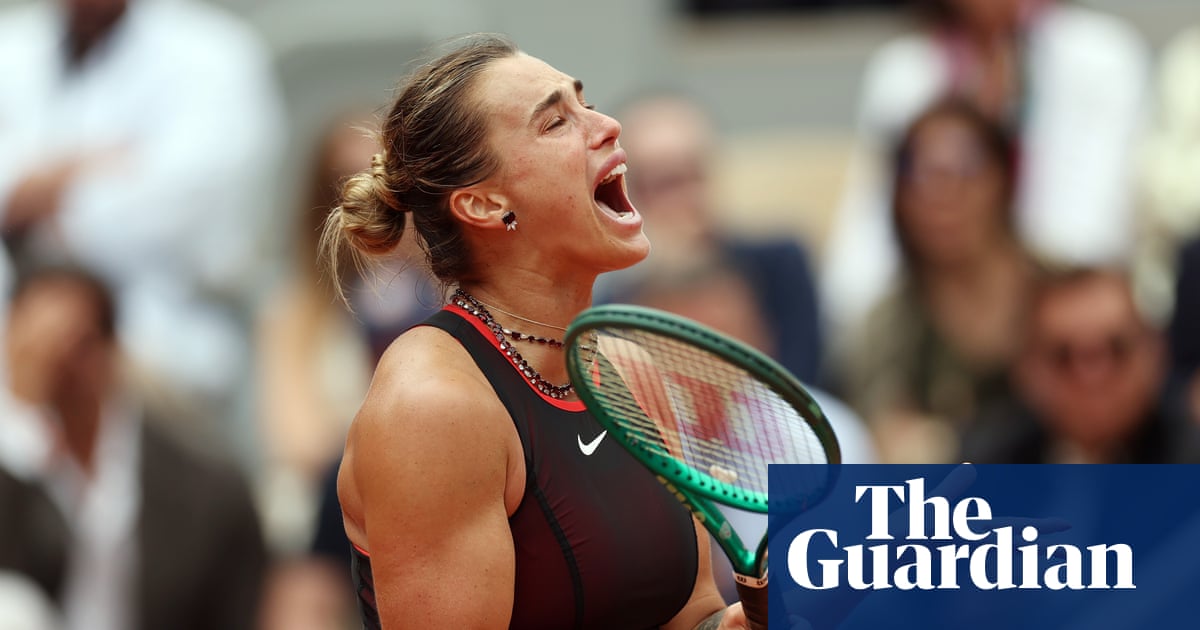
The wind is still swirling as Shnaider steps up to serve, and it’s clearly affecting both players. Sabalenka, having appeared so locked in, is starting to look a little bothered, and she’s not allowing herself enough margin for error in these conditions, which are getting worse. An exasperated scream follows her errant backhand on game point. Shnaider holds to 30 and from 5-1 and it’s 5-3.
Baseline winners, drop shots, volleys … Sabalenka is doing it all right now, and a trip to the net helps her dismiss the danger at 15-30. She’s made to wait to serve at 30-all because the wind is kicking the clay up into her face, but she regroups well to bring up set point at 40-30. But an untimely double fault – largely because of the wind, to be fair – blows Sabalenka off course and it’s deuce. A break point follows for Shnaider, and then a second set point for Sabalenka, and a second break point for Shnaider … and the Russian secures her first break! At 5-2 though, Sabalenka won’t be pushing the panic button yet.
Sabalenka is now crunching winners off Shnaider’s first serve. Ooof. It gets her to 15-40. And then Sabalenka shows she’s not all about the power, displaying some lovely finesse, to break once more. She’s added such impressive variation to her game and is now in full flow, leading 5-1.
A first break point of the match at 30-40. Just as the wifi goes down. Wonderful timing. I’m guessing Sabalenka’s timing must have been better because when the spinning circle of doom finally disappears from my screen, it’s 3-1 Sabalenka. If Roland Garros’s AI commentary is to be believed there were “eight shots of fierce baseline trading, cross-court backhands flying both ways — and Sabalenka uncorks a backhand winner wide to seal the break!” What I can say, with more certainty, is that Sabalenka backs the break up for 4-1.
The left-handed Shnaider knows she’s got no hope of outhitting Sabalenka, just as Chwalinska couldn’t against Kalinskaya, but like Chwalinska she’s got a game full of spin and slice; she’s a tricky opponent who can change the rhythm and moves well. But just as I type that it’s Sabalenka who dispatches the drop shot, and it helps her secure a hold to 15. Sabalenka leads 2-1.
Sabalenka’s victory over Osaka in the previous round was as good as I’ve seen her play on clay, showing such a brutal and beautiful mix of power and touch. A smart, skidding slice gets her to deuce on Shnaider’s serve here, but the Russian holds from there. So they’re both on the board at 1-1.
Shnaider, the 22-year-old who is seeded 25, has never faced Sabalenka before, and the world No 1 goes easy on her at the start, allowing the Russian to claw her way back to deuce. Sabalenka brings up advantage twice without capitalising, before closing out the game with an unreturned serve down the T, despite having to wipe some clay out of her eyes before serving. The wind is vicious and the skies are overcast … this feels like a totally different tournament to last week and the slower conditions will give Shnaider a little more hope. Sabalenka leads 1-0.
The wind, up to 26mph, is still tearing around Chatrier, as Sabalenka and Shnaider step on to court. Which may be a slight leveller for Shnaider, as it was for Chwalinska, who definitely coped with the conditions better than Kalinskaya, because of her height, spin and variety. There again, if anyone can hit through the wind with their power and force of nature, it’s Sabalenka, who will serve first.
So the Pole who absolutely no one expected to reach the semi-finals could yet follow in the footsteps of Iga Swiatek by winning the French Open. She’s only the second women’s qualifier to reach the Roland Garros semi-finals in the Open era, she’s lost only one set to get this far, and having entered the tournament as the world No 114, this run will catapult her to around No 30. Maybe this isn’t the time to burst her bubble, but the bad news is that Aryna Sabalenka is her likely semi-final opponent. The world No 1 is up next against Kalinskaya’s fellow Russian, Diana Shnaider. And with Sabalenka the only grand slam champion left in the draw, she knows this is very much her title for the taking.
Chwalinska defeats Kalinskaya 7-6, 6-3!
A game of cat and mouse goes Chwalinska’s way for 30-all. And gasps as Kalinskaya blinks with her backhand to hand Chwalinska a match point! And after all the drama, back and forth and toing and froing it ends rather quickly as Kalinskaya hits beyond the baseline! The 24-year-old qualifier is into her first grand slam semi-final at only her third major, and in a tournament packed with shocks and surprises, Chwalinska may just be the biggest of them all. “I honestly don’t know what’s going on,” she says, looking absolutely stunned. “Every single match here is crazy.”
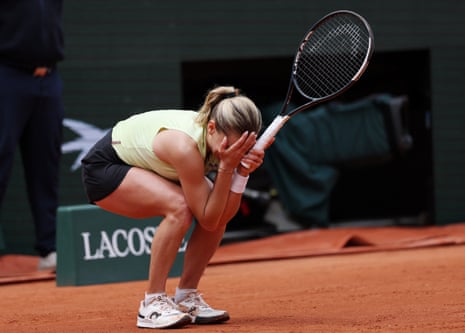
Chwalinska has fine hands but her racket must feel as if it weighs about 100kg as she steps up to serve. She still moves to within two points of victory at 30-15, before Kalinskaya lets go of some of her frustrations with a brutal return winner. So will it become match point or break point? Break point, as Kalinskaya again comes out swinging. Chwalinska is still able to think clearly enough to confound Kalinskaya with a body serve. Deuce. Advantage Kalinskaya. And Chwalinska goes well long with a clunky forehand! A fourth successive break! Sacre bleu!
But here’s a sudden, jarring shift in momentum as Kalinskaya, hitting slightly freer now she has nothing to lose, tears through Chwalinska’s serve, 0-15, 15-all, 15-30, 15-40 … and Kalinskaya gets one of the breaks back with a fizzing forehand winner! But no sooner does she give herself a glimmer, she slumps 30-40 down on her own serve, and she balloons a backhand long! Yet another break – the 10th of the match – and now Chwalinska will serve for the match!
Kalinskaya’s face hardly ever betrays emotion but she is clearly rattled here, and is now arguing with her coach about tactics. With her focus gone, she slips 30-40 down, and is totally wrong-footed as Chwalinska clobbers a forehand winner beyond her! Chwalinska has the comfort of a double break (which she’ll be thankful for given the way the first set went) and she’s potentially two games away at 7-6, 4-1!
Chwalinska’s first serve is slower than Kalinskaya’s second serve, but she shows great variation to back up the break by holding to 30. The qualifier, with one grand slam match win to her name before this tournament, is now three games away (!) from the semi-final. Words not even Chwalinska would have thought possible a couple of weeks ago. Or possibly even half an hour ago when Kalinskaya was making her comeback.
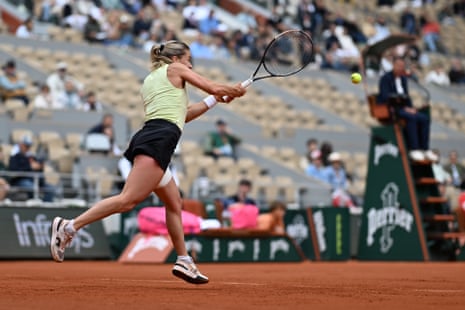
After that wildly see-sawing opener, a couple of straightforward holds get the second set under way. Kalinskaya then finds herself under a bit of pressure on serve, at 30-all, before dealing with Chwalinska’s loopy ball with a perfectly executed drop shot. 40-30. But Chwalinska comes straight back at her for deuce and advantage and game, or more accurately Kalinskaya self combusts with three errors, to hand Chwalinska the break! The qualifier leads 7-6, 2-1.
Fancy some post-set entertainment? Sure you do:
Chwalinska wins the first-set tie-break 7-3
Kalinskaya concedes another point on serve to drop 4-3 behind. A high-quality clay-court rally complete with moon balls, net charges and lobs ends in Chwalinska’s favour for 5-3. And having waited so long for a point to be won on serve, two come along at once! It’s 6-3, three set points, to add to the two it feels like Chwalinska had yesterday. And this time, after all of Kalinskaya’s resistance, the Russian fires long! It’s been tortuous at times and very tense, but Chwalinska finally has the first set after 69 minutes.
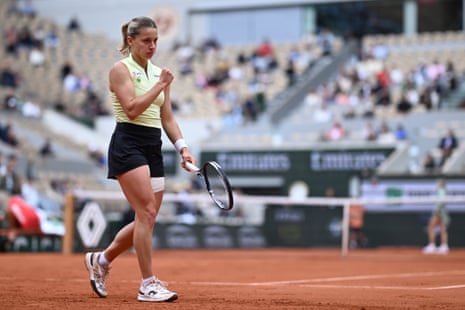
The first five points of the breaker go against the server, make that six, as Chwalinska’s vicious slice stops dead on the clay, leaving Kalinskaya with little chance. So they change ends at 3-all …
Kalinskaya, perhaps panicked, rushes the opening points on her serve, losing the controlled aggression she has found as the set has progressed, and she slides 15-30 down. Credit to her for the way she comes back for 30-all, 40-30 and game. So much of the narrative here is on the Chwalinska, the qualifier, that it’s easy to forget this is only Kalinskaya’s second grand slam quarter-final and she’ll be feeling the nerves. This will be a tense, tense tie-break.
Kalinskaya looks to be the favourite from here, with her greater experience and power, though having said that the key to her comeback has been staying a bit more patient in the rallies and not trying to pull the trigger so quickly. At 30-all on Chwalinska’s serve, the Pole pushes Kalinskaya deep before sprinting to the net to finish off the point. Smart play. And Chwalinska takes the next point too to staunch the flow of games against her and nudge 6-5 ahead.
Kalinskaya is never a player to show much emotion, and with her game face on, she works her way to 40-15 with minimal fuss. Before crunching away a winner to settle matters. From 5-1 down, they’re back on serve at 5-5! So who will feel the pressure now? Chwalinska, having conceded such a commanding lead and missed those two set points, or Kalinskaya, now she has something to lose again?
Kalinskaya holds to 30 to further reduce her arrears, to 5-3. But Chwalinska will get another chance to serve this out … and comes out on top after a lung-busting 27-shot rally, finished off with a drop shot/lob combination, for 30-15! Even Kalinskaya is applauding. Chwalinska delves into her box of tricks again to bring up 40-30, so here’s another set point to add to the one the Pole had at at 5-1. Some big, brave hitting from Kalinskaya saves it. The wind is really ripping around Chatrier now, just to add to the drama. And this goes exactly the same way as game seven, as Kalinskaya breaks on a second BP! Remarkably, they’re back on serve.
So Chwalinska is serving for the set … and she’s playing as if this is her 34th grand slam quarter-final rather than her first. From 30-all, she advances to 40-30 … but Kalinskaya saves the best for last, fending off the set point with a backhand winner! Chwalinska, perhaps still thinking about that SP, makes a total hash of a smash at deuce, giving Kalinskaya the chance to break. And while the Russian doesn’t on the first break point, she does on the second. Could the comeback be on? Kalinskaya trails 5-2 but at least she’s starting to ask some questions of Chwalinska.
Make that four, although the Pole is make to work for the hold, saving a break point at 30-40. Chwalinska is giving Kalinskaya so little rhythm and the Russian is totally befuddled in the next game as Chwalinska zips 15-40 ahead. Now Kalinskaya is trying to get in on the drop-shot act … but it’s not her natural game, it doesn’t work and Chwalinska charges forward before dispatching a winner into the open court! It’s now 5-1. Phew.
The 5ft 5in left-hander Chwalinska, who makes up for her lack of height and power with intelligence, is drop-shotting and slicing Kalinskaya into submission here, and it gives her a break point at 30-40. Kalinskaya saves it with a big backhand – but soon enough it’s break point again and after a nine-shot rally Kalinskaya’s forehand drifts wide! Chwalinska breaks for 3-1 and that’s three games on the spin.
Now it’s Chwalinska’s turn to recover from 40-15 down on Kalinskaya’s serve to break … and then she rattles through four successive points on serve to hold! The world No 114 is on the board and leads 2-1. This interview with Chwalinska and Swiatek as 15-year-olds is a good watch, btw. How good is their English, given their age?!?!
Chwalinska looks anything but stressed as she swiftly moves 40-15 ahead on serve in the opening game. But Kalinskaya comes back at her for deuce. Despite this being only a second grand slam quarter-final for Kalinskaya, the 22nd seed knows this match is on her racket, and she’s trying to stamp her authority from the off. She has the greater firepower, which she demonstrates to get to her advantage. Chwalinska craftily works Kalinskaya around the court and saves the break point. But the next two points go Kalinskaya’s way and the Russian breaks in the opening game.
The qualifier Chwalinska (pronounced Hfa-leen-ska in case you were wondering) is having the time of her life in Paris, having won all but one of her seven matches in straight sets, upsetting Zheng Qinwen, Elise Mertens and Maria Sakkari along the way. Her solitary grand slam match victory before this tournament came at Wimbledon four years ago, after she’d taken a break from tennis because of depression. She has said she associated the sport with “pressure, stress and crying” but now has a more balanced approach: “The results don’t define me as much as they did before. I just couldn’t differentiate Maja and tennis player. I was just one.”

Tumaini Carayol
Marta Kostyuk was her own toughest rival for so long during the early stages of her career. As she tried to navigate the pressure that accompanied her status as a teenage prodigy, she often struggled to think clearly on the court without her emotion, fears and desperation to succeed torpedoing her form.
The path towards unlocking her potential has been tough, requiring the Ukrainian to be honest with herself and encounter the right people to help take her forward. That work continues to pay off. Kostyuk made another significant breakthrough by ending the Ukraine derby as the victor, holding her nerve to defeat Elina Svitolina 6-3, 2-6, 6-2 and reach a grand slam semi-final for the first time in her career.
Although Kostyuk has broken new ground in Paris, this is simply a continuation of the form she has put together during what is looking increasingly like a career-defining clay-court season. She is now on a 17-match winning run, having secured titles in Rouen and Madrid in the buildup to Paris. Considering the clarity and temperament she is playing with each time she steps on the court, she can clearly go further.
After firing down a final unreturned serve, Kostyuk struggled to hold back her emotions as she digested such a significant result. Still, even in her personal triumph, she started her speech on the court by referencing the war back home, earning a long, standing ovation.
“I want to start with this historical match that we played today with Elina,” she said. “We had a very difficult night again in Ukraine, especially Kyiv. So many people dead. I want to give this match to Ukrainian people and to their resilience.”
This tournament has provided ample reminders of the horrors still unfolding in Ukraine. It started with Kostyuk waking up to the news that Russia had fired a missile within 100 metres of her family home, where her sister, mother and great aunt were staying, yet she had to compose herself and play her first-round match. Meanwhile, their compatriot Oleksandra Oliynykova has levelled stinging criticisms of the sport’s handling of Russian players.
Another duel between a Russian and Ukrainian player beckons. Kostyuk will next face the 19‑year‑old Mirra Andreeva, who produced a stellar performance to dismantle Sorana Cirstea 6-0, 6-3 and reach her second Paris semi-final. It will be a rematch of their recent final at the Madrid Open. Asked what it is like to play a Ukrainian player in these matches, Andreeva said: “For me it doesn’t matter who I play. I really try to play against the ball that is coming at me. Usually it doesn’t matter to me who I’m playing against, so I’m trying to really focus on the game and on the game plan that I have to use on the court.”
The full report:
Tumaini Carayol
For at least a few fleeting moments, it appeared that something significant might be unfolding on Tuesday beneath the Court Philippe-Chatrier roof. Rafael Jódar had started his first grand slam quarter-final desperate to make his mark and he spent the first 40 minutes eviscerating the ball off both sides, lasering groundstrokes that seemingly struck every line. He built a 5-2 lead over Alexander Zverev, a game away from starting with a statement in the biggest match of his career.
Normalcy resumed quickly. Jódar’s attempts to serve out the set ended in a break to love for the second seed, who quickly took control and refused to relinquish his position until the end of the match.
Zverev offered Jódar minimal breathing room for the rest of the encounter, serving extremely well and striking his forehand freely. In the process, the German took another step towards winning an elusive first grand slam title as he returned to the semi-finals of the French Open with a 7-6 (3), 6-1, 6-3 win.
The past 10 days in Paris have been unlike any in the recent history of men’s tennis, with so many of the top players suffering early upsets. As the dust has begun to settle on the early defeats for Jannik Sinner and Novak Djokovic, the central question surrounding the men’s draw in the final rounds is simple: can anyone beat Zverev?
After being repeatedly blocked by Sinner, Carlos Alcaraz, Djokovic and others, the door is clearly wide open. Beyond him, the world No 6, Félix Auger-Aliassime, is the only remaining top-10 player. There are still some shooters left in the draw, quality players with big enough weapons to take him out, but while Zverev has navigated his section with few problems, reaching the semi-finals without facing a player ranked inside the top 25, the rest of the field has been in a frantic rush to take advantage of an opportunity that may never come again.
So many players have already worn themselves out in multiple five-set matches as they have battled to get through.
Jódar was a perfect example of this. Seeded 27th, he has been one of the revelations of the clay-court season. He entered the match leading the ATP with clay-court wins this year, compiling a record of 19 wins and three defeats, with quarter-finals in Madrid and Rome before his run at Roland Garros. But he navigated consecutive five-set matches for the first time in his career to reach the quarter-finals. After squandering his opportunity in the opening set, he quickly ran out of steam.
The top half of the draw, meanwhile, now more closely resembles a wrestling match than anything like tennis. So many players in the top section have been embroiled in marathon matches, not least Italy’s Matteo Arnaldi, whose 17 hours and 54 minutes on court to reach the last eight is an open era record by, astoundingly, over two hours.
You can read the rest here:
Yesterday’s showers have departed, there’s even a bit of sunshine in Paris and the Philippe Chatrier roof is off as Kalinskaya and Chwalinska arrive on court. While we wait for the action to begin, here’s Tumaini’s take on what happened yesterday …
Today’s singles order of play
COURT PHILIPPE CHATRIER – 11am (10am BST)
Anna Kalinskaya (22, Russia) v Maja Chwalinska (Poland)
Aryna Sabalenka (1, Belarus) v Diana Shnaider (25, Russia)
Felix Auger-Aliassime (4, Canada) v Flavio Cobolli (10, Italy)
Not before 8.15pm (7.15pm BST)
Matteo Berrettini (Italy) v Matteo Arnaldi (Italy)
Preamble
Bonjour et bienvenue au jour onze de Roland Garros, where there’s something of an eastern European and Italian takeover on Philippe Chatrier.
First it’s the qualifier Maja Chwalinska – not the Pole who everyone thought would still be standing – against the 22nd seed Anna Kalinskaya. Chwalinska, who came through the junior ranks with Iga Swiatek before their careers went in very different directions, had won only one grand slam match before this tournament, but the 24-year-old is now in the quarter-finals – a stage the 27-year-old Kalinskaya has admitted she didn’t expect to reach either, having got this far at a major only once before, at the 2024 Australian Open.
This, of course, is anything but uncharted territory for Aryna Sabalenka, who has remained utterly unaffected by the chaos around her, as the only grand slam champion left in one piece in the women’s and men’s draws, on her way to a meeting with another surprise quarter-finalist, Russia’s Diana Shnaider. Sabalenka laid down the biggest of markers in the red dirt with her blistering win over Naomi Osaka in the previous round – prompting even Shnaider to concede that today’s match is most likely a chance to “get experience for the future”.
Sabalenka knows her time is now – while it could be now or never for Felix Auger-Aliassime, the former wonderkid who is, for the first time in his slam career, the highest-ranked player left in his half of the draw that may have lost the greatest Italian of all in Jannik Sinner but still features three others in Flavio Cobolli, Matteo Berrettini and Matteo Arnaldi. Auger-Aliassime faces Cobolli in a much-anticipated match that is so hard to call (Auger-Aliassime has the big-match experience; Cobolli is such a fine talent) – before in the night session the renaissance man Berrettini, back after his injury hell, meets the marathon man Arnaldi, who’s already played 18 sets to get this far.
Play begins: à 11h ( 10am BST). On y va!