.png)
 1 month ago
51
1 month ago
51
5 hours ago
Tiffanie Turnbulland Lana Lam,Sydney

 AFP PHOTO / ROCCO FAZZARI
A court sketch of Roberts-Smith during his bail hearing on Friday
Warning: This story contains distressing content
Beaming into a small Sydney courtroom on Friday via video link, Ben Roberts-Smith sat silently as he appeared on war crimes charges for the first time.
The country's most-decorated living soldier was earlier this month charged with five counts of murder - allegedly committed while the former Special Air Service (SAS) corporal was deployed to Afghanistan on Australia's behalf.
Fresh court documents seen by the BBC reveal – in detail – allegations that the 47-year-old murdered a disabled Afghan detainee, kicked a handcuffed prisoner off a cliff, ordered rookie soldiers execute others in an initiation practice called "blooding", and planted items on the alleged victims to cover-up misconduct.
Roberts-Smith vehemently denies the claims, which his lawyer says are "unchartered legal territory" for Australia – a country that has never held a war crimes trial.
So what are the allegations - and what happens next?
'Whiskey 108' Compound - 12 April 2009
Roberts-Smith joined the Australian Defence Force (ADF) as a fresh-faced 18-year-old, and did two tours in East Timor before joining the SAS in 2003.
By the time he was sent to a compound dubbed "Whiskey 108" on 12 April 2009, he had more than a decade of service and a Medal of Gallantry under his belt.
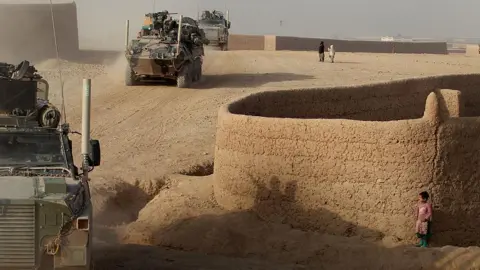
Australian troops had been battling Taliban insurgents at the site near Tarin Kowt, in central Afghanistan, and Roberts-Smith's SAS crew were called in to clear it after an airstrike, the court documents state.
They discovered a tunnel from which they pulled and handcuffed two men – identified by prosecutors as father and son, Mohammad Essa and Ahmadullah.
Ahmadullah, who wore a prosthetic leg, was allegedly carried by Roberts-Smith outside the wall of the compound, thrown to the ground, and shot multiple times using a belt-fed machine gun, the court documents say.
"That action was witnessed by several ADF members, including those who were providing a protective cordon outside the compound," the documents continue.
 The Age/Getty Images
A convoy of Australian troops near Tarin Kowt
Back inside the compound, Roberts-Smith turned his attention to the senior Essa, the prosecutors' submission continues.
Grabbing a trooper referred to as "The Rookie" – anonymised in the court documents as Person Four – Roberts-Smith borrowed a firearm suppressor from another man before placing the detainee on his knees.
"Shoot that [expletive]," the court documents allege he said to Person Four – who understood it to be an order and complied.
"At the conclusion of the mission, both Roberts-Smith and his patrol leader claimed that they had 'blooded the Rookie'," the court documents said.
Darwan Village - 11 September 2012
In late August 2012, an Afghan National Army soldier working with Australian soldiers turned on them, killing three and injuring two others, sparking a massive manhunt. The search for Sergeant Hekmatullah became the highest priority for the ADF.
Roberts-Smith - who the year before had been awarded the Commonwealth's highest military honour, the Victoria Cross - went looking for him in a village called Darwan two weeks later.
Arriving by helicopter on 11 September, his team searched a series of compounds near a dry creek bed, capturing three detainees, the court documents say. One of them was a man called Ali Jan.
The prisoners were "tactically questioned" by Roberts-Smith, prosecutors allege, which involved him punching and physically assaulting the handcuffed men.
Roberts-Smith then allegedly pulled Ali Jan, who was taken to the edge of a cliff by a colleague given the pseudonym Person 11.
"Whilst [Ali Jan] was still cuffed and physically restrained, Roberts-Smith kicked him causing him to fall approximately 10 metres and causing injuries including the loss of teeth," the court documents claim, adding that Person Four and local villagers say they witnessed the fall.
Roberts-Smith and Person 11 then climbed down the slope to where Ali Jan lay, hurt and still handcuffed.
Person Four told prosecutors he saw Roberts-Smith and Person 11 – both carrying rifles – have a short chat.
Several shots rang out when Person Four's back was turned, and when he looked over, Person 11 had his rifle up on his shoulder. The prosecution alleges that Person 11 shot Ali Jan.
The court documents claim that a hand-held radio - one that Roberts-Smith had taken from the body of a man he had earlier killed - was placed near Ali Jan and photographed to support the killing.
Roberts-Smith, during the defamation trial, denied any men had been detained, or that the cliff existed.
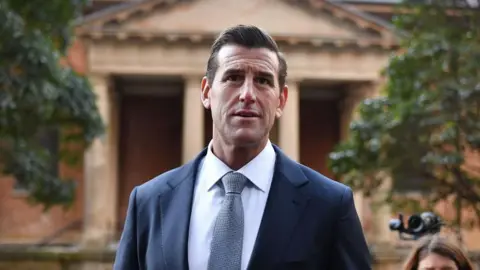 Getty Images
Roberts-Smith, pictured outside Federal Court in 2021 during his defamation trial
Syahchow - 20 October 2012
On 20 October 2012, Roberts-Smith – by then a patrol commander – was sent into Syachow village to look for an insurgent dubbed "Objective Pine".
The reports from that mission say that two people were killed during fighting in a compound. Another two were killed shortly after, shots and a grenade sent into a cornfield where they were refusing to surrender.
That was a lie, prosecutors allege. A junior soldier – called Person 66 – says the two men in the field were detainees murdered on Roberts-Smith's command.
Person 66 says the pair were detained in the compound, and then questioned by Roberts-Smith, who punched one of them in the stomach.
The two men were later lined up at the end of the cornfield, the court documents allege.
A senior soldier shot dead one man, before Roberts-Smith allegedly removed handcuffs and a blindfold from the second and ordered that Person 66 do the same.
The man had been pushed to the ground, his hands up in front of his face, the prosecutors claim. Person 66 – who was on his first operational mission – paused for a moment, then shot the man two to three times in the chest, the documents say.
He then watched as Roberts-Smith threw a grenade towards the dead detainees, described by investigators as an act to support the "false claim" they were killed during legitimate fighting.
Forensic pathologists identified marks consistent with ligatures in photographs of at least one of the men. Less discernible linear marks were also found on the other.
Trial could be 'years away'
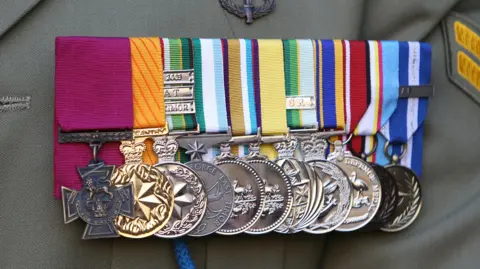 Getty Images
Roberts-Smith's medals, which remain on display at the AWM
Roberts-Smith stepped back from active duties at the end of 2012, and formally left the ADF in 2015, shortly after receiving a commendation for Distinguished Service.
About a year later, top military brass began an inquiry into rumours of war crimes committed in Afghanistan, and media reports detailing allegations began circulating.
Roberts-Smith was by 2018 identified as the alleged perpetrator in several incidents – something he vehemently denied and launched a landmark defamation case over. He lost.
In sworn evidence given at that civil trial, transcripts of which were included in the court documents tendered in the criminal case, Roberts-Smith denied he had ever broken the rules of war, underpinned by the Geneva Convention.
He also said he knew killing a "person under control" - or detainee - would never be permissible, and denied ever using "throwdowns", jargon to describe items like a radio or weapon planted at the scene of lethal engagements to justify them.
"Roberts-Smith exercised his right to decline the opportunity to add, amend or comment upon his previous sworn evidence," the court documents say.
However prosecutors have outlined other evidence they want to use to make their case at trial.
There were "common themes" to the alleged murders, the court documents concluded: every single alleged victim was handcuffed, detained for a period, and questioned prior to their execution, and each was killed in a situation where the ADF had control of the situation and there were no active engagements with enemy forces.
There was also at least one direct or eyewitness account to each of the alleged killings. The court documents reveal that list includes three witnesses who testify that they were involved in the execution of one or more detainees – either at the direction of, or with the complicity of, Roberts-Smith, who was their military superior.
Roberts-Smith's legal team has not yet responded to the detailed allegations put in the documents, nor has the veteran entered a plea, and any trial is still a long way off.
Granting Roberts-Smith strict, conditional bail on Friday, Judge Greg Grogin said it would be "not weeks or months, but years - possibly years and years" before Roberts-Smith appears in the dock.