.png)
 1 month ago
43
1 month ago
43
Jim Redmond
The older I get, the more profoundly I appreciate that, when I’m writing about sport, I’m also writing about love. This makes perfect sense given these are mankind’s two greatest inventions and the stuff we can least do without, but there’s more to it than that: sport and love are both expressions of identity, creativity and devotion, pursued because they are right but also because it’s impossible not to.
Love takes many forms, experienced by different people in different ways and by the same people differently on different days. But one of its strongest iterations is that of a parent for a child, a love that is implacable, indivisible and incomparable.
None of which seemed remotely relevant at the 1992 Olympics, when Derek Redmond stood on the start line prior to his 400m semi-final. Four years previously, he’d withdrawn from the opening round 90 seconds before the gun, suffering with one of many injuries that blighted his career. But now he was right there, having recorded the fastest time in qualifying before winning his quarter-final. He was ready.
And Redmond got away well, but as he stretched down the back straight, his right hamstring popped. “I heard a funny clap,” he said, “and I honestly, for a split second, thought I’d been shot. And then, when the pain had sort of died down, I remembered where I was and what I was doing, and remember thinking: ‘Quick, you’re in the Olympic semi-finals you prat, get up and start running.’”
Professional athletics is not an inherently enjoyable activity: you sacrifice fun and freedom to hurt yourself on a daily basis, to eventually hurt yourself for the viewing pleasure of a worldwide audience. But even in that context the 400m stands out, a barbaric event offering no escape: you sprint until you can’t sprint any more, then you sprint more.
Only those who do it know what that takes, never mind what it takes when constantly battling injury; the hope is the rewards justify the toll. Rewards such as competing at the Olympic Games.
“I got to the 200m mark after hobbling 50m,” Redmond continued, “looked across and all the guys had finished, and it pretty much hit me: it ain’t gonna happen, it’s all over.”
Behind, meantime, is a minor kerfuffle, as Jim, his dad, races down from the stand, breaking past security to comfort his ailing son – in a banging Nike Air Huarache T-shirt too. Almost immediately, it all becomes too much, Redmond still an Olympian but now also a kid freed by seeing his daddy at the worst moment of his life: suddenly the world is inhabited only by them. So he cries out in agony, the weight of sacrifice and devastation consuming him, then rests a head on his dad’s shoulder, the parent/child relationship in living metaphor.
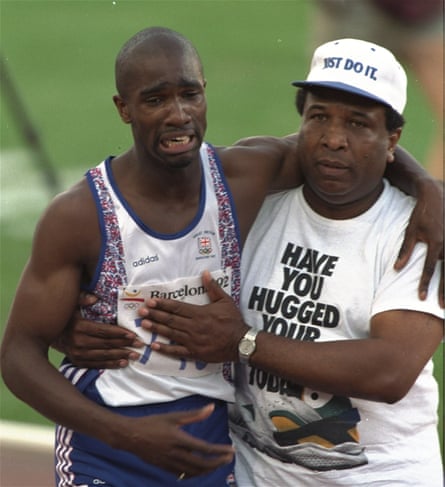
Jim’s act resonates because it was out of the ordinary yet totally ordinary: a child is in pain, a parent does what it takes to be by their side. Then, rather than impose his will as parents are wont to do, he advises his son to stop running and, by assuring him he has nothing to prove, tacitly reminds him that validation comes from within, not without. But when Derek’s determination to finish the race is undimmed, he supports him in forging his own path.
In the book of Genesis, when Abraham escorts Isaac to his binding, Isaac eventually notices that, though they’ve planned a sacrifice and have firestone and wood, there’s no lamb. Calling out to his father for guidance, he receives an equivocal, unsatisfactory response – roughly, God will sort it – yet it does the trick and, in a scene of moving intimacy and tenderness, we’re told that “the two walked on together”. Why? Because for Isaac, his father’s gentle presence is enough, the simple fact of their love giving him the strength to face any situation. Together, they are safe.
So it was in Barcelona, Jim’s implacable care converting a terrible moment into one that is unique and eternal. Had Derek won the gold medal he’d have been one of many but instead he’s one of one, his father’s love for him and his love for his father enshrined into Olympic folklore and the annals of humanity for ever more.
Andrew Strauss
One Friday in May 2004, I was crossing the Severn en route to the FA Cup final, just as Andrew Strauss marked his Test debut with a century. Naturally, horn tooted loud and foot stomped gas on the basis that, at 27, Strauss had probably given up hope of representing England in the longest format yet here he was, scoring a ton at Lord’s, his home ground.
Once the hotel had been gained, I put on the telly to watch the moment on the news, noticing that, around Strauss’s neck was his wedding ring. “It’s to remind me why I play cricket,” he explained some years later. “For my family – my wife Ruth and my boys Sam and Luca.”
Some more years later, these were names we knew, because Ruth was diagnosed with terminal lung cancer so Strauss, by this time director of England cricket, stepped down to spend time with her. In December 2018, she died aged 46.
Though renowned as an articulate, measured and insightful communicator, like many sportsfolk Strauss cites the ability to bury emotions as a crucial part of his success. But after Ruth’s diagnosis, thanks to her commitment to “do death well” and his dedication to honouring their love, he developed a powerful emotional literacy, discussing grief – often while promoting the Ruth Strauss Foundation, the charity he set up for others to access support – with candour and hope.
“To tell her story, is tough, there’s no doubt about that and it doesn’t get any easier,” he said. “But I like this idea of when it is tough, it’s tough because you’re remembering her, you’re not just charging on and sort of forgetting all that side of your life … to take some time to remember, for me to take some time to remember what she stood for and what she was like. She was incredibly compassionate and charitable … really wanted to focus on those people in the world who were underprivileged or taken advantage of and the Foundation is trying to keep that spirit alive.”

Romantic love is special because it is love out of choice, a complete commitment to and trust in another person, with both parties able to end the relationship at any moment: it is really wonderful, but it is really hard. And it is clear Strauss appreciates both of these aspects, noting that: “For too much of the time when I was playing I wasn’t present enough, even when I was present” – sentiments with which anyone with experience of a relationship can identify, international cricketer or not.
Now, though, he uses death to give life, inspired by the love of his life and her approach to living it. “Ruth never had that ‘poor me’ thing,” he says. “She was always like: ‘Why not me? Why should I be any different?’”
The most affecting stories are specific and general, allowing us to believe them while centring ourselves, and the way Strauss tells his highlights both its uniqueness and its universality. This inspires us to conceive of our own relationships differently, not just through the scalding reminder that one day, one of us will leave the other, but through the affirming lesson that life is finite but love lives inside us for ever.
Kevin Sinfield
Parental love and romantic love are great but there is a debt to those pleasures: they can be demanding, they can be gruelling and they can be relentless.
Friendship, on the other hand, has no motive other than enjoyment. We vibe with someone to whom we’ve no previous connection, so share with them our existence and our essence because we want to, because it makes us feel good. There may be fluctuations of intensity as time passes and life happens, but that serves only to highlight that it is a relationship of choice, the parties there because they want to be, not because they have to be. With interactions untainted by the desire for sex, naches or a peaceful home, they allow a freedom to be authentic that is sometimes compromised in relationships of co-habitation and co-dependence; friendship is pure.
Originally, this entry planned to honour the joyous connection between Martina Navratilova and Chris Evert, a relationship which moved from cordiality to rivalry to sisterhood, taking in a serious helping of life experiences. No one understands what it’s like to be Martina better than Chris, and no one understands what it is to be Chris more than Martina.
But it’s impossible to write about friendship without writing about Rob Burrow and Kevin Sinfield. A bond forged in the hyperreal, hypermasculine environment of rugby league, when Burrow was diagnosed with the motor neurone disease that eventually killed him, Sinfield responded with so much love it made them famous, their names now bywords for the most inspiring intimacy imaginable.
A succession of fundraisers, including jogging from Leicester to Leeds, running 101 miles in 24 hours and completing seven ultramarathons in seven days – or, as Sinfield put it, “going for a run for a mate” – made clear there was nothing he wouldn’t do to help, increasingly ridiculous activities presented as perfectly normal behaviour. “Rob inspires me to be a better person, a better friend, to be more kind, to think of others,” Sinfield said. “Doing this, amazing things happen. Life becomes so much more fulfilling and special.”
Watching the two together, the support and the rapport – the secret language that only they fully understood – was obvious, their closeness suffused with so much honesty and meaning it is almost too much to bear.

“We just wanted to be a great friend,” Sinfield said, “and if we can all try to be a bit of a better friend from time to time, I think we have a bit of a better place to live in.”
Matt Busby
“A footballer has come to this house today,” said the doctor who delivered Matt Busby, the anecdote igniting his lifelong romance with the game. “There were only two ways for boys to go,” said Busby of his childhood in Orbiston, Lanarkshire. “Down, working in the pits, or up if you happened to be good at football.”
Football saved not only him but his family, helping him provide after his father and uncles were killed at war. And if, to that, we add the nature of the game itself, it’s no wonder Busby was head over heels.
“Sometimes he does dare-devil things that make the directors feel old before their time,” wrote the Manchester Guardian of Busby the player in 1934. “But who would have him different? He laughs equally at his blunders and his triumphs, which of course is the privilege as well as the proof of a great player. He would be a certain choice for that select 11 of Footballers Who Obviously Love Football – and that is the highest praise of all.”
This intensified when Busby was appointed manager of Manchester United in 1945, a brute of a job given Old Trafford was still a bomb site. But his charisma, empathy and genius could not be denied, allowing him to build a team good enough to win the FA Cup in 1948 and the league in 1952.
It was after that, though, that his love developed into something more profound. Alongside Jimmy Murphy, his assistant, he scoured the country to recruit the best young players, taking extremely seriously his responsibility to care for other people’s children and building a family unit in which everyone felt valued.
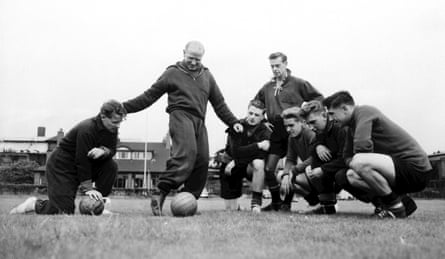
The Busby Babes quickly came to embody youthfulness, joy and integrity – a way of being and a way of life. Intimately acquainted with football’s restorative powers, Busby demanded his players entertain the working people who relied on them for excitement, and they were captivated.
After United won the league in 1955-56, Busby defied the Football Association to enter the European Cup, choosing love over insularity. And he was fully vindicated in so doing, United’s last-eight tie with Athletic Bilbao a classic, so too their semi-final defeat by Real Madrid.
Another title earned the chance for another crack and we all know what happened next: one cold and bitter Thursday in Munich, with United having reached the semi-finals the previous evening, eight players, three members of staff, two journalists and one crew member died when their plane crashed on take-off.
Spending nine weeks in hospital, the first three without knowing the terrible extent of the tragedy, Busby twice had the last rites read. Then, finally, his wife, Jean, broke the news that eight of his sons were gone, his beautiful team devastated. Unsurprisingly, he resolved to resign, the trauma of loss too much to bear, but Jean thought otherwise. “Football is your life,” she said. “You’ve got to face it.”
So Busby carried on, driven by his love for the boys he’d lost and the boys still there, likewise for the club he’d built and the game he’d graced: honouring that by winning the European Cup became an obsession. And amazingly, within seven years, United were league champions again, only to once again be eliminated from continental competition in heartbreaking fashion at the last-four stage. With his team ageing, Busby’s dream looked over.
Then, in 1967, United won another title, earning Busby one last go at redemption. But away to Madrid and trailing 3-2 on aggregate with just 17 minutes of their semi-final left, he once again looked destined to fail. His players, though, knew what was at stake, fighting back to secure a miraculous 4-3 aggregate win before beating Benfica in the final to secure Busby’s redemption.
Rarely, if ever, have celebrations been so heartfelt and, at the post-match party, Busby somehow found it within himself to sing What A Wonderful World, an incomprehensible outpouring of love and loss. Football had taken everything from him, but it had also given everything to him, while he had taken everything it offered and given it all he had in return.
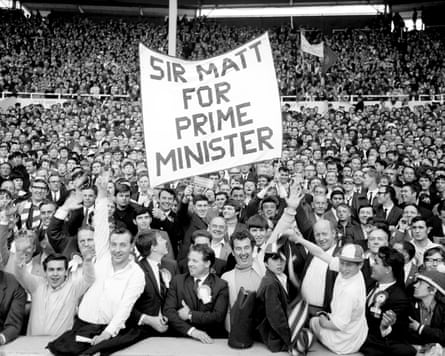
Busby retired in 1969 and two years later was invested as a freeman of the city of Manchester, his speech at the ceremony describing a love for the game so profound it should be pasted in every dressing room and boardroom in the country.
“Winning matches at all costs is not the test of true achievement, he said. “There is no dishonour in defeat as long as you play to the limit of your strength and skill. What matters above all things is that the game should be played in the right spirit, with fair play and no favour, with every man playing as a member of his team and the result accepted without bitterness and conceit. Played at its best between two first-class teams, football is a wonderful spectacle. I love its drama, its smooth playing skills, its carelessly laid rhythms, and the added flavour of contrasting styles. Its great occasions are, for me at any rate, unequalled in the world of sport. I feel a sense of romance, wonder and mystery, a sense of beauty and a sense of poetry. On such occasions, the game has the timeless, magical qualities of legend.”
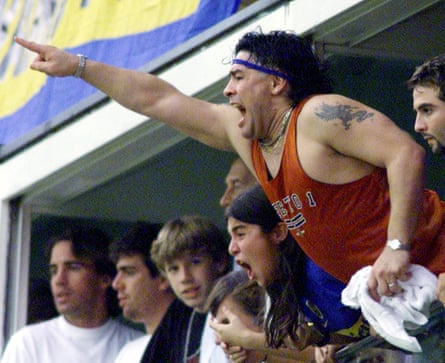
There used to be a tradition in Argentina: if you were picked for La Albiceleste, you did not mount your debut shirt in your snooker-room shrine to self, nor did you swap it or give it to your parents or grandparents. Rather, you offered it up as a sacrifice to Diego Armando Maradona.
Never has there been a sportsman as widely and profoundly revered; if Busby loved the game, the game loved Maradona to the point of restraining order. Most particularly in Argentina, where there are at least 10 players who have him tattooed on their bodies, but also in Naples and around the world.
This is partly because he was a brilliant footballer, perhaps the best ever, but there is much more to it than that. At Mexico ‘86, he did more than anyone ever has to dispel the truism that football is a team game, giving those who watched the tournament as children a false impression of how things work. It turns out that it is not possible for one player to settle World Cup knockout matches by taking the ball and running past everyone between him and the goal – unless that one player is Maradona.
The way most sportspeople compete represents something of their character, but few have realised this as fully as Maradona. Small but invincible and bouncing but balanced, his curls danced with innocent, nasty mischief, energy both dreamily potential and alarmingly kinetic. Nor does his embodiment of football simply reflect his mastery of it; he is equally loved for his instinctive grasp of its less sporting but equally alluring aspects, embracing confrontation, challenging authority and looking to humiliate – or “vaccinate”, as he put it – anyone daring to deny his will.
The honesty with which he presented allowed people to invest in him. He had appetites and passions, failures and failings, a mythological warrior but fully human, wholly known yet elusively enigmatic and never less than compelling. Creating worlds and performing miracles, bestowing ecstasy and joy upon the people while demanding nothing in return, Maradona is the God we wish our Gods were, transcending borders and differences with such elan we can’t help but forgive his excesses. If you love football, you love Maradona.
Colin Kaepernick
Going into the 2016 NFL season, Colin Kaepernick, a San Francisco 49ers quarterback, was injured. So when he opted not to stand for the national anthem no one noticed. Eventually, he was asked to explain himself, and he could scarcely have been clearer: “I am not going to stand up to show pride in a flag for a country that oppressed Black people and people of colour,” he said. “To me, this is bigger than football and it would be selfish on my part to look the other way.”
The move came in response to the killing, by police, of Alton Sterling and Philando Castile; to the shooting, by police, of Charles Kinsey; and to the acquittal, of police, after the killing, in police custody, of Freddie Gray. All four men were Black.
Naturally, Kaepernick had considered what his protest might cost him. “I am not looking for approval,” he said. “I have to stand up for people that are oppressed ... If they take football away, my endorsements from me, I know that I stood up for what is right.”
And they did. The protest evolved from sitting to taking a knee, while Kaepernick broadened his activism into other areas and, sure enough, the 49ers released him before, by amazing coincidence, every other franchise ignored the free agency of a proven performer.
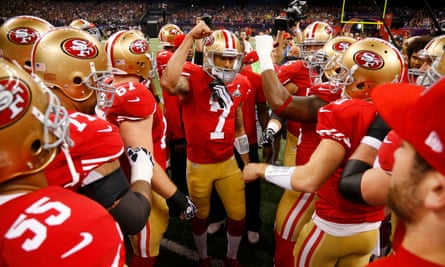
In the first instance, Kaepernick’s courage reflects a love of his community and a love of humanity. But to risk and sacrifice so much, in a country structured to tell him that, as an African American, he is expendable, would be impossible without a profound acceptance of self. Whitney Houston’s greatest love can also be the hardest love, but Kaepernick’s was so strong, he could face down corporate America, because more important than anything was facing up to himself.