.png)
 8 hours ago
3
8 hours ago
3
There are a few contenders for the most striking image from the first block of fixtures in the inaugural Nations Championship. Was it South Africa splintering the Wales scrum like balsa wood in Durban? Or England’s Manny Feyi-Waboso underlining his potential to be one of the superstars of next year’s Rugby World Cup? Or maybe New Zealand reminding everyone, themselves included, how lethal they can be when they trust the catch-pass game that was once their default setting?
There were some definite coaching winners, too, inevitably led by Rassie Erasmus but also including the All Blacks’ new head man, Dave Rennie, who is three from three so far. Anyone seeking another serious fix of international rugby need look no further than next month’s Greatest Rivalry series between the Springboks and the All Blacks, an even spicier prospect now the visitors are back up and running.
Before that, though, anecdotal feedback suggests the new Nations Championship format has been enjoyed by many sofa-bound viewers, with all games freely available on ITV and the action flowing from one throbbing encounter to the next. As anyone who sat through the football World Cup final between Spain and Argentina will testify the title of The Beautiful Game is temporarily vacant; at its best international rugby can refresh the parts other sports cannot reach.
Scotland were certainly compelling at times against South Africa, as was Matthieu Jalibert for France. England had their moments when they were not humming the title of Coldplay’s first big hit, Ireland nicked a tight one against Australia, Wales beat Fiji and Japan took Italy by surprise. Whether or not you buy into the wider North v South contest, there was something for pretty much everyone, aside from Fiji or Argentina who both appear to have slipped backwards.
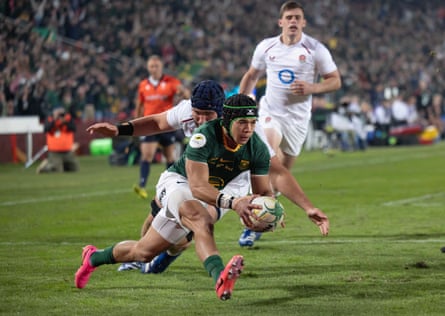
There was even a touch of comedy, with the crowd at Ellis Park so intent on booing Henry Pollock they didn’t notice the player concerned was actually Guy Pepper. It was about the only rugby-related misstep in South Africa this month; from Cheslin Kolbe’s coruscating sidestep past Cadan Murley to Damian Willemse’s all-round excellence, the Boks were certainly too good for England.
There has been just one recurring snag. Rugby’s ability, regardless of individual brilliance or fresh formats, to get in the way of itself remains unrivalled. In an ideal world the Nations Championship would be the launchpad to a shiny new era where refereeing consistency is a given, TMOs are seldom heard and the ability to understand the laws of the game does not require a doctorate. In reality, new-look competition or not, many of the same old frustrations remain.
Take New Zealand against Ireland at the weekend and the nasty, over-the-top ruck clear-out by the All Black back-rower Luke Jacobson. Red cards do not come much clearer – so, naturally, he only received a yellow. Then there were the deliberate knock-ons by, among others, Quinn Tupaea that also failed to attract cards when players in other games were dispatched for much less obvious transgressions.
This could be swiftly consigned to the folder marked one of those things if the margins in top-level rugby were not so slim and the demarcation lines so blurred. Another prime example was Argentina’s non-try in the closing moments of their defeat to England in Santiago del Estero. Watching from the other side of the field it looked like a try which is how it also looked to the Australian referee Angus Gardner, standing just a few yards away.
But the longer the TMO process dragged on and the more slow-motion angles that emerged, the more questions presented themselves. Ultimately a case could have been made for almost everything from no try – and thus an England win – to a penalty try which would have ensured a 31-31 draw.
And by the time a decision had been reached and the final whistle had sounded a supposed 80-minute game had spanned some two and a quarter hours – almost as long as the full version of Argentina’s national anthem. By then the drama and colour of Bautista Delguy’s original dive and Henry Slade’s heroic cover tackle had been reduced to greyscale irrelevance by, among other things, the endless minutiae of a law book never designed for repeated trial by video.
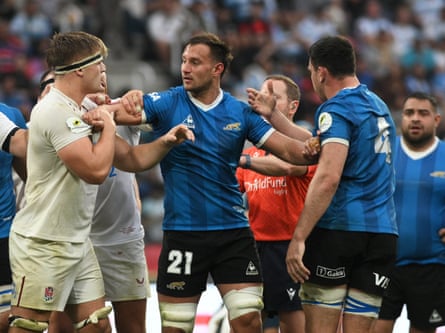
So here are a few related ideas to ponder on the beach. 1) In future TMOs should only be responsible for flagging up head injuries or serious foul play with all other decisions the preserve of the on-field referee. 2) Aside from clearly deliberate cynical slap-downs by the last defender close to the try line, other less serious one-handed knock-ons or failed intercepts no longer merit a yellow card. Instead the opposing side will have the option of either a scrum or a tap penalty 20 metres upfield. 3) Only captains to be permitted to talk to referees. 4) Players guilty of instigating head contact will receive a 20-minute orange card to clear up the “Is it a red or a yellow?” bunker confusion.
While we’re on the subject of streamlining and enhancing the game, the authorities also have to acknowledge at some stage the need for a reduction in the volume of kicks to the corner followed by predictable close-range lineout drives. The tournament promoters should also be demanding that national teams take a more proactive, open-door approach to spreading the rugby gospel via the media in match weeks. In an increasingly crowded sporting landscape, doing the bare minimum simply isn’t enough any more.
The jury is still out, either way, on how November will pan out, with the competition’s only two current unbeaten sides unable to meet in the final as they are both from the same hemisphere. And will ticket sales be compromised if certain teams are already out of broader title contention, rather than each game existing as a standalone event? Travel wise, as England’s Ben Earl has confirmed, the new tournament is extremely tough logistically. But, hey, it’s a long way to the top if you want to ruck and maul.
-
This is an extract from our weekly rugby union email, the Breakdown. To subscribe just visit this page and follow the instructions.