.png)
 1 month ago
85
1 month ago
85
Sir Craig Reedie, who has died aged 84, was a key figure in London’s successful bid to stage the 2012 Olympics. As a member of the London Organising Committee for the Olympic Games from 2005 to 2013, he formed a brilliantly effective campaign partnership with Sebastian Coe, the bid leader, doing much crucial work behind the scenes, first by helping to win the support of British politicians and then by marshalling the all-important votes of Olympic delegates who would determine where the Games would go.
Coe, to whom Reedie was a long-time mentor, was under no illusion that without the older man’s diplomatic skills and influential presence within the Olympic and Paralympic movement, which he had developed earlier as chair of the British Olympic Association (BOA), London might never have won the right to host the 2012 Games.
Reedie chaired the BOA between 1992 and 2005, and from 1994 was also a member of the International Olympic Committee (IOC), ultimately serving as its vice-president from 2012 to 2016. A passionate advocate of drug-free competition (“there’s no point in any of it if the sport is not clean”), he became a founder board member of the World Anti-Doping Agency (Wada) in 2000, rising to be its president from 2014 to 2019, and a thorn in the side of those who tried to gain advantage by taking performance enhancing substances.
During his five-year term at Wada he clashed repeatedly with the then IOC president Thomas Bach, who rejected Reedie’s argument that Russia should be thrown out of Olympic competition once it had been proven that their athletes benefited from state-sponsored doping regimes.
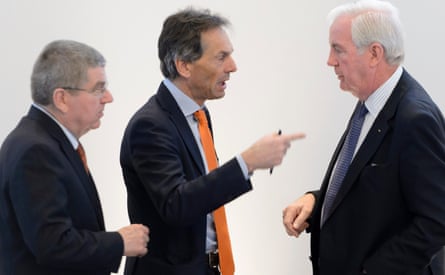
Although the IOC cleared some Russian athletes to compete at the 2016 Rio Olympics, Reedie refused to let the matter drop – and three years later Wada ruled that the Russian Federation should be banned from all international competition, although some of its athletes were able to take part in the Olympics under a neutral flag.
Reedie remained utterly intransigent on the issue of drugs: for him it was not a matter of adhering to lofty Corinthian values, but a simple case of tackling cheats and showing that they would not be allowed to prosper.
That strong stance arose partly because Reedie, despite his successes as an administrator, was a sportsman at heart, having been a leading badminton player in his younger days. He began his career in sports politics with the International Badminton Federation, of which he became president, and made an initial name for himself by successfully campaigning for the sport to be included in the Olympics.
Born in Stirling in central Scotland, Craig was the son of Robert, an Inland Revenue surveyor, and his wife, Anne (nee Smith). He took up badminton at the age of 10, first playing the game in a church hall, while he also played golf with his father at Dunblane GC and was good enough at rugby to appear for the first XV at Stirling high school.
At Glasgow University he played for the badminton team while studying history and law, and it was on a visit to Belfast for a match against Queens University in 1962 that he met Rosemary Biggart, a medical student who was playing for the Queens hockey XI. Five years later they married, and they went on to have two children, Colin and Catriona.
After university Reedie became a partner in a Scottish company offering financial advice, and remained a financial consultant, based in Glasgow, for the rest of his working life.
He became secretary of the Scottish Badminton Union in 1966, and later its president, serving until 1981 while also operating as a council member, chair and president of the International Badminton Federation (now the Badminton World Federation) from 1970 to 1984.
After guiding the Federation through a difficult period when warring factions threatened to split the organisation, his concerted lobbying for badminton’s inclusion in the Olympics bore fruit when in 1985 the IOC decided to allow its entry into the 1992 Games. He also helped to usher professionalism into badminton by allowing players to retain prize money and introducing the World Grand Prix circuit, now the BWF World Tour.
It was Reedie’s administrative work in badminton that led him to be appointed a council member and treasurer of the General Association of International Sports Federations (1984–92), which in turn set him up for the chairmanship of the BOA. After contributing to Manchester’s unsuccessful bid for the 2000 Olympics he joined the London Organising Committee for the 2012 Games. All of his sports administration posts were fulfilled on a voluntary unpaid basis.
Meeting Reedie was an experience. Tough, shrewd and formidably well informed, he knew his own mind and was always ready to voice an opinion. Such qualities might have rendered him boorish and intimidating, but the truth was very different. He was witty, charming and unfailingly helpful to anyone who sought his advice.
Made CBE in 1999, he was knighted in 2006 and elevated to knight grand cross in 2018. In 2014 Scotland’s refurbished national badminton hub in Glasgow was renamed the Sir Craig Reedie Badminton Centre in his honour.
He devoted much of his leisure time to honing his golf game. A single figure handicapper, he was a fiercely competitive player and a member of the Royal and Ancient Club of St Andrews. After the successful London bid he took huge pride in being asked to feature in the pre-2012 Games torch relay, carrying the Olympic flame past the Old Course at St Andrews, where he had spent so many hours on the turf.
He is survived by his wife and two children.