.png)
 2 hours ago
3
2 hours ago
3
NJ Convery

 BBC
BBC
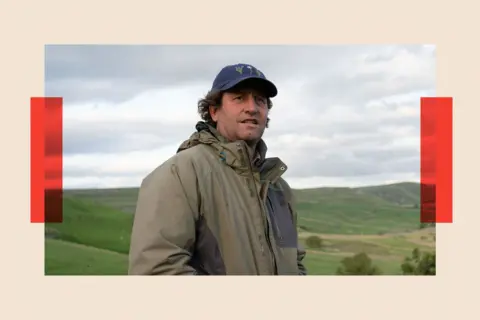
For four generations, Neil Heseltine's family have worked on Hill Top Farm, perched on the hillside of Malhamdale amid the dramatic landscape of the Yorkshire Dales. And for most of that time, sheep were the mainstay of the business.
But, Neil says, over the past 20 years there has been "a complete turnaround" and he has shifted away from sheep farming to stay afloat. In that time the 1,500-acre farm has gone from a peak of over 800 lambing sheep to just 45 this spring.
"I dread to think where the farm would have been financially had we not started to make those changes," he tells me. "I either continued along the sheep-farming route because of sentimentality or made bold decisions."
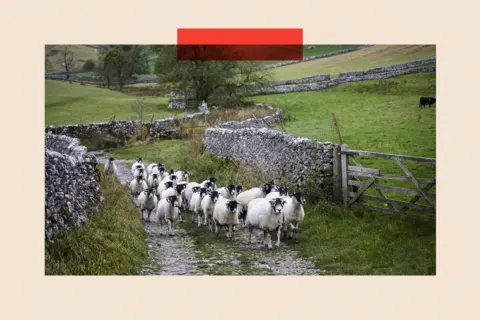
While most upland farmers still keep sheep on their land, the changes here have been mirrored across not just the Dales but the entire British farming industry. The shepherd's life has never been an easy one, but for many it's getting tougher and more difficult than ever to make a profit.
 Gail Caddy
Neil Heseltine's family have worked on Hill Top Farm for four generations
The average British farmer is 60 years old, according to the National Farmers' Union (NFU), and prices for everything from fuel to fodder have risen hugely for them in recent years. Meanwhile, many farmers are facing significantly reduced income from subsidies and there are worries that recent trade deals will mean increased competition from overseas.
The UK's recent trade deals with New Zealand and Australia, struck since Brexit, eliminate tariffs and give producers in both countries large quotas on the amount of lamb they can export into Britain.
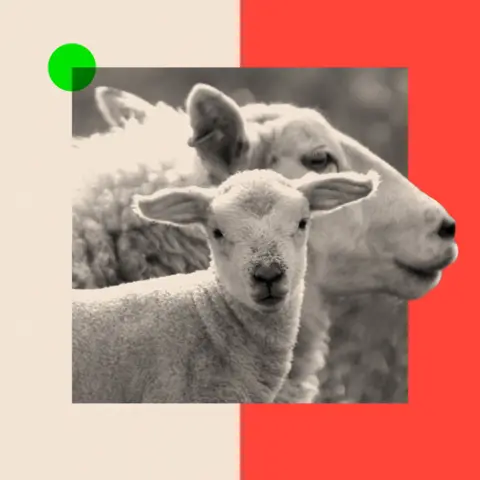
There are now 14.7 million breeding ewes in the UK - the lowest figure in living memory according to Phil Stocker, chief executive of the National Sheep Association.
Overall the national flock is also falling, down to 30.4 million sheep in 2025 - numbers last seen in the mid-20th Century, when the UK population was smaller and thus the potential market for British lamb and mutton much lower.
And over the last 50 years there has been a significant fall in lamb and mutton consumption across Britain according to Becky Smith, a senior analyst at the Agriculture and Horticulture Development Board (AHDB), which represents farmers.
In 1980 the average UK household purchased 128g of sheep meat (lamb and mutton) per person, per week. In 2024 that same measure was down to 23g per person, per week.
Sheep farming has shaped the image many of us have when we picture somewhere like the Dales with drystone walls to keep livestock enclosed and green, rolling hills kept short by seasonal grazing.
But any desire to protect the heritage of one of the UK's oldest agricultural industries is rubbing up against not just a diminishing appetite for sheep meat but also the question of whether some of our uplands might be better used to promote nature recovery and biodiversity.
All this raises the question of whether we have passed "peak sheep" in the UK - and, in turn, what that might mean for consumers. Will my children still be eating British lamb for their Sunday roast or in their baltis and bhunas in 25 years time?
And, what will happen to some of our most revered and beloved landscapes like the Lake District, Yorkshire Dales and Welsh mountains, and the people who live and work there?
Why sheep farming has become so tough
At Craven Cattle Marts on the outskirts of Skipton, North Yorkshire, the auction ring is buzzing as farmers from across the Yorkshire Dales and Pennine Moors come to buy and sell livestock.
To an outsider, business might look brisk - but general manager Jeremy Eaton says it's nowhere near as busy as when he started in the industry 47 years ago.
"We'd have some sales at this market where we'd regularly be selling 19,000 store lambs," he says. "Now we're fortunate if we get to 8,000 or 9,000."
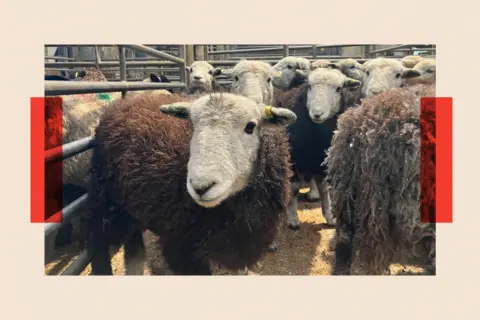
At Craven Cattle Marts, farmers come from across the Yorkshire Dales and Pennine Moors to buy and sell livestock
People who work sheep know that it's some of the hardest farming in Britain. A former shepherd once told me that sheep are only ever trying to do one of three things: "Escape, or die, or escape and then immediately die."
Globally, lamb consumption is expected to grow by 15% between now and 2032, according to a report from the Organisation for Economic Co-operation and Development and the Food and Agriculture Organization.
But changing tastes in the UK mean mutton, made from mature sheep, is no longer eaten in the same volume it was by previous generations and lamb has seemingly gone from a weekly staple to a meat more often eaten on special occasions, with "white meat" like chicken being increasingly chosen over lamb and beef.
The drop in the national flock has actually led to robust growth in the price paid for lamb according to Becky Smith from the AHDB, with the sheep price hitting record highs in 2024.
But despite the higher price for their sheep, upland farmers with tight margins feel the pinch more than many when diesel and oil costs go up. And on top of that, the cost of feeding sheep has also rocketed - the average cost of a bale of hay is £155 a tonne this spring compared to £75 a tonne this time last year.
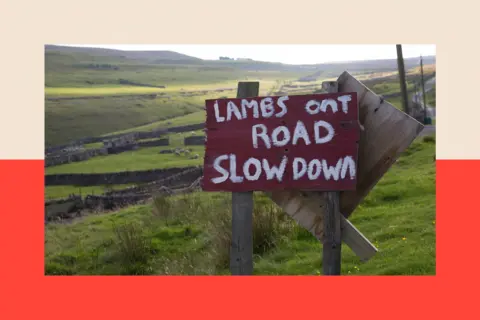 Corbis via Getty Images
There are now 14.7 million breeding ewes in the UK, according to the National Sheep Association
Farmers and groups such as Compassion in World Farming have also raised concerns that new trade deals could undermine British agriculture because UK farms must meet high welfare standards that may not be not required in several partner countries.
Extremely tight margins mean growing numbers of younger people can't see a future in farming.
This is immediately apparent as you wander around Craven Cattle Marts. "You can see here today, most of the generation of farmers are over 60," says Hayley Baines, a 39-year-old sheep farmer from Gisburn in the Ribble Valley. "There [aren't] many young ones because there's better options."
And some welcome the decline in sheep farming.
"Fewer sheep means less suffering […] a sheep's life in the wool and mutton industries belies our reputation as a nation of animal lovers," says Mimi Bekhechi, senior vice president at the UK's People for the Ethical Treatment of Animals (Peta).
The UK's Climate Change Committee has also previously advised the government to encourage people to cut the amount of meat and dairy they consume, to combat climate change.
How changing subsidies have made an impact
Matthew Cole of the NFU says a further issue has been the move - especially post-Brexit - away from farmers receiving paid subsidies from the EU either for the volume of livestock they have or amount of land they farm.
In their place, successive UK governments have introduced new schemes with a stronger focus on farming for nature - meaning many farmers are facing significantly reduced subsidy income.
For example the government's Sustainable Farming Incentive scheme, which was updated last month, includes further incentives for farmers to graze moorland with cattle and ponies instead of sheep as it "contributes positively to biodiversity". Cattle, for example, do not graze as low to the ground as sheep, allowing smaller plants to flower.
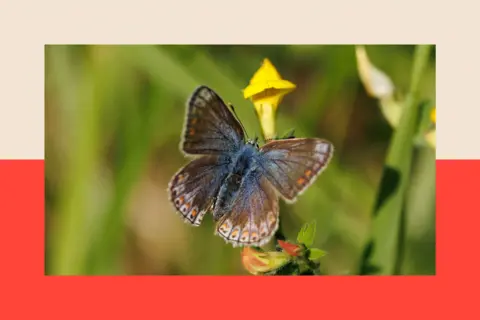 Getty Images
UK governments have introduced new schemes with a stronger focus on farming for nature
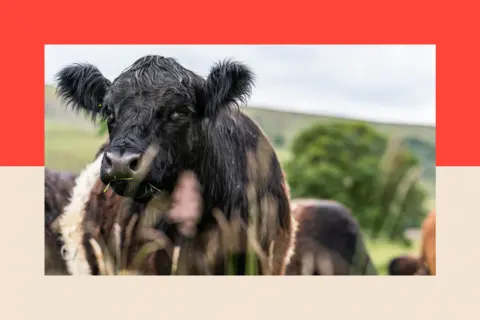
Neil Heseltine of Hill Top Farm now has 300 cattle who graze outside all year round, a shift that he says has made the farm more profitable and dramatically reduced the hours he has to put into it.
But while these new subsidy schemes are welcomed in principle by many farmers, some find the funding available falls far short of the levels provided under earlier support systems.
"Going forward, do I see a future? I'm not sure where we're going with it," says James Foster, who has been farming beef and sheep on the Bolton Abbey Estate for 30 years. "I do believe the government don't want us, but people have to eat and we just have to adapt with that."
Defra says that an average of £2.3bn a year is being invested through its farming schemes and insists it is protecting farmers in trade deals and also making supply chains fairer.
Sheep were first domesticated approximately 10,500 years ago in the Middle East, and were eventually brought to British shores by Neolithic farmers some time around 4000BC. Sheep became such an important part of the landscape that by medieval times the phrase, "half the wealth of England rides on the back of the sheep" became familiar.
In 2004, sheep were removed from the limestone landscapes of Ingleborough, the second-highest mountain in the Yorkshire Dales and replaced with roaming native cattle breeds, who are less intensive grazers as part of the Wild Ingleborough project.
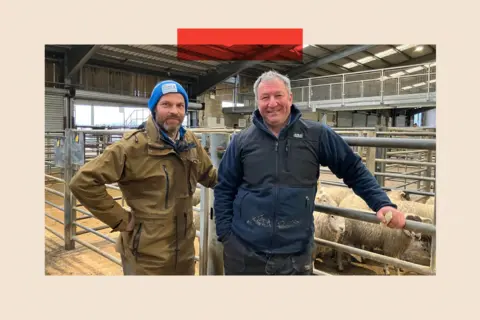
"Going forward, do I see a future? I'm not sure where we're going with it," says James Foster (right)
Two new scientific studies published in the academic journal Ecological Solutions and Evidence, show the huge impact that change has had for nature across the 1500-hectare landscape, with plant diversity increased by over 40% and a five-fold increase in the number of butterflies in the absence of sheep.
Robyn Wrigley, from the University of Leeds School of Earth and Environment, co-authored both studies and says the research provides long-term evidence of how different grazing impacts biodiversity and can help inform discussions about restoration.
 Gail Caddy
Neil Heseltine of Hill Top Farm now has 300 cattle who graze outside all year round
These changes, however, are not ones that all farmers welcome. Some I spoke to look at the landscape and see only lost livestock pasture and question how their way of life and livelihoods fit into such a future.
But David Stanners, Uplands North Group Chair at the NFU, says it's possible for the rewilding lobby and the farmers to find common ground.
"To understand better what Natural England wants from the uplands, what wildlife trusts want, they need to understand what we (the farmers) want," he says. "There needs to be compromise and respect on all sides."
How Muslim communities could make a difference
But there is a ray of sunshine for the industry, according to Phil Stocker from the National Sheep Association. He believes the domestic market for sheep meat is going to keep driving forward, in large part thanks to demand from the increasing number of Muslim people in the UK.
AHDB statistics suggest that 80% of halal consumers eat lamb on a weekly basis and 64% eat mutton weekly. By contrast, only 6% of the general UK population eats lamb each week.
According to the AHDB, while Muslims make up around 6.5% of the UK population they account for 30% of lamb sales annually. Lamb is often Muslim consumers' meat of choice for family occasions and festivals like Ramadan and Eid, while mutton is a popular ingredient in curries and stews.
Because of this, Stocker says he doesn't envisage the total demise of the industry. But right now, he adds, "we're surviving by people's interest and by market demand almost in spite of the work that the policy makers and others are doing on agricultural and land management policy".
 Bloomberg via Getty Images
Most upland farmers still keep sheep on their land
A worst-case scenario for farmers and consumers would see British lamb become even more expensive and less common on our shelves in favour of ever more sheep meat imported from major suppliers like New Zealand and Australia.
The AHDB project sheep are likely to decrease in number across many farms but take a walk in the Lake District or Welsh mountains in another 25 years and you will likely still see sheep dotting the hillsides.
Farmers and conservationists alike told me they need to see clear plans for what policymakers want from the uplands for the next generation. Their hope is that, as we move into the second quarter of the 21st Century, traditional sheep farmers and rewilders alike find their place in the nation's cherished uplands.
Top picture credit: Universal Images Group via Getty Images

BBC InDepth is the home on the website and app for the best analysis, with fresh perspectives that challenge assumptions and deep reporting on the biggest issues of the day. Emma Barnett and John Simpson bring their pick of the most thought-provoking deep reads and analysis, every Saturday. Sign up for the newsletter here