.png)
 1 month ago
27
1 month ago
27
It was a chance encounter that would ultimately help change countless lives for the better but, at the time, all Shaka Hislop wanted to do was escape.
As the then Newcastle goalkeeper stood on a petrol station forecourt, filling his car on a dark November night in 1995 his overriding emotions were outrage and fear. Hislop was heading home after an evening out with his wife and young daughter when, with the fuel gauge edging towards the red zone, he pulled into a garage just across the road from St James’ Park.
“A group of youths were walking down the hill towards me and started shouting abuse,” he says. “Then one recognised me and they began chanting my name and asking for autographs. I drove away as quickly as I could.
“It was an incident that set me back. I was anxious to protect my wife and daughter and, as a black man, I’d been disrespected. But then it hit me: I’d been taught about the power of individuals – and the platform footballers have.”
That realisation explains why, two months later, Hislop and his teammate John Beresford, key components of Kevin Keegan’s then Premier League-topping team, headed into Newcastle’s northern suburbs to discuss racism with pupils at Gosforth High School. It was the first event organised by Show Racism the Red Card, the leading educational charity founded by Hislop’s friend Ged Grebby.
This month SRTRC celebrates its 30th birthday. It runs anti-racism workshops in schools, colleges, workplaces and football stadiums across the UK but owes its origins to a conversation between Grebby, the chief executive, and Hislop after that petrol station epiphany.
“From 50 yards away I was a black man seen as deserving the most vile, frightening and dehumanising abuse but from 100ft I was a footballer worthy of adulation,” he says. “That sums up a lot of my wider experiences in life. When we see people who don’t look like us on the outside we see differences but, when we get to know them, we realise there are more similarities than differences. Ged felt that the duality of who I was in the north-east offered us a chance to create a foundation and start going into classrooms.”
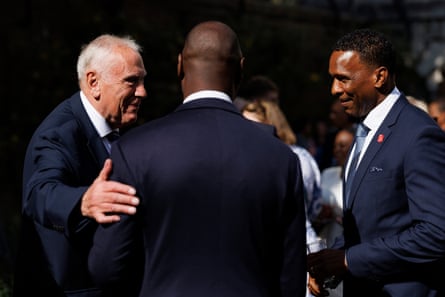
His relationship with Grebby had begun shortly after Hislop arrived in Newcastle in the summer of 1995. Grebby, working for a European anti-racism charity, wrote to Hislop asking whether he was interesting in assisting a north-east campaign. Hislop, who had grown up in Trinidad and Tobago, initially sent a £50 donation but, after the incident at the garage, the pair really bonded.
With the support of Sunderland’s Gary Bennett and Middlesbrough’s Curtis Fleming, SRTRC was born and Hislop enlisted a series of dressing room volunteers to tour local schools. Beresford was the first to put his hand up and the full-back’s candour proved invaluable.
“John spoke about going to Bramall Lane to watch Sheffield United as a boy and joining in with the crowd when they shouted racial abuse because he didn’t know any better,” says Hislop. “Then, as a young Manchester City player, he became good friends with Darren Beckford and they roomed together. But it was only when John used a racial slur in casual conversation with Beckford and Darren sat him down and explained how upsetting it was, that he fully understood how incredibly powerful language can be.
“John was brilliant; he really connected with the schoolkids and used his experiences to educate them in a way they could identify with.”
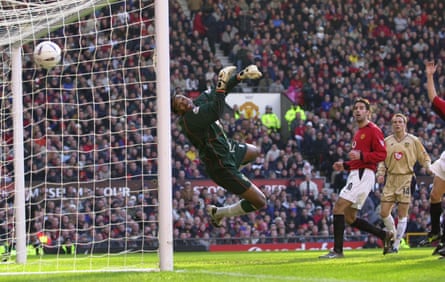
Beresford remains a key supporter of SRTRC and talks openly about his watershed experiences. He and Hislop – who lives in the United States, near Boston – had hoped to catch up at a reunion, scheduled for this year, of the Newcastle squad that agonisingly lost the 1995-96 title race to Manchester United. It has been postponed while Keegan receives treatment for cancer.
The disease has also been an unwelcome visitor in Hislop’s life. Although the 56-year-old appears a picture of health and remains a regular, highly regarded football analyst for the broadcaster ESPN, he has recently completed an eight-week course of radiation therapy to treat a “fairly aggressive” form of prostate cancer.
Hislop, who underwent a radical prostatectomy 13 months ago, says he is “doing very well”. He also emphasises that his life was saved by the PSA screening that is routine for men over 50 in the United States but is not officially recommended in the UK.
The conversation down the line from the US turns back to Keegan. “Kevin was so supportive of Show Racism the Red Card,” he says. “He told me to go straight to him if I met any problems.”
In the 1980s, Keegan, then a Newcastle player, had been horrified to see the National Front distributing pamphlets from the precincts of St James’ Park. “I learned that Kevin had gone into Newcastle’s boardroom and said that if the National Front wasn’t moved, he would leave the club,” he says.
Hislop, who also played for Reading, West Ham, Portsmouth, Dallas and Trinidad and Tobago, was – like Keegan – far from a stereotypical footballer. He entered Newcastle’s dressing room as an engineering graduate from Howard University in Washington DC with attendant experience as a Nasa intern and found rubbing shoulders with Faustino Asprilla and co eye-opening.
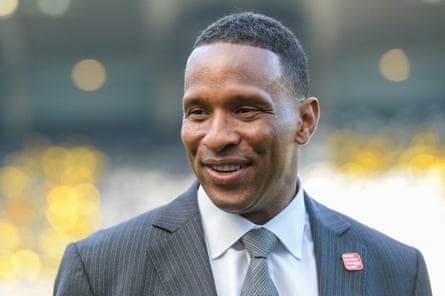
“I’ve got two degrees but I couldn’t have had a better education than the one I received at Newcastle,” he says. “I was with players from London, Belgium, Colombia, Greece, Georgia, Newcastle and Sunderland and they taught me so much.”
Those teammates would learn why Hislop, SRTRC’s honorary president, did not want to join them in accepting a squad invitation to a restaurant where the goalkeeper and his wife had been refused an empty table. Hislop says he is “incredibly proud” that, partly thanks to Grebby’s efforts, the landscape in the north-east has changed so much for the better. But as the abhorrent abuse the Newcastle midfielder Joe Willock recently received on social media highlights, the charity remains as necessary as ever.
That saddens Hislop – as does “the hateful rhetoric” dominating much political discourse in the US – but his eyes remain fixed on a brighter, if still distant, horizon.
“I was originally an idealist: I wanted to deliver my kids a world without racism,” he says. “But I now recognise this is a marathon. Racism has been here for hundreds of years and it might take another 100 years to dismantle but we’ll get there.”