.png)
 8 hours ago
4
8 hours ago
4
Mark SavageMusic Correspondent

 Mass Appeal
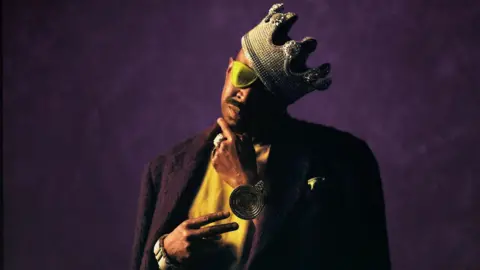
Slick Rick's 1985 song La-Di-da-Di is the most sampled hip-hop track of all time
If hip-hop is the folk music of the post-industrial age, then Slick Rick is it's Woody Guthrie.
Born in London and raised in the Bronx, the rapper essentially invented the smooth-talking storytelling style that has inspired everyone from De La Soul and Digital Underground to Snoop Dogg and Kendrick Lamar.
His witty, thoughtful verses broadened the scope of hip-hop with stories about treating your mother with respect and catching your girlfriend cheating with the postman, alongside hard-hitting lyrics about social deprivation and immigration.
Eminem described himself as "a product of Slick Rick", Jay-Z likened the star to Matisse, and Questlove called his voice "the most beautiful thing to happen to hip-hop culture". Amy Winehouse immortalised him in the song Me and Mr Jones.
On Thursday, he will receive a lifetime achievement prize at the Mobo Awards after performing a career-spanning set with Estelle.
Speaking from his home in New York, Slick Rick is remarkably humble about the honour.
"That feels great, the appreciation," he says. "Thank you, England."
 Getty Images
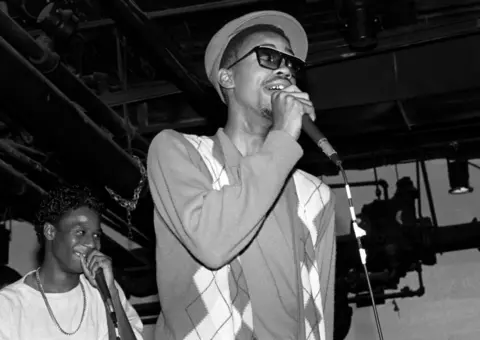
The musician wrote some of the most quoted lyrics in hip-hop
Born to Jamaican parents in Mitcham, south London, in 1965, Ricky Walters was blinded in one eye by broken glass as an infant and took to wearing an eye patch.
He emigrated with his family to the Bronx in 1976, when he was 11 years old. But New York was a different city then.
Gripped by a financial crisis, drugs and crime were rife. The infrastructure was crumbling and travelling alone was unwise.
"If you were poor and coming up, you were pretty much [stuck]," says Rick.
His family moved in with his grandmother, squeezing into a cramped apartment full of aunts, uncles and cousins.
"It reminds me of the beginning of Willy Wonka and the Chocolate Factory, where he has two sets of grandparents all in one bed," he says.
"We still had fun but when you look back, you say, 'Wow, that was a lot of us on one mattress.'"
By chance, however, he'd ended up in the birthplace of hip-hop, right at the moment of conception.
"People would bring out sound systems and set them up in the parks," he recalls.
"It drew the youth because it made you dance and have fun. I was hooked instantly."
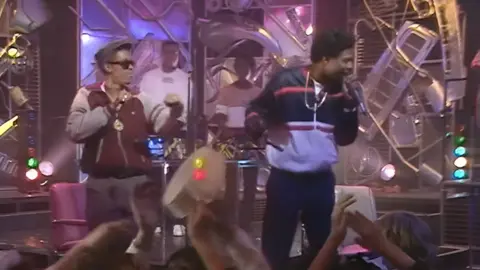
Slick Rick (right) and Doug E Fresh brought the sound of the Bronx to British TV screens in 1986
Attending LaGuardia High School of Music & Art, he became friends with future rapper Dana Dane and they started writing their own rhymes.
"We didn't have instruments or nothing. We just banged on the desk. And every other day, we would write a rap to try and impress each other."
Performing as the Kangol Crew, Rick played up his English heritage - wearing regal capes and ostentatious jewellery, while referring to himself as Rick the Ruler or Richard of Nottingham.
His unique delivery – conversational and charismatic, combining Jamaican intonation with witty Britishisms and elevated vocabulary – was already in place. It's a style he developed in the hustle and bustle of his busy Bronx home.
"As a kid, I'd tell stories and jokes in front of my uncles and aunts and see the effect on them. I was just having fun, I don't know how to explain any better than that."
That flow ultimately earned him the name Slick Rick, bestowed by legendary hip-hop producer Doug E Fresh, who spotted him at an open mic night and invited him to join his Get Fresh Crew.
In 1985, they made history with the songs The Show and La-Di-da-Di, the "greatest two-sided single since Hound Dog/Love Me Tender", as critic Peter Shapiro later wrote in The Rough Guide to Hip-Hop.
Rick downplays that, describing the songs simply as the sound of two friends "playing around" and "having fun".
The Show was created on the fly, based around a drum loop and the theme song to kids' TV show Inspector Gadget.
A global hit, the single made the UK Top 10 and even got the musicians onto Top of the Pops – marking the first time a DJ with turntables appeared on the BBC chart show.
La-Di-da-Di, meanwhile, was Rick's calling card at rap battles, an endlessly quotable story about getting ready for a day out (he makes having a bubble bath sound cool) before being accosted by an old flame and her mother.
It's now the most sampled hip-hop song of all time, appearing on more than 1,000 different tracks. In 1993, Snoop Dogg covered it in its entirety on his landmark album Doggystyle.
"Snoop's cover was definitely the best," says Rick. "That was an honour."
Allow Google YouTube content?
This article contains content provided by
Google YouTube
. We ask for your permission before anything is loaded, as they may be using cookies and other technologies. You may want to read
and
before accepting. To view this content choose ‘accept and continue’.
The BBC is not responsible for the content of external sites. Google YouTube content may contain adverts.
After signing to Def Jam Records, the rapper launched his own solo career with the platinum-selling The Great Adventures of Slick Rick.
It further evidenced the star's ability to spin a narrative – especially on Children's Story, a compellingly dark account of seeing a teenage friend shot dead by cops.
Unlike many freestyle rap hits, Children's Story was planned and written with a deliberate story arc.
"I guess it's trying to be dramatic, to give it like an adventure feel," says Rick. "He was running down street, the police was chasing him, he jumped into a stolen car, he hit a tree.
"It gives it a theatricality. You can still see it, even though there's no visual."
By contrast, Teenage Love tackled affairs of the heart - an unusual move in hip-hop, where only a few rappers (LL Cool J, The Roots, Method Man) have scored hits with outright love songs.
"I guess it depends on the individual, whether he wants to express himself in that manner," says Rick.
"It's a broadening your horizons type of a thing. We don't have to be one dimensional.
"It's good to express your childhood, when you was in high school, the first time you ever fell in love, your first heartbreak and stuff like that, and write it down like a diary."
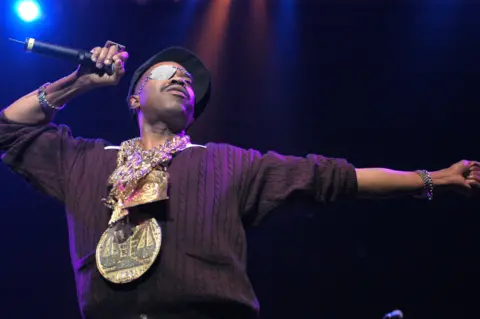 Getty Images
The musician will perform some of his biggest hits on stage at the Mobo Awards on Thursday night
However, after the success of The Great Adventures, the musician was arrested for shooting at his cousin - a former bodyguard who had threatened the family after trying to extort money.
Rick pled guilty to a charge of attempted murder and spent five years in prison (he was given a full pardon in 2008).
During that time, he released two albums recorded while on bail or day release, but he generally glosses over them as unsatisfactory when discussing his career.
That's a shame, as they contain some gems – not least All Alone, the heart-rending story of a young single mother whose life "never goes the way she may have wanted it to".
Full of empathy, it's the sort of song that led to Rick being called the "gold standard" for hip-hop lyricists. It's a description he wears with pride.
"I think we took novels to the next level, we took writing to the next level, because we're talking to people's imagination visually," he says.
Freed from prison in 1997, he quickly got to work on his comeback album, The Art of Storytelling – featuring Nas, Snoop Dogg, Redman and OutKast.
But his legal troubles weren't over.
In 2002, he was seized by immigration officers in Miami. Threatened with deportation, he was held in prison for 17 months, with everyone from Will Smith to Rev Jesse Jackson petitioning for his release.
Those experiences fed into the song We're Not Losing – a standout track on last year's Victory Album – which takes aim at politicians who blame immigrants for America's woes.
"That's my way of venting about the errors we see in leadership," he says.
"I feel like the world needs a moral compass, you know? A motherly [approach to] law and order, that shows compassion when she needs to, and sternness when she needs to."
These days, Rick is a naturalised US citizen – but he's proud to be coming back to his birthplace for the Mobos, and he's confident the lifetime achievement award marks the start of a new chapter, rather than an epilogue.
So what keeps him going, almost 50 years after he stepped up to the mic?
"You know, the main thing is just that music enriches your existence," he muses.
"Then you bring it to the marketplace and enrich others. But it's really just about enriching your own life."
The Mobo Awards take place on Thursday, with highlights shown on BBC One on Friday at 23.35 GMT.