.png)
 6 hours ago
4
6 hours ago
4
Chris MasonPolitical editor

 Getty Images
Some critics of the tech giants are already calling this social media's "big tobacco moment."
The verdict of a jury in Los Angeles, that Google and Meta intentionally built addictive social media platforms is being seen as a landmark, as societies around the world decide how, or whether, to regulate social media further and consider banning children from using it.
When this began earlier this month, ministers set out what they see as the essence of the challenge they - and we as a society - face.
"Social media use among children and adolescents is almost universal. The proportion of children with social media profiles has increased significantly in the last 5 years. We must ensure children can engage with the online world safely," they wrote.
The key question, clearly, is how. The first question the consultation poses and seeks to address is the idea of "setting a minimum age for children to access social media" - and were this to be seen as a good idea, "what age would be right".
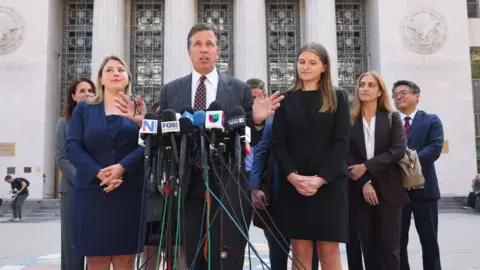 EPA
EPA
Mark Lanier, the plaintiff's lawyer in the US case, speaks to media outside the Los Angeles Superior Court, after a jury found Meta and YouTube liable
Within hours of the verdict in Los Angeles, the government said in a statement that its consultation was looking at banning social media for under 16s as well as how it might tackle "addictive design features."
It concludes: "When it comes to children's safety, nothing is off the table and we will set out our plans in the summer."
The consultation finishes towards the end of May and I'm told the government will respond before the end of July.
The vibe I pick up is ministers feel this court case creates space for ministers to feel more confident in making an argument that tighter restrictions, particularly for children, are appropriate.
But hang on a minute. Right now at least, it is opposition politicians, rather than the government, making the running on pushing for a ban for under 16s.
During a debate on the Children's Wellbeing and Schools Bill on Wednesday night, peers voted by 266 to 141, a majority of 125 votes, to support changes brought forward by a Conservative former schools minister, Lord Nash.
It is the second time the Lords has defeated the government on the issue.
Earlier this month MPs voted against the proposed change but peers insisted on the amendment which would give ministers a year to decide which social media platforms should be unavailable to under-16s.
The vote means there is now a stand off over the issue.
Shadow education secretary Laura Trott said: "Peers have once again done the right thing and backed a ban on social media for under 16s by a huge margin. It is disappointing that Labour were the only party not to support it. Labour have once again chosen delay over action, with yet another consultation.
"This falls well short of the scale of the problem and leaves the door open to weak and ineffective measures."
The prime minister's broad views on the issue are clear.
He wrote on Substack last month that social media "has become something that is quietly harming our children" and he wants "crack down on the addictive elements… the never ending scrolling, that keeps are children hooked on their screens for hours, and stop kids getting around age limits."
But how far will he be willing to go? How far is too far and how far is not far enough?