.png)
 10 hours ago
3
10 hours ago
3
Régis Le Bris (Sunderland)
Promoted through the playoffs, Sunderland began the season as white-hot favourites to go straight back down but never once flirted with relegation and a win over Chelsea on the final day secured Europa League qualification. Their success was rooted in an inspired summer recruitment drive that prompted Le Bris to ruthlessly phase out most of his promotion-winning squad and replace them with a winning mix of raw young talent and seasoned leadership. Tactically flexible and a study in touchline equanimity, the 50-year-old Breton is an expert in tailoring his team’s approach to their opposition but tends to favour lightning-fast transitions before getting the ball wide in matches against teams he expects to beat. Victories at home and away over Newcastle mean his legendary status on Wearside is already cemented and the concern now for Sunderland fans is that executives at more high-profile clubs will have taken note of the stellar job he has done in his two seasons at the Stadium of Light.
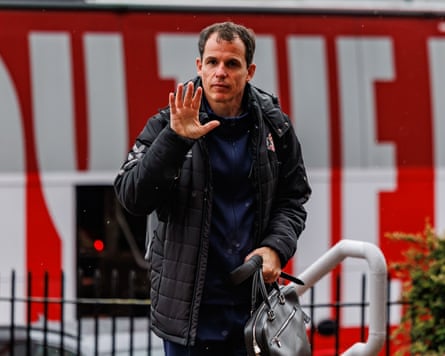
Unai Emery (Aston Villa)
If the Premier League had waited until after the title was decided to release its six-man shortlist for manager of the year, one suspects Emery would have featured instead of Pep Guardiola. Despite what seems like an obvious and understandable exercise in arse-covering, the absence of the Aston Villa manager still seems extraordinary. After a dismal start in which his team took only three points from 15 available, any murmurings of disquiet were silenced by a run of 12 wins in 13 top-flight games. The squad management and tactical nous required to orchestrate such an impressive mid-season turnaround cannot be overstated, not least because Emery was hamstrung by profitability and sustainability rules, masterminding a successful Europa League campaign and coping with a midfield injury crisis. Transforming a season that began so woefully into one of the most successful in the club’s history is a remarkable feat and Emery’s name should feature prominently in any conversation about the top flight’s most impressive coach.

Mikel Arteta (Arsenal)
Having begun the season with a squad widely recognised as having the top tier’s greatest strength in depth, most doubts about Arsenal’s ability to win the league centred around the team’s questionable mental fortitude after three consecutive second-place finishes. Going into April they were four points clear and the wobble their fans dreaded duly arrived in the form of back-to-back defeats at the hands of Bournemouth and Manchester City. With their supporters the subject of much online mockery and his many critics rubbing their hands together with glee, Arteta made a few tactical tweaks and galvanised his squad and the Emirates crowd before a series of often unconvincing wins that finally won them the league. While Arsenal’s often pragmatic belt-and-braces approach is not for everyone, this season it has been undeniably effective. With a Champions League final to come and so much uncertainty surrounding all their traditional domestic title rivals, Arteta may well have laid the foundations for a lengthy period of Arsenal dominance at exactly the right time.
Keith Andrews (Brentford)
It is inconceivable that Andrews began his rookie season as a head coach oblivious to murmurings from outside the Brentford bubble that he was widely expected to fail. The doubts were understandable, given the club had lost their iconic head coach, Thomas Frank, and several first-team staples, all of whom have since significantly enhanced their bank balances if not necessarily their CVs. Evolution, rather than revolution, was the likable Irishman’s modus operandi and while Brentford remain a force to be reckoned with when it comes to set pieces, he has made significant adaptations to the parameters of the tactical framework that served his predecessor so well. The scalps of Aston Villa, Liverpool and Manchester United featured among the more high-profile taken during a season in which Brentford defied most expectation by knocking on the door of European qualification. For a club owned by Matthew Benham, a man who made his money from the world of high-stakes betting, the appointment of Andrews is a gamble that has seriously paid off.
Andoni Iraola (Bournemouth)
Despite beginning the campaign hamstrung by a summer exodus that included – but was not restricted to – his goalkeeper and three of his first-choice back four from last season, an unfazed Iraola finished it by securing a historic maiden foray into Europe for Bournemouth with a club record haul of 57 top-flight points. Among the most notable results delivered by his side’s high-energy brand of controlled chaos: victory over the title-winners, Arsenal, and last week’s draw with Manchester City that confirmed his childhood friend Arteta’s side as title winners. Indeed, were it not for Bournemouth’s 18 draws, 10 in matches they led, they might have finished significantly closer to the champions. In terms of personnel, Iraola was further inconvenienced by the departure of Antoine Semenyo in January but in Eli Junior Kroupi and Rayan he has another couple of unpolished but valuable gems. Having overseen his final game in charge, Iraola’s future remains up in the air but that of the club he leaves behind could scarcely look brighter.