.png)
 1 month ago
38
1 month ago
38
Craig WilliamsBBC Scotland

 Getty Images
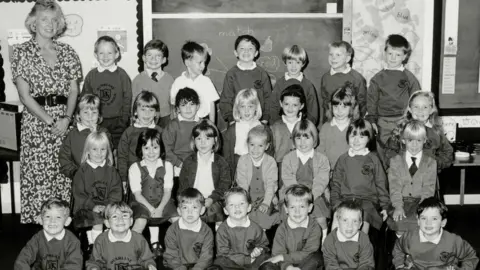
Teacher Gwen Mayor and her class at Dunblane Primary School
Even after 30 years, the facts of the Dunblane massacre are hard to comprehend.
On the morning of Wednesday 13 March 1996, a gunman entered the gymnasium of the town's primary school and, over the course of less than four minutes, murdered 16 children and their teacher.
Another 12 children and three adults were either shot or injured in the assault. All but two of the children attacked that day were aged just five and six.
The horror of the murders was matched by disbelief. How could this have happened in the UK? How could it happen in such a small, quiet place?
And how had a man been able to walk into a school armed with four handguns and more than 700 rounds of ammunition to commit mass murder?
What happened in Dunblane that morning changed thousands of lives. It also changed the country forever and, in the minds of those who campaigned afterwards, has prevented anything like it from happening again.
As the 30th anniversary of that day approaches, a BBC Scotland documentary - Dunblane: How Britain Banned Handguns - looks back at what happened and speaks to those affected by the murders.
On the day of the shootings Thomas Hamilton, a 43-year-old Stirling man with a troubling reputation, arrived at the school a little after 09:30.
He went directly to the gym, where Gwen Mayor's primary one class were about to start their PE lesson.
 IWC Media
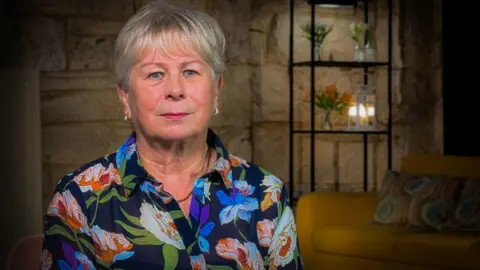
Eileen Harrild was the school's PE teacher and was shot in the attack
Eileen Harrild was the PE teacher.
"I was aware of the gym door being banged open and a man came in, dressed in combat gear with earmuffs on, and immediately started to shoot," she says.
"And he targeted the adults first. He shot me first and then he turned his gun on the two other adults in the gym and then started on the children.
"The shooting was continuous and rapid, and he had intent in his eyes. After about three or four minutes there was silence. Just silence."
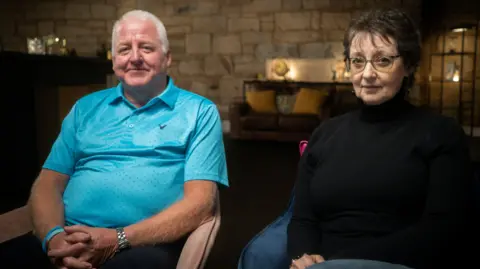
Kenny and Pam Ross's five-year-old daughter Joanna was in the class. Her parents describe her as a "lively wee girl", "quite a personality" and a "daddy's girl".
Mick North's daughter Sophie was also in the gym. Mick's wife, Barbara, had died when Sophie was three.
"I was a single parent, bringing up my five-year old daughter. Sophie had only recently started at the local primary school and we were doing well. We had taken our time to get over her mum's death, but we were doing extremely well," he says.
Both girls were among the 16 children shot dead with Gwen Mayor that morning.
 Mirrorpix via Getty Images
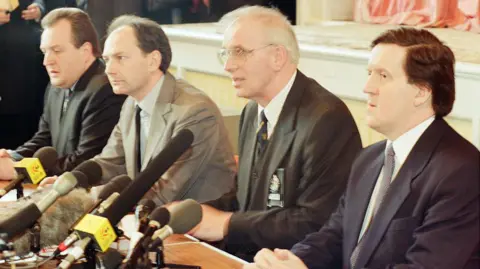
Michael Forsyth (second from left) and George Robertson (far right) were in Dunblane within hours of the shootings
 IWC Media
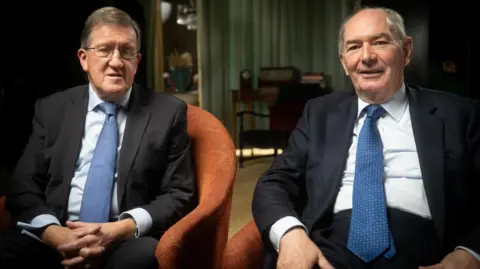
Lord Robertson and Lord Forsyth have never been able to forget what they saw in Dunblane in March 1996
As the news broke and the media descended on Dunblane, word spread to London, and Scotland's two most senior politicians.
Michael Forsyth was Scottish secretary in John Major's Conservative government. George Robertson was his opposite number for Labour.
Both had personal connections to Dunblane. Forsyth was the local MP, while Robertson lived in the town and his children had been pupils at the primary school.
It would later turn out that both had encountered the killer. Hamilton had written to Forsyth on several occasions and Robertson had withdrawn his sons from one of Hamilton's boys' clubs, concerned by the way it was being run.
That morning, political rivalries were put aside.
"My first reaction was disbelief that this could have happened," Forsyth says.
"I said 'you have to get hold of George Robertson'. I think they thought that was a bit strange because George was my opposite number who spent his life making my life difficult."
Robertson took up an invitation from Forsyth to travel together to the town.
 IWC Media
Kenny and Pam Ross lost their daughter Joanna in the Dunblane shootings
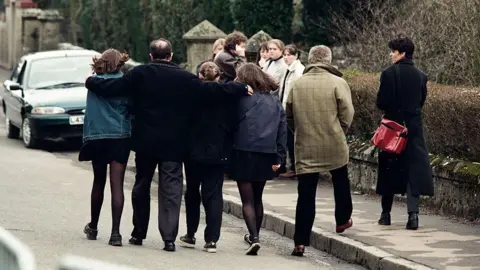
Meanwhile, parents Kenny Ross and Mick North had been contacted and told something had happened at the school. By the time they got there, a crowd of locals and journalists was outside the gates.
"There seemed to be a vacuum of information," North says.
"Nobody knew for a while anything at all. Until we were told that it was Mrs Mayor's class, the class that Sophie was in."
"It was just panic and crowds of people," according to Pam Ross.
As the gravity of the tragedy began to emerge, casualties were being taken to local hospitals.
Shot in both arms, her right hand and left chest, teacher Eileen Harrild was waiting to be taken into theatre, desperate to find out what had happened to the children.
"I did say: 'How many children survived?'. I really wanted to know that. That was really important to me.
"I felt responsible because it was my class and suddenly this had happened. I needed to know how many were going to be surviving it."
 Getty Images
The streets around the school were quickly filled with locals and the world's media
Forsyth and Robertson arrived at what was now the scene of a major crime.
"We were there very quickly after the deed had been perpetrated," Robertson says.
"The chief constable did say 'do you want to see the gym?'. A lot of the bodies were still there. And he said: 'You know, you're not obliged to do so'.
"I think we both believed that was the right thing to do. It was important to see the scene of the crime."
Forsyth adds: "So we went into the gym and I'm afraid I lost it."
"It's not surprising," says Robertson. "I'm brought to silence even thinking about what we saw. But I think it was right that we did see it."
"That scene. I can see it now," says Forsyth.
 Getty Images
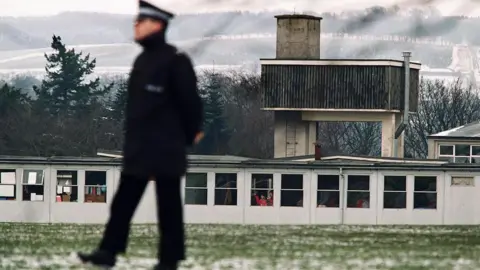
The school in Dunblane became the centre of intense media attention after the killings
The scale of what had just happened meant parents were left waiting to find out about their children.
Pam and Kenny Ross were taken aside and told Joanna had died. Afterwards, they went home to their four-month-old baby daughter.
Pam says: "Both Kenny's mum and my mum were in our house watching the baby and they could see us coming up the path without Joanna and they knew. We didn't even really have to tell them."
"You were just numb," says Kenny.
"It felt like a very long wait without very much information at all," says Mick North.
"I had to wait until quarter to three in the afternoon before I was told what had happened to Sophie. And then I went back to the house where it would just be me."
 IWC Media
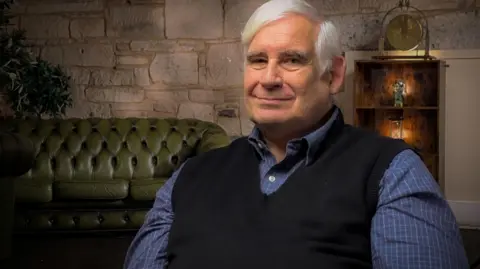
Mick North campaigned for a handgun ban after the murder of his daughter Sophie
Hamilton had fired 105 bullets. He was carrying 743 rounds of ammunition and four handguns – two 9mm Browning semi-automatic pistols and two Smith & Wesson .357 magnum revolvers.
In the shock of the murders, attention immediately turned to how he had been able to legally own such an arsenal - and how the country could prevent anyone from having one like it again.
Hamilton, who shot himself dead at the end of the attack, was well known to police and other authorities.
He had been blacklisted from the Scouts Association in 1974, after complaints about his leadership and concerns about his "moral intention towards boys".
He would go on to run 15 boys' clubs across the central belt between 1981 and his death. Many raised concerns about his conduct during that time.
The official report into the Dunblane shootings would conclude that Hamilton, who blamed "malicious gossip" on his blacklisting and for the failure of his DIY business, had a sexual interest in young boys and a paranoid personality.
 Getty Images
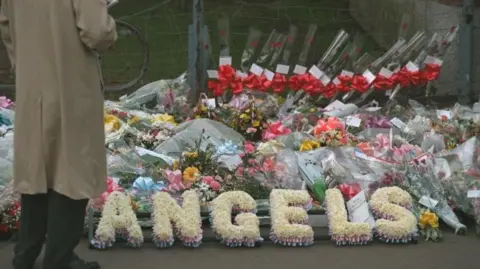
Tributes to the victims were sent to Dunblane from all over the world
Dunblane occupies a similar place to Lockerbie in the Scottish memory.
Both are small towns, populations of fewer than 10,000, tucked away in quiet corners of the country. Their names are attached to terrible events which both tested their communities to the limit and took on a wider significance.
Just as the hunt for the Lockerbie bombers became a global legal and political affair, how the families and allies of the Dunblane victims responded to the tragedy changed the UK and its relationship with guns.
Immediately, Michael Forsyth began planning a public inquiry to examine the circumstances of the killings, and what could have been done to prevent them.
He felt an opportunity had been missed to restrict access to guns after the Hungerford massacre of 1987, when Michael Ryan killed 16 people and injured 15 more in a shooting spree in the south of England.
Some of Forsyth's colleagues were sceptical, but "from the moment I left that gym I was absolutely determined we were going to have to have legislation to ban handguns," he says.
From the start, there was a move to take party politics out of the campaign. As Robertson says: "Trying to make sure that this remained bipartisan, that it was to be seen as all-party, was going to be crucially important".
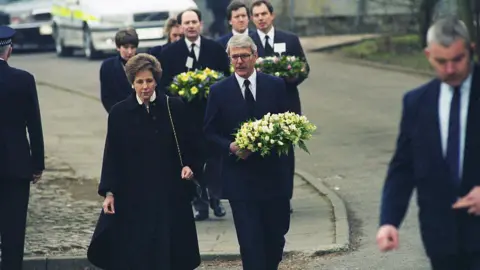
To that end, Prime Minister John Major and Labour leader Tony Blair visited Dunblane together, meeting with victims' families and survivors.
 Getty Images
Prime Minister John Major and his wife Norma visited with Tony Blair in a show of cross-party support for the people of the town
There was also growing public and private anger that Hamilton had owned his guns legally.
Eileen Harrild says: "When I realised that until he banged that gym door open, with his gun outstretched, everything he had done was legal, he held them in his house, these guns were legal, I was really angry. I felt angry, actually."
But there was strong push-back from gun owners and the shooting lobby.
They argued that people had the legal right to own handguns, that shooting was a legitimate sport no different from any other, that shooting incidents were rare and almost all gun owners were responsible.
Meanwhile, three women from the Dunblane area had begun campaigning for a total ban on handguns.
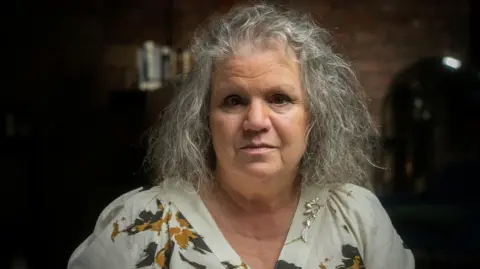
Ann Pearston, Jacqueline Walsh and Rosemary Hunter had formed the Snowdrop Campaign, named after the only flower blooming at the time of the shootings. They wanted the law changed by the time the snowdrops bloomed the following spring.
"We'd lived in Dunblane for about 18 months. We had been in that community and known people.
"Had we bought a house in Dunblane I would have had two children in the school that day, one of which would have been in one of the three primary one classes," Pearston says.
 IWC Media
Ann Pearston became the face and voice of the Snowdrop campaign for a handgun ban in the wake of the Dunblane shootings
Despite, by their own admission, knowing "nothing, really, about politics" they began collecting names to petition parliament for a ban.
By any measure, the Snowdrop Petition would be a remarkable success. In that pre-internet age, they were inundated by sacks of letters and cards. It would collect 705,000 signatures.
The organisers' public profile brought both praise and death threats. It made public figures of three private women, who found themselves debating with politicians and gun owners on TV and radio.
At the same time, the legal and political responses to the shootings were getting under way. The public inquiry, chaired by the Scottish judge Lord Cullen, began sitting in Stirling at the end of May.
It took place over five weeks, hearing often harrowing testimony, with a remit to investigate the circumstances of the Dunblane shootings, gun legislation, and school safety.
 Getty Images
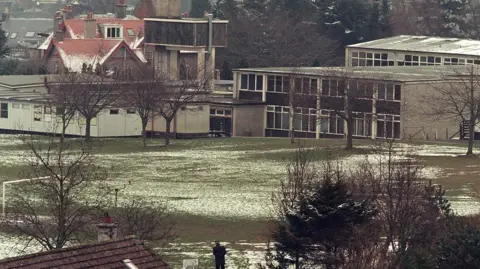
At the time of the shootings, Dunblane Primary School was the largest in Scotland
Ann Pearston was present throughout.
"Having listened to all the evidence and having read every single submission that was put into that inquiry, I didn't think he could come down on anything other than a complete ban," she says.
But Home Secretary Michael Howard took the view that he could not pre-commit the government to implementing whatever Lord Cullen found. That rang alarm bells for some campaigners.
"I was not optimistic that we would succeed," says Mick North. "They needed to be pushed and they needed to be pushed hard."
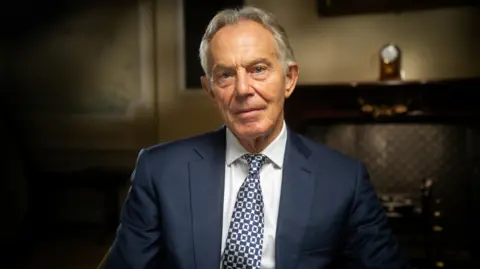
They met Labour Party leader Tony Blair while in London to deliver the Snowdrop Petition.
"Part of the shock for me was that my children were, I mean, a little bit older than that, but they were still at school," Blair recalls.
"I felt deeply for them, but as a political leader you can't take all your decisions on the basis, simply, that there's a campaign to do something."
 IWC Media
Tony Blair was convinced of the need for a total handgun ban by the Dunblane families and Snowdrop campaigners
Blair, a former lawyer who was preparing for a looming general election, was minded to wait and see what Lord Cullen's report found before committing to action.
That wasn't good enough for Kenny Ross.
"Tony said if he were elected, he'd do what he can to go by our wishes, if you like. See what he could do. And I was just fed up with it," he says.
"I finally said to him: 'Have you got any children?' - and he says, 'yes'.
"I say: 'Well, I had a daughter. She's now six foot under. That is why you have to do something about these gun laws'.
"Total silence. You could have heard a pin drop. And then I was starting to think: 'Have I said the right thing? Have I said the wrong thing?'.
"It was to get his attention as to how serious this is. And hopefully it hit home."
Kenny describes confronting Tony Blair over the death of his daughter
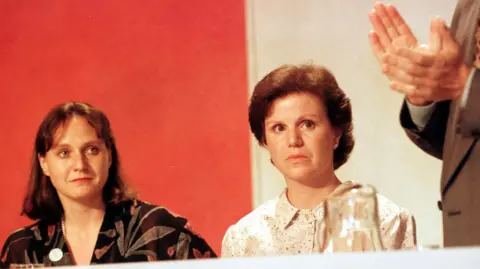
That October, Pearston gave a powerful speech at Labour's annual conference.
Delivered the day after what would have been Sophie North's sixth birthday, her words reduced many in the audience to tears and prompted party members to back a full ban.
"She came, she saw, she conquered," remembers Tony Blair.
"That was the end of it because it was an extraordinary and electrifying moment. She spoke with such conviction and such reason that, I think, for me that was conclusive.
"Let's do something that is so clear and so firm that we know we have done everything we can to prevent this in the future."
 PA Media
Rosemary Hunter and Ann Pearston of the Snowdrop campaign visited the Labour conference in October 1996
Two weeks later, Lord Cullen published his report.
He made 28 recommendations but stopped short of calling for a ban on handguns, suggesting instead a complex system that would see them dismantled and stored in different places.
The Conservative government accepted everything in the report but went further, suggesting a ban on all handguns except .22 pistols - a less powerful calibre used for Olympic target shooting.
Michael Forsyth had spent months persuading and managing some of his fellow Conservative MPs, many of whom were against any ban.
"Certainly, Michael Howard knew that, unless we did something, I just wouldn't have been able to accept it. So, the government of which I was a member went beyond Cullen, which no one expected," he says.
George Robertson says he knew that Forsyth also wanted the ban on .22s but was bound by cabinet responsibility.
"In government, you don't always get everything you want," says Forsyth.
The Firearms (Amendment) Act became law in February 1997. It was not enough for the families or the Snowdrop campaign, who continued to press for a full ban.
That wasn't long in coming.
Labour won the general election of May 1997, and almost immediately legislated.
That November, the amended act was passed and the age of legal handguns in the UK was over, 20 months after the murders in Dunblane.
 PA Media
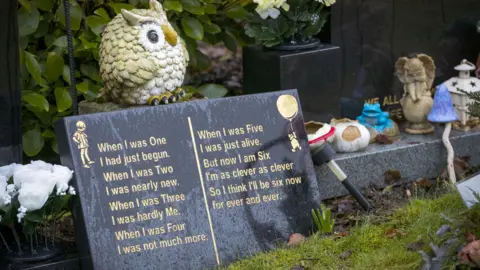
Dunblane will remember its lost away from the public eye
Three decades on the people of Dunblane, the community that was torn apart by the tragedy, will mark the anniversary privately.
For those who fought for the handgun ban, there is some small consolation in what happened next.
"People make demands on the government the whole time," says Blair.
"You can't meet all those demands but this demand in this way was something, it wasn't about money, it wasn't about priorities, it was just about a terrible, terrible event that the country was determined should lead to a change."
For George Robertson, what the parents lost is "always going to be greater than anything that came out of it".
"When there is another school shooting in America, I do take a degree of satisfaction from the fact that we stopped that from happening in our country," he says.
"Because there is no doubt at all in my mind. If the law had remained the way it was, it would have happened again."
Michael Forsyth still finds what happened on 13 March 1996 difficult to talk about.
"It was a miserable experience for me, but nothing like what it was for those parents who lost their children. I just wish I'd never had to deal with it."
"Our children paid the ultimate price," says Joanna Ross's father, Kenny.
"And what I miss most is I can't remember what she sounds like. It was before the time of videos, mobile phones.
"I've forgotten her voice."