.png)
 1 month ago
41
1 month ago
41
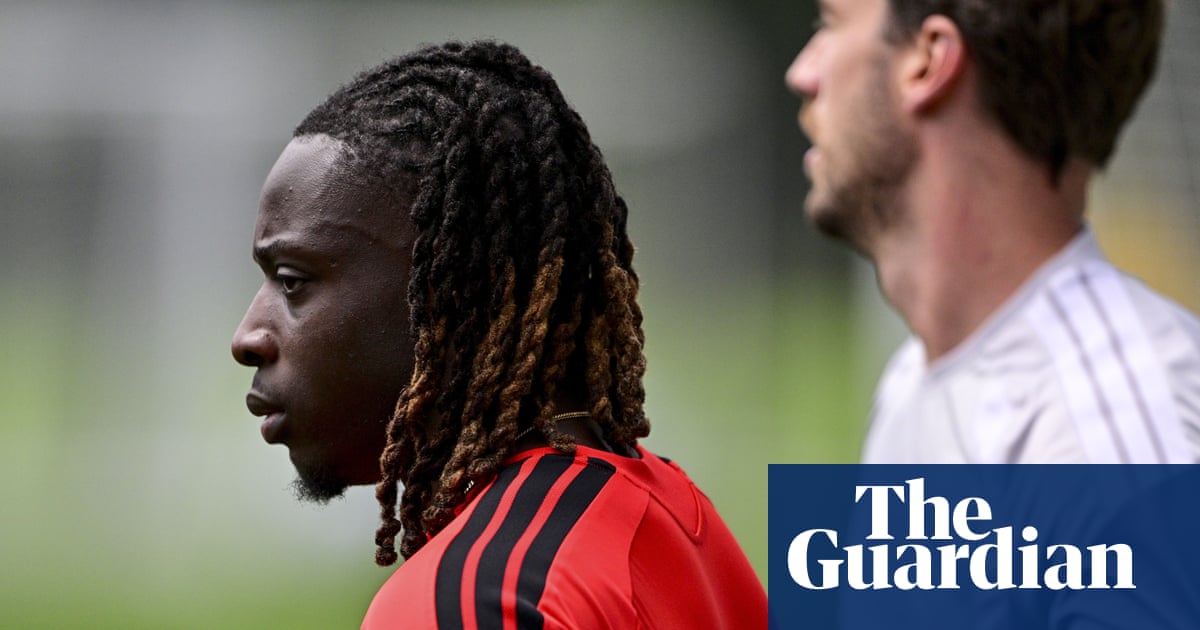
A warm sun bathes the Barcelona training ground as Frenkie de Jong arrives to chat. The midfielder’s work is done for the day and the Netherlands international is in his comfort zone here, the first team’s longest-serving player, a regular captain and effortlessly fluent in Spanish. It is a far cry from the day just over 10 years ago when he visited the Camp Nou.
In late December 2015 De Jong made the most of the Eredivisie’s winter shutdown to take a city break in Barcelona with his now wife, Mikky. He was 18 and days from linking up with Ajax, who had signed him four months earlier but loaned him back to Willem II, and he managed to get tickets for Barcelona v Real Betis. It is an occasion that stuck in his mind.
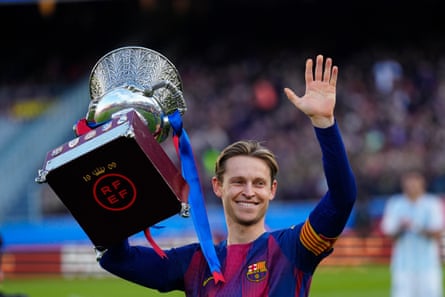
Before the match Barça posed with the five trophies they had won in 2015 – La Liga, Champions League, Club World Cup, Super Cup and Copa del Rey – and De Jong witnessed Lionel Messi score on his 500th appearance for the club. Come 2019 he was playing alongside the Argentina great.
“I clearly remember sitting there, watching Messi, Neymar and [Luis] Suárez, with Barça winning 4-0,” De Jong says. “At Betis, there was Heiko Westermann, with who I would later play at Ajax and who is now our assistant coach at Barça. It was a special trip and very nice to experience it together with my wife, as we have been on this journey at Barcelona together.”
That journey has spanned almost seven years and reached a milestone last week when he became the Dutch player with the most appearances for Barcelona (293). After the match, he was honoured by his compatriot Phillip Cocu, whose record he surpassed. “It means a lot to me,” De Jong said. “The Netherlands and Barça have a special connection.”
In terms of trophies, his journey has been gathering pace. If a single Copa del Rey was a modest return for De Jong’s first three seasons, he has since secured two La Liga titles, another Copa del Rey and three Spanish Super Cups. Back from a hamstring injury, he is on the verge of third La Liga title. That will be secured if Barcelona win at Osasuna on Saturday and Real Madrid slip up at Espanyol the next day. Otherwise it rolls on to Barcelona v Madrid the following Sunday.
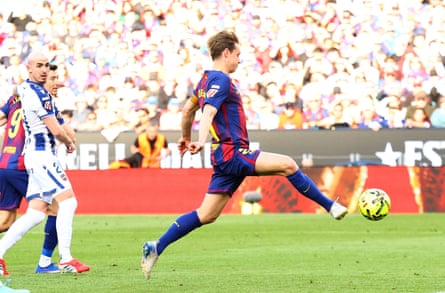
“You’re expected to win trophies every year,” De Jong says, but he knew patience was needed after the Covid period. “A lot of big names left and we were playing with many young guys. That takes a bit more time – it needed a year or two, I think – and then a few reinforcements came in as well.”
The Champions League and a trophy with the Netherlands remain on his list but he says: “I truly enjoy every day that I can come here. Because that’s what I always wanted: to play at Barcelona.”
It explains why he has been so reluctant to leave. Last October De Jong extended his contract to 2029 but a few years ago he appeared to be on his way out as the club sought to raise funds. Manchester United and Chelsea were seriously interested and Barcelona made attempts to facilitate a move.
“Of course, it’s crossed your mind at times, like: ‘OK, what should I do?’” De Jong says. But he is clear: “So as long as I’m good enough to be a starter here, to make an impact and Barcelona is at the level I want to play at – with the sense that they’ll be competing for the major trophies – then there’s no reason for me to go.”
De Jong faced regular rumours about a potential exit, with one leak claiming to detail his salary, though he says the figures were inaccurate. “The press can really influence how people see you; that’s something I especially noticed during that period. Back then, it was all about my contract, with all sorts of figures about what I was supposedly earning, while that was not true. But then you notice they [the outside world] see you differently from that point; they judge you differently … It starts to get into people’s heads.”
De Jong illustrates his point with an example from watching football on TV. “When a player loses possession but the commentator says nothing, people don’t really notice. But if he says: ‘Hmm, that’s already the fourth time he’s lost the ball, he’s not playing well today,’ that sticks with people. Many don’t really watch a game closely, they don’t notice what’s happening. And so it’s very important how people report stories, or comment on a match. I think it has more influence than people realise.
“And besides that, in football there are interests: some journalists have contacts with players, or through others. There are also several players who have PR agencies working for them. And you just notice there’s a difference in how people are judged. Sometimes in football people don’t watch objectively, without even realising it.”
For De Jong it is all about football. It has been since he joined the academy at Willem II – the club where Virgil van Dijk also grew up – at about seven years old. De Jong reflects on the pivotal role his grandfather played then, driving him to training. “Otherwise I wouldn’t have been able to go to Willem II at that age; I couldn’t have taken public transport.”
The two developed a special bond and De Jong has always played with No 21 on his shirt, as a homage to the birthday of his now late grandfather. His two young sons, Miles and Mason, were then born on the 21st. “They were due earlier, and we didn’t induce labour or anything, but it is really special.”
Measured by first-team debut no one in Barcelona’s squad has given longer service than De Jong, now that Marc-André ter Stegen is on loan at Girona. Asked for the highlights, he mentions several clásico wins, starting in 2023. “We beat Real Madrid in the final minute with [Franck] Kessié’s goal,” he says. “We were 12 points clear after that match, which gave us the confidence that we would win the league.”
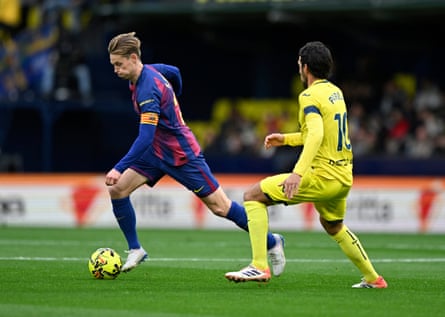
Last season’s clásico was even more spectacular, Barcelona coming back from a 2-0 deficit to win 4-3 and all but confirm their 28th La Liga triumph. “Then last season there was the cup final [against Madrid] as well. Those are the games you remember.”
The clásico also handed him arguably the toughest moment of his career. At the Bernabéu two years ago, De Jong sustained a serious ankle injury which sidelined him for more than five months. There were moments where fear entered his head regarding whether he would return. “It sometimes crossed my mind, like if I felt discomfort again from anything, like going up the stairs. You think: ‘Oof, maybe … But it was not like I was dwelling on that thought for days.”
Forced to miss Euro 2024, he watched the Netherlands’ matches on holiday in Ibiza and from home before coming to Germany for the quarter-final against Turkey and visiting the dressing room after a 2-1 win. “There’s joy and pride when they do well but at the same time it’s really sad that you can’t be out there with them … That was really tough.”
It shapes his thoughts regarding this summer’s World Cup. “You have got even more desire to be there and to get the most out of it. Since my time with the Dutch team, I think we now have the squad with the most potential. But we also need to make sure we become the best team.”
De Jong has become a pillar of the Barça side under Hansi Flick, enjoying a good bond with the coach and serving as his on-pitch lieutenant. De Jong has also cemented a positive relationship with Marcus Rashford, on loan from Manchester United.
“A really good guy,” De Jong says. “Open and kind and he’s also having a big impact for us on the pitch. With his speed and depth, he really adds a lot to our game. And by doing so, he also forces the opponent’s defence to drop back a bit, which creates more space for us in the middle.”
De Jong believes Barcelona have a good mix, academy talents blending with signings. “We have a very open team, quite young, so there’s a lot of energy,” he says. “We have a lot of potential. It’s about making sure we unlock that.”