.png)
 12 hours ago
5
12 hours ago
5
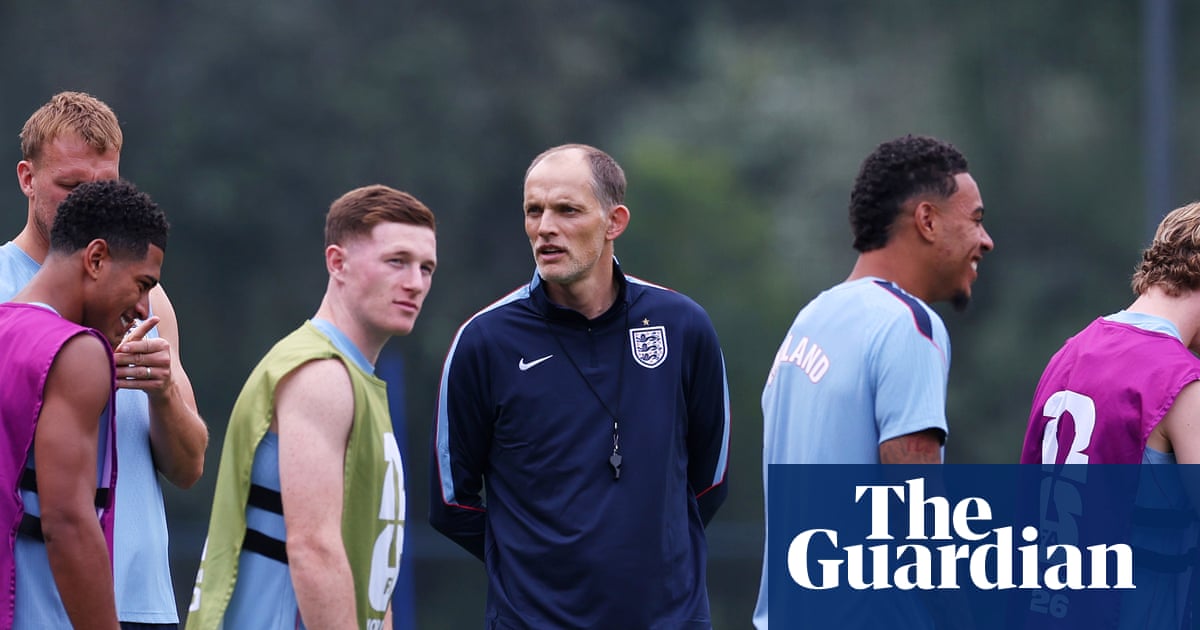
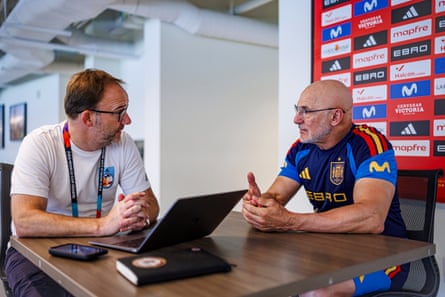
“You’ve filtered these, right?” Luis de la Fuente asks, looking at the laptop of your questions on the table in front of him, and cracking up. He takes his seat on the third floor of the Cotton Bowl, Dallas, where Spain have just finished training ahead of their last-16 meeting with Portugal. Some of the players are still out there in the sunshine, in the place where Bebeto rocked the baby in 1994. It is the morning after that Cape Verde performance against Argentina. The World Cup is a creator of memories, pictures in the mind that never go. We all have one, or more.
“Because of what it means for Spain, it has to be [Andrés] Iniesta’s goal,” De la Fuente says. “It’s not very original but that’s the image of the World Cup for us. I would have been at home watching it. I have always been very into the national team. Whenever the Selección played, it was an event at my parents’ house. My parents would watch, my brothers and sisters, people would come round to watch. That’s in Haro, La Rioja. And then as a professional, wherever the game found me, I would watch it. I would enjoy every World Cup game, but especially the Spain ones. There are other images of the World Cup, but that’s the most powerful.”
Now that we know how good Cape Verde are, should we see the first Spain game in a different context? Leo
I’m someone who if he has to offer an opinion likes to do so with a lot of information to hand. When I don’t know anything, I don’t offer an opinion. Before the tournament I said it was going to be a historic World Cup and that people would discover lots of national teams that even if they didn’t have a ‘name’, even if they weren’t mediatico, would find their place. We would end up recognising how important they are. And one of those is Cape Verde. We were not surprised by their performance. I said that what they do, they do very well. And it’s true.
When Lamine Yamal was asked which opponent he fears the most, he said Nuno Mendes. What advice would you give Lamine for the next time he faces Nuno? Amiglobal
He has faced him with his club and his country [Lamine has played Mendes four times: three times for Barcelona, losing twice and winning once, and in the 2025 Nations League final, which Spain lost to Portugal on penalties]. In that process of development that Lamine is still in, he knows that it is the big games against great opponents that lay down a marker: they’re the ones that shape and define you, show you a path. Lamine is a competitor and he will have the desire to remove the thorn from his side from that [Nations League] game. But a long time has passed since then and Lamine has grown a lot. Lamine is not the player he was a year ago; he’s another player, more mature, more assured, he reads the games better, logically. With every stage of his development, every experience, he will be more complete. So what would I say to him? ‘Be yourself, enjoy football, with the responsibility that comes with it, the responsibility that you take on, but be yourself.’
I’d like to know about Borja Iglesias’ role in the squad. Thanks. Hannah Darvill
Borja is a very important player. He’s a player who is preparing, working so that he is ready whenever he is needed. The other day, I said I was very sad that in the game against Austria, there was a moment – and I had told him, too – that I was just about to make two changes: Martín Zubimendi and him. But the game takes you to a place, then it takes you to another one, you can’t control it, and just then something happened in the game that led me take a different decision. We made a different change. But this is a group of players who are ready to compete in the moment in which they are needed. I would like them all to have an opportunity, but it is a World Cup. They are all very important. And Borja’s role is to make the rest of the players better because he is very good and that makes demands on the rest so they can be better.
Is De la Fuente aware that millions of Garcías have fallen in love with the Cucurellas, Yamals, Oyarzabals and Porros of La Roja? José García
It’s globalisation. Other, new winds blow. Those processes bring different races, creeds and ideologies, an adaptation to something different. Football is a reflection of society. There’s a role for football to play in integration. Football is a powerful tool for unity, it’s a school of values. There is an ugly part to football, of course, but I prefer not to dwell on that; the true essence of football is very positive, very good for society and that’s what we have to hold on to. It is an agent for integration.
What is Luis’s favourite word in Spanish? Jane Black
The word I like best is “respect”. With respect as the starting point, you can build anything. The edifice of coexistence is built upon foundations of respect. I read that one day, and it’s true. The key word in my life is “respect”. And it’s the word I most use with the players, too. And without actually using it, without actually saying it, it’s still reflected in everything; in the decisions, in the behaviour, in the attitude. That’s the key word.
What’s the hardest thing about being seleccionador? Ethan Taylor
Seleccionar! Look, I always say that we are coaches, but the most important role we have to play, and the hardest too, is to select the players. In the end we talk about technical and tactical concepts … well, yes, OK … we [coaches] all have that grounding, that foundation. You can have an idea, fine, but then you have to select the players that best fit that idea, that best adapt, and that’s the hard part. You have to choose, and the hardest thing when you name a squad is leaving out someone who could be here perfectly.
Does Luis think the current midfield already is (or could be) as great as the one in the 2010 World Cup final? Anne Butterfield
Well … they’re two great midfields. In my opinion, and I say this with the greatest of respect to everyone, we have the best midfield in the world. We have two players per position who are the best players. I can list them: Rodrigo, Zubimendi, Fabián, Pedri, Olmo, Merino, Fabian, Baena, Gavi, Fermín who isn’t here [because of injury], etc … etc. I have probably left someone out and he will get angry; don’t get angry. I remember you all. That was an extraordinary midfield [in 2010] as well, it’s true. Football changes, but I would put us at almost the same level.
Pedri is, in my view, the greatest midfielder in the world, but is seldom acknowledged as such in the English media. My theory: he looks like he is about to lose possession, yet he never does. What’s going on here? How the hell does Pedri pull this off so often? Sean McNulty
Haha! Yes, yes! He’s a magician, a magician. It’s quality, talent, technical ability. I had a teacher at school who told us that the definition of technique, talent is: completing tasks of maximum difficulty without apparent effort. That is technique. And Pedri is a maestro in that. He does things that are extremely difficult and it seems easy. Very few people can do that. He plays with an astonishing ease. He sees passes the rest of us don’t see. That’s something geniuses have.
What colour is happiness? John B
Once you get old, once you reach a certain age, you see that happiness is being able to see what’s truly important. Happiness is colour, life, health, and it’s being able to enjoy moments with family and friends; that’s the colour of happiness.
La tortilla española: with or without onion? Tim King
Without! Without onion. My mother doesn’t like onion but at home my dad and my brothers and sisters always did. I don’t. I don’t eat it. I inherited my mum’s taste. Tortilla is one of my favourite dishes, but without onion.
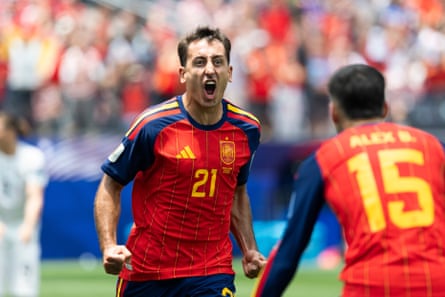
Is Oyarzabal a “natural” striker or almost a false 9? IB
He is a top footballer with a unique ability to interpret and play every position. I remember when people said there was no centre forward: there is. A different profile, maybe, but there is. Mikel has played at media punta, right wing, left wing and has always played well. He understands every aspect of the game, the moments of a match, the decisions he has to take. And one day he will be a coach, because he sees the game so well.
Watching Spain dismantle Austria, I was partially reminded of Brazil’s near rhythmic possession play, circa 1982. So much so that I went ahead and downloaded a bunch of Brazil matches from the era. Anyway, have you drawn inspiration from Telê Santana’s magical side? Abhinav Dutta
What I have always said is that I know the players very well and obviously my way of understanding the game has evolved, but essentially because of the players. And those players have forced us to evolve an idea according to their qualities. I knew I had an idea, but they made my idea better. You have to have a basis for everything but you realise that they’re the ones that play it out, that adapt it. And you have to give them the tools to that. In the end, it’s about the primary material. That’s where the inspiration is.