.png)
 4 hours ago
2
4 hours ago
2
Even in the hyperreal world of football, there are few characters more compelling, more polarising, or more everything than José Mourinho, the best and worst of public him on full display in a new three-part Netflix series. “It reminded me how good he was,” says Joe Pearlman, who directed Mourinho, and the actual Mourinho is, believe it or not, keen to communicate the same. As he puts it in the show: “I look, you look, I see more than you.”
Making documentaries, though, is often about taking people to the places they’re most skilled at avoiding. “I knew the interviews were going to be very intense,” says Pearlman, “and he was going to try and control the narrative and manipulate us. Everything bad is everyone else’s fault and everything he’s done is validated by winning. Because that’s all that’s important.”
This is just one aspect of an unusual worldview. “There’s a moment in episode three where I ask him about his childhood,” says Pearlman, “and he doesn’t want to talk about it because he doesn’t think it’s relevant to who he is, essentially saying he’s not interested in people. Which, for one of the greatest man-managers of all time, is quite odd.”
The son of a much-loved coach, Mourinho felt like an outsider from childhood because he was known by way of his dad. Then, when he became a coach himself, having not been a player, that appeared to confer insider privilege. Indisputably, this self-image has helped Mourinho self-actualise, surviving unlimited wealth at Chelsea and a spell at Real Madrid, with the attitude of “someone who’s had a chip on their shoulder for a lot of their life” – along, of course, with his irrepressible charisma and tactical acumen.
Félix Mourinho died in June 2017 and, when that comes up in the documentary, there are tears. “He’s obviously buried the loss of his father,” Pearlman says. “It’s very painful for him to talk about. As someone who’s lost a parent, I can talk about my mum very openly because I’ve processed it. I’ve been to therapy, I’ve tried to understand what that part of my life means. I don’t think José’s ever tried to understand what any part of his life means. I think he’s always looking forward, always looking for the next thing. He’s winning the treble for Inter against Louis van Gaal and Bayern but, at the same time, he’s really thinking about crushing Pep [Guardiola] when he joins Madrid.
“Losing his father changed him; it tainted the years that came afterwards. And on top of that, José carries every word, every goal, every decision that doesn’t go his way; it’s a rucksack of pain he’s been lugging around since he was probably 19, 20 years old.”
Nevertheless, everything that makes Mourinho special – the wit, the insight, the confidence, the zest, the charm, the genius, the cool – burns through the screen. “He was looking for an outlet to be the biggest possible version of himself and football allowed that,” says Pearlman. “The ego and the charisma on top of the talent meant he could embody a character he’d always dreamt of being, that maybe he wasn’t in his childhood, and that is the person that we’ve come to know as José Mourinho.”
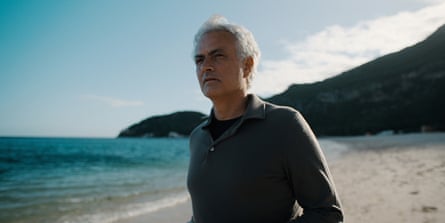
That person is, of course, only one version of reality, a character honed for the purpose of footballing warfare. One who, it seems, sees football as distinct from the real world, with combatants permitted to do anything in the pursuit of victory; he is no more apologetic for his Anders Frisk and Eva Carneiro excesses now than at the time. Yet Mourinho also articulates his desire to be loved, though you sometimes wonder if, to him, that has as much in common with adulation as affection. “It can also be: ‘I want to have a lot of attention on me’,” says Pearlman, “and conflict brings that in spades. It’s like this safety blanket that allows him to feel like he’s doing things for a righteous cause.”
At home Mourinho is different: more reserved, quieter. And it is with regard to his home life that we experience the show’s other sad moment: Mourinho explaining he’s been away from his family a lot, so much so that it’s easier for them when he’s not around. “You can kind of hear it in my voice,” says Pearlman. “I’m like: ‘Oh my god, what does it even feel like saying that?’”
after newsletter promotion
What does Pearlman think the show is about? “A lot of it is about winning at all costs,” he replies, “and what happens when you’re defined by winning and that winning stops. It’s also the portrait of a hero and a villain, one of the great leaders of men that the world has ever seen. As a civilisation, we’re lucky Mourinho didn’t go into politics!”
And, of course, the show now has a surprise happy ending, with Mourinho’s return to Madrid. “The person I’ve seen over the last few years at Roma, Benfica … until this last one, I don’t think I could say that I’ve met a happy man or a content person,” says Pearlman. “He is now where he believes he should always have been – after every cup Madrid have won since he left, Florentino Pérez has called to say: ‘This is because of you,’ because of how he modernised the club. And one thing we all know is that whatever comes next, it’s going to be a box-office blockbuster.”
Mourinho is on Netflix