.png)
 8 hours ago
7
8 hours ago
7
Magnus Carlsen, the 35-year-old world No 1, has won the annual Norway Chess elite tournament, for six of the past seven years. However, he was shocked in Monday’s opening round by Alireza Firouzja, who had finished last at Bucharest the previous week in the Grand Chess Tour event won by Germany’s Vincent Keymer.
The Frenchman, 22, defeated Carlsen for the first time in classical chess despite playing with a sprained ankle, caused by falling off a stage at Bucharest. It was the most high-profile success by a physically injured grandmaster since Tilburg 1985, where England’s Tony Miles shared first prize playing prone from a massage table after injuring his back.
Carlsen has a deserved reputation for a pragmatic approach to his clock time, but in this game he slipped into time pressure in the critical moves leading up to the move 40 time control.
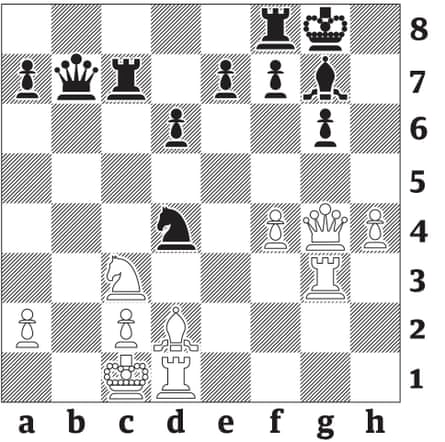
31... Qb7 was better than Carlsen’s 31...Qd7, and 32... Qb5 was better than Carlsen’s 32...Re8, but the decisive error came at move 33.
Instead of the fatal blunder 33...Kg8?, after which Firouzja’s central pawns advanced decisively up the board, 33...Nxe3! would have held: 34 Qg6+ Kh8 and if 35 Ra7 Nd1!! 36 Bd2 (not 36 Rxd7?? Rxe1 mate) 36...Qxa7 37 Qxe8+ Kh7 and although Black is a pawn down, his queen and knight combine better than White’s queen and bishop (queen and knight against two rooks and a bishop is even better for the Q+N pairing).
After 13 years in Stavanger, Norway Chess has moved to the Deichman Bjørvika library in central Oslo. The significance for Carlsen’s bad day at the office on Monday is that he has often declared that he prefers not to play in the capital to avoid hometown pressures, while one of his worst career results occurred in 2019 when he lost the final of the Fischer Random world championship (since rebranded as Freestyle) to Wesley So by the disastrous margin of 13.5-2.5 in a match played in the Oslo area.
Norway Chess has a unique scoring system. A win in a classical game counts for three points, a loss zero, while draws are immediately replayed with the same colours as Armageddon games where White has 10 minutes on the clock, Black seven minutes, but a draw on the board counts as a win for Black on the score table. The winner of the Armageddon game scores 1.5, the loser 1. Carlsen was the only classical loser in round one, putting him under immediate pressure even though nine rounds remained.
In round two Firouzja was again the only classical winner, defeating India’s Praggnanandhaa Rameshbabu and regaining his place in the world top 10 in the live ratings.
Carlsen lost again in round three, in a chaotic defeat to Praggnanandhaa, who described the result as “like tossing a coin”. The Norwegian star spent far too long in the opening reacting to White’s surprise novelty 6 h4!? in the Najdorf Sicilian, responded weakly after 28 minutes by 6...h6?! and was under pressure for much of the game.
He turned it round during the time scramble, but went wrong again right at the end. The time control on Oslo is brutal, with only a 10-second increment at move 41, where players can usually relax with the aid of an extra half hour.
Round four on Thursday included Carlsen v Gukesh, world No 1 v world champion, in a repeat of the match-up that resulted in last year’s infamous table punch incident. In yesterday’s game, Carlsen at last showed his best form, won in powerful style, and advanced in the standings.
The scores after four of the 10 rounds in the open category: Firouzja (France) 8.5, Praggnanandhaa (India) 6, So (US) 5.5, Carlsen (Norway) 4.5, Keymer (Germany) 4, Gukesh (India) 3.5.
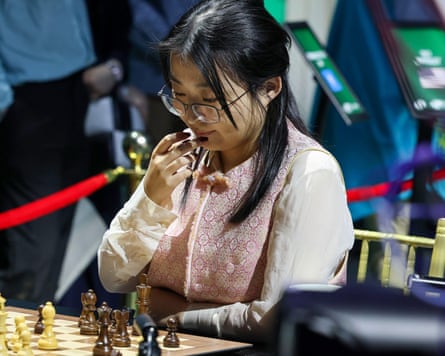
The event also aims to raise the profile of women’s chess, and Norway Chess Women – in which the women’s world champion Ju Wenjun is the top seed – breaks with longstanding tradition by offering equal prize money to the men’s event.
Women’s scores so far are: Bibisara Assaubayeva (Kazakhstan) 7, Divya Deshmukh (India), Zhu Jiner (China) and Anna Muzychuk (Ukraine) 5.5, Ju (China) 4, Koneru Humpy (India) 3.
Hans Niemann and Ian Nepomniachtchi meet in Belgrade on Friday morning for an eight-game classical match with two games a day, in a rare and significant encounter between top players from Russia and the US. You can follow live on the lichess website.
This is arguably the most important East-West match since the Anatoly Karpov v Gata Kamsky Fide world title series of 1996, or even since Boris Spassky v Bobby Fischer in 1972.
Both grandmasters are ambitious to reach the world’s top 10, Niemann for the first time and Nepomniachtchi after dropping below it. Both are currently in good form, Niemann after winning a series of individual GM matches and Nepomniachtchi after his first prize at Moscow Aeroflot.
Meanwhile, Supratit Banerjee, 12, narrowly missed his second international master norm at Stockholm last week where he needed a final round draw for his IM norm but his opponent needed a win, which he achieved, for a grandmaster norm.
4026 1...f5! and White resigned. If 2 Qxg6 Ne2+! 3 Nxe2 Qb2 mate.