.png)
 1 hour ago
2
1 hour ago
2
After Francesco Farioli surrendered a nine-point lead in his final five matches at Ajax, he felt the word “loser” had been stamped across his forehead. Clubs that had pursued him quietly stepped back and his rise abruptly stalled. Now, after an impressive campaign at Porto, the 37-year-old is again one of Europe’s most sought-after coaches.
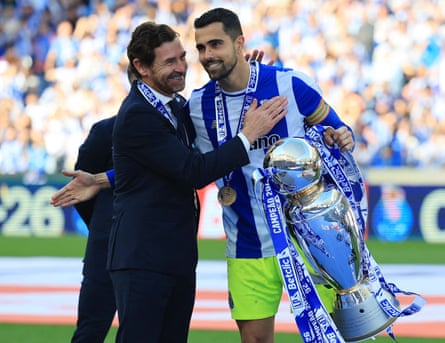
Porto’s title triumph, wrapped up with two games to spare, came 12 months after Ajax’s collapse enabled PSV to become Dutch champions. It is a sign of Farioli’s status that he was linked with Chelsea before they appointed Xabi Alonso, raising fears among Porto supporters of an early departure. They remember what happened 15 years ago when André Villas-Boas was prised away to Stamford Bridge after winning the league. Farioli, though, insists the club and fans have nothing to worry about.
“I feel I need to go again and push again – now the expectations are even higher,” he says. “Three weeks ago, from the outside, I had big question marks on my head. Now there is an exclamation mark that needs to be confirmed and proved.”
Villas-Boas is Porto’s president these days, voted in just over two years ago, and the trust he placed in Farioli has been good for both parties. Porto had gone three seasons without the title before Farioli’s arrival.
“I was really looking for a club with people who had the same motivation I had – a spirit of overturning a failure or something that went wrong – after the very heavy season I had at Ajax,” Farioli says.
The Italian inherited a Porto squad that had experienced a chaotic season marked by two managerial changes, a third-placed finish and the loss of Champions League football. But Farioli saw an opportunity to restore dignity to the club and his career.
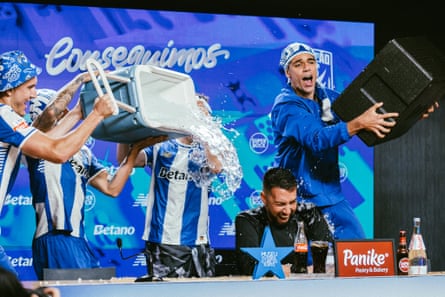
“The president’s decision to give me this opportunity was remarkable, especially after a year with two young coaches [Vítor Bruno and Martín Anselmi] already,” Farioli says. Choosing a third one – and someone who had ‘loser’ stamped on his head – was not a rational move. But André Villas-Boas had faith and deep belief.”
Farioli’s path has differed greatly from that of most elite managers. At 23 he was studying philosophy at the University of Florence and he started working in top-level football as a goalkeeping coach under Roberto De Zerbi at Benevento and Sassuolo. His first head coach role came six years ago at Fatih Karagumruk in Turkey, when he became the youngest manager in Turkish top-flight history. Since leaving that country he has spent a season each at Nice (finishing fifth), Ajax and Porto.
With those three teams he recorded the best defensive record in the league, Porto conceding 18 goals in 34 matches last season. Their change in attitude under Farioli was unmistakable. Porto pressed relentlessly, never backed down from duels and stayed united in difficult moments. The commitment was obvious to supporters, who applauded the players’ effort in every match.
“Metrics like total distance, high-speed running and sprint distance have been very reliable indicators for us throughout the season,” Farioli says. “In almost all matches we managed to outperform our opponents in these areas, and that gave us important confirmation about the effectiveness of our physical planning and workload management.”
The squad also united emotionally after the death of Jorge Costa, the football director, at the training ground in the opening days of the season. The club flag that covered his coffin was hung inside the stadium from one of the stands – a constant reminder of what they were fighting for. Farioli held tightly to one sentence Costa uttered in his final days: “We have a team again.”
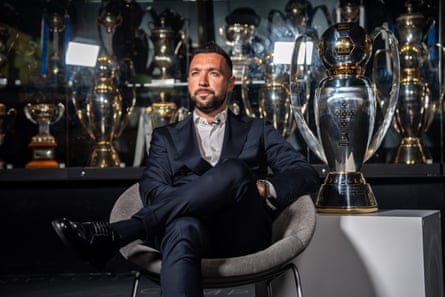
As part of his reboot Farioli took new players to the club museum. “Porto needed to reconnect with certain values and rediscover the mystique that, in recent seasons, had partially faded away,” he says. “But it was also essential to change the emotional atmosphere around the team: to bring back enthusiasm for the work, serenity inside the environment, and the desire to feel like a true team.”
For Farioli, the goalkeeper is the keystone tactically – creating numerical superiority in the first phase of buildup and attracting pressure to open central spaces. In Diogo Costa, the Portugal keeper who passes with the poise of a midfielder, he found the ideal fit. Costa can pinpoint the free man under heavy pressure. “The goalkeeper has a very particular perspective on football because he sees the game globally,” Farioli says.
In front of Costa, the Polish duo Jan Bednarek and Jakub Kiwior formed a towering defensive wall. Often they were the only players behind the halfway line as Porto operated with an exceptionally high defensive line.
Just ahead of them stood the team’s breakout star, Victor Froholdt. The 20-year-old Danish midfielder, signed for €20m (£17.3m) from Copenhagen, was initially regarded as a risky investment but is now considered as a bargain. Relentless out of possession, incisive on the ball and decisive in the final third, he scored eight goals and assisted six.
In some matches Porto held more than 70% possession – though at times the risky structure was punished. The most glaring example: Martim Fernandes’s own goal against Nottingham Forest, a heavy back-pass that caught Costa out of position and ultimately cost Porto the tie.
“Very quickly opponents started studying our way of playing in great detail,” Farioli says. “Trying to interrupt our buildup, limit our initiative and suffocate our game became a recurring theme.” What saved Porto? “An adaptive mentality to keep finding solutions,” he says. Players rotated and dynamics adjusted, but the team’s core principles, also including wingers to stretch the opposition, remained unchanged.
Farioli has invited his squad to offer their opinions on next season. “A few days ago I gave them an anonymous questionnaire to fill out, so they had the freedom to hit us with a bazooka – me and the coaching staff – telling us what they liked and didn’t like,” Farioli says with a smile.
As Porto prepare for the Champions League, Farioli steps into the next phase of his career no longer carrying the label that threatened to define him. A season that began in doubt ended in conviction: Porto have rediscovered their mystique – and Farioli is back on the rise.