.png)
 1 month ago
83
1 month ago
83
“You can be the thickest bloke and you still think you know more about football than a woman,” reads a line from Newcastle fan named Jo around halfway into a new exhibition on women in football culture. “[They] say, ‘you don’t know what you’re talking about.’ Oh, I could wipe the floor with you, man, with my knowledge and how much I’ve been, how much I’ve seen.”
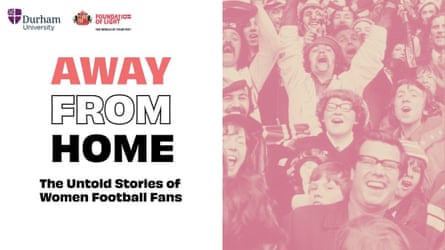
“I love that quote,” smiles Prof Stacey Pope, a leading women’s football sociologist and creator of the Away From Home: The Untold Stories of Women Football Fans exhibition, alongside David Wright of Durham University’s museums, galleries and exhibitions Team.
The recently-opened pop-up exhibition, The Beacon of Light, next to Sunderland’s Stadium of Light, portrays the experiences of women on the terraces of the north-east since the 1950s. “If you’re a man going to a match, it is automatically assumed you know everything about football,” Pope continues. “Women are undermined while the status of male fans is enhanced.”
Accompanying interviews with 22 Newcastle and Sunderland fans is archival footage, spotlighting patches of female contingents in male-dominated stands, from long lines outside St James’ Park for tickets to the 1955 FA Cup quarter-final replay against Huddersfield, to iPhone photos the day Newcastle won the League Cup in 2025.
Hand-sewn silk scarves nod to an era of handmade merchandise – “so much has been lost with commercialisation,” Pope says – and newly-commissioned artwork and soundscapes bring life to the curation of matchday rituals.
The exhibition presents undeniable proof of female presence and passion in the game throughout its history. It is an extension of two decades of Pope’s research, over which she has conducted 200 interviews with female fans to understand their place in football culture.
“I wanted to bring those stories to life,” she says. “There’s been this feminisation of sports fandom, by which I mean an increased opportunity for women to actually become football fans over the last three decades. But that hasn’t automatically led to gender equality. Whenever you see small steps towards equality, you get backlash. That’s what we wanted to hit in the exhibition: the ways women are required to defend and justify their fandom.”
In a recent study, she surveyed 2,000 male football fans; it found that three-quarters of men held either overt or covert misogynistic attitudes towards women in football. Away From Home comes at an apt time. Kick It Out recently revealed that reports of sexist incidents at matches between the start of the season and the end of February had doubled from the previous campaign.
“I would say that’s the tip of the iceberg,” says Pope. “For far too long, there’s been this assumption that ‘it’s football, get on with it’. Well, football is sexist, what do you expect? Part of the exhibition is celebrating women’s history, amplifying their voices, but it’s also about using that for solutions.”
The illusion of intrusion into football’s world, which Pope has described as “the last bastion of masculinity” in society, is both celebrated and probed. “One thing that comes up time and time again is the ways men’s and women’s fan careers follow different trajectories,” she says, referring to gendered caring and household responsibilities. A woman, after being married or having a child, is expected to give up the weekend matchdays before a man.
Likewise, stadiums have, for decades, been designed for male convenience. Other factors, from reports of assault or abuse on transport or in cities on a matchday, all linger uncomfortably in the background of the female fan.
Several women describe losing boyfriends or facing the disdain of their husbands for craving football. Others refer to the hours of daydreaming and discussion that would be an unquestioned obsession for a man.
“What we expect, and hope, is that there will be a lot there that is familiar to people. It doesn’t matter what club you support, what your gender is, when you talk about the importance of football in their lives, people understand that,” Pope says. “But peel back, and you see the more negative sides of gender inequalities and assumptions around women as inauthentic fans.”
Amid a background of academic theory, the exhibition’s catalogue of mixed media animates the north-east’s divination of football into the universal and accessible. Undercurrent themes are of familial loss and renewal, long labours of travel, time and memory. In one soundscape, complaints of hunger, mud, and coldness all evaporate into euphoria once the game begins. Interviewees recall the first time the green pitch jumped out of them with intensity, the stands rising and falling like a waterfall. The women get to the heart of what football has felt like for hundreds of years.
-
Away From Home runs until the end of the season at the Beacon of Light, and is available online.
Get in touch
If you have any questions or comments about any of our newsletters please email [email protected].
-
This is an extract from our free email about women’s football, Moving the Goalposts. To get the full edition, visit this page and follow the instructions. Moving the Goalposts is delivered to your inboxes every Tuesday and Thursday.