.png)
 1 month ago
38
1 month ago
38
Marianna SpringSocial Media Investigations Correspondent 

 BBC
BBC
Friday February 27th should have been like any other day at secondary schools in Southwark and Croydon in south London. But instead, when lessons finished for the day around 3pm, large numbers of teachers positioned themselves on streets around their schools as children made their way home.
In some places, after-school detentions were cancelled so pupils could get home as early as possible. There were police officers present too in some places and they had at their disposal dispersal orders that would allow officers to order any young people gathered to leave a particular area.
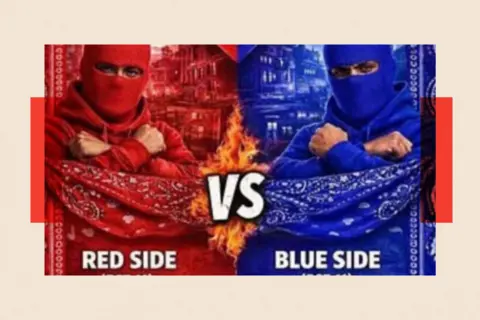
The prompt was concern over a series of social media posts that called for 'red v blue' wars between schools across the city. The posters began encouraging battles between students in the capital and seemed to begin circulating on TikTok and Snapchat. Copycat versions were subsequently shared about schools in Bristol, Cardiff and the West Midlands. The posters - one half red, one half blue - often feature images of people in balaclavas, weapons and lists of different school names listed on either side. In theory, fights were due to happen in south London that afternoon, hence the presence of teachers and police.
Only, the fights didn't happen - for their part, the Metropolitan Police say no actual violent incidents related to the posters have been reported.
 TikTok/Instagram
The posters, which appeared to advertise fights outside London schools, appeared on social media last month
Taken at face value, the whole incident appears to be another example of social media's apparently massive ability to influence our young people. But was something else at play?
Notably - from tracking down some of the original posts and speaking to people within the social media companies - there appears to have been only a modest reaction among young people when the posts first appeared. Instead, the real interest began after it started being shared across parent WhatsApp groups.
Look in the comments on the now viral posters and you find teenagers joking about what side they were on, saying they'd only heard about the posts from their parents' group chats.
Snap removed a small number of posts for violating their community guidelines - and according to TikTok, there were only a small number of searches for School Wars until it received wider attention from parents and media.
"We have to take it seriously when parents and kids do - even if the people who came up with it weren't that serious," one police detective told me on the condition of anonymity.
"I've found the real life (over-)reaction fascinating to watch."
So is this an example of what is known as a phantom trend, where fear can end up exacerbating the real-world impact rather than mitigating it? And what does it reveal about the gap between how children and their parents experience social media?
It was back in mid February when the first school wars posters seemed to pop up on social media from accounts based in east and south London. The schools listed were in Hackney and in Croydon - encouraging students to meet up on particular days and locations to fight.
The origin of the first posts are murky - but several TikTok accounts I've tracked down tell me they believe they were made by teenagers or young people who live locally because of the style of the posts and the particular schools they referenced.
"These young kids think it's cool trying to create an "og" [original gangster] gang war, blue vs red," one gaming account called Panos told me.
The posters build on a wider "red v blue" trend - where users create videos and encourage people to choose the red or the blue side based around different issues. For example, users are asked to choose between two phones or two characters, one who is categorised as red and the other as blue.
"I'm not sure where they originated — I [saw] it on Snapchat where everything posted has only 24 hours… then it disappears," another gamer from Bristol told me.
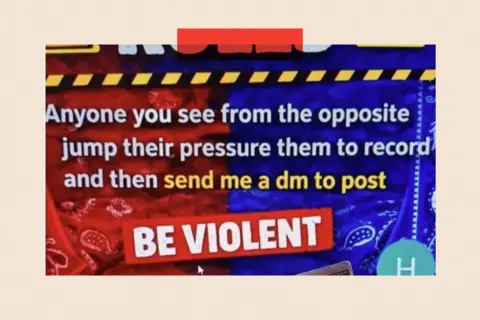
The posters appear to have been created using AI and this made them look fairly slick and professional. It also makes it trickier to locate their origin, especially since social media accounts thought to have been behind them were subsequently banned.
Sander Van Der Linden, a professor of social psychology at the University of Cambridge, says the posts were deliberately designed to trigger a reaction.
"I think it's important for parents, teachers, and students to realise that in-group vs out-group psychology [an us versus them mentality] is often exploited by social media algorithms to create division," he explains.
 TikTok/Instagram
Some of the posters were made with AI, making them appear slick and professional
His team published a study in the National Academy of Science journal in 2021 looking at millions of posts across social media platforms. The study suggests that "virality and engagement are most heavily predicted by the degree of out-group derogation or "dunking" on the other side", he explains.
"Each additional word referring to the 'other side' increased the odds of a social media post being shared by 67%. We refer to this as the 'perverse incentives of social media'. I think the red vs blue campaign is a nice example of that."
The Metropolitan police has since arrested a 15-year-old and a man in his twenties in east London in connection with the trend, but couldn't confirm if they were linked to the original posters.
They say both were arrested "on suspicion of encouraging or assisting in a crime" and that "they were bailed pending further enquiries".
"Local officers continue to work alongside local authority partners, school leaders and parents, whose joint robust response has been vital in protecting young people across the last week," a spokesperson from the Metropolitan police told the BBC last week. They confirmed on Monday there had still been no reports of violence.
The anonymous detective I spoke to says they were first made aware of the trend several weeks ago - and they had to think quite carefully about how best to respond.
 Getty Images
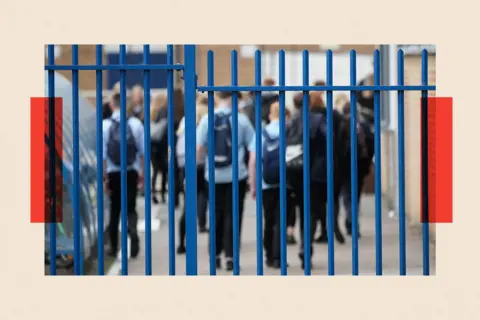
Some schools cancelled detentions so pupils could get home as early as possible
"Once it's mentioned to teachers and fed through to a local authority, we do have to act. It would be terrible if say 100 kids armed with knives turn up at one place and stuff like that has happened before."
According to Marc Burrows, a trust and safety expert who used to work at Twitter, the meaning behind the posts can be hard for many to grasp.
"What's fascinating about something like red vs blue is the layers and layers of lore built into it that make it so utterly impenetrable to anyone not swimming in the right end of the pool it originated from," he explains.
"All the gang stuff, the points systems, the AI posters, all of it is totally native and completely legible to the generation it emerged from, and easy to completely misread if you're outside. That's how internet culture works. These things develop their own internal logic, their own mythology, and they're not designed to be understood by parents or police or journalists, they're a community talking to itself in its own language."
When some parents discovered the 'red v blue' posts, the posters were forwarded to parental WhatsApp and Facebook groups and schools were made aware.
And so some secondary school-age children only became aware of the posters in the first place because of what their parents were seeing.
They included the children of Abi Lewis from south London. She has two sons aged 11 and 15.
"I first saw the 'school wars' post circulating on my year seven son's parents' WhatsApp group. Quite a few parents were asking about if anyone had heard about it and there was quite a lot of concern," she explains to me.
"The children at that point hadn't heard anything about it and they only became aware of it a few days later. At that point there were police standing outside the school every day. There was also a safeguarding assembly at the school about it."
She says as far as she knows, "there wasn't any actual fighting and this was something that was just concocted on social media", which the children seemed to find out about "after the adults were aware of it".
According to the detective, once teachers became involved, there was a huge amount of "pressure" on the police to do something, especially with some worried parents keeping their children off school.
"One thing we're increasingly teaching is a concept called "critical ignoring" which will become more important in the face of AI-generated slop, where sometimes it's better to just ignore low-quality stuff," explains Dr. Van Der Linden.
 Bloomberg via Getty Images
Some worried parents began sharing the posters on parental Facebook groups
"I think it's important that we educate teens, parents, and teachers about how algorithms and social media might exploit our psychological biases to sow division and elicit violence."
One solution Dr. Van Der Linden advocates for is to "create internal simulated social media feeds to illustrate to teens the dangers of online manipulation in a safe controlled setting". He thinks this would make both them and their parents "more resistant to it when it happens in real-life".
A history of phantom trends
This appears to be an almost phantom trend: one where the reaction to it largely eclipses the impact the trend itself was having on social media.
There have been trends, though, that have been made up entirely.
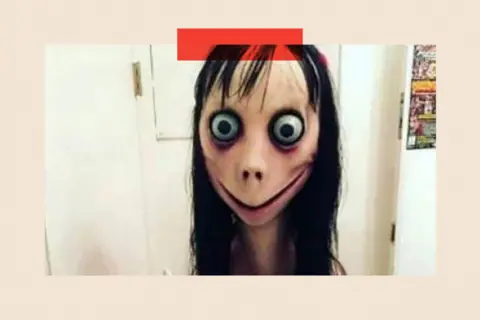
In 2019, there was the 'Momo Challenge'. The original tale said a character with bulging eyes would "hack" into WhatsApp and set children dangerous "challenges" such as harming themselves. Some schools warned parents about the 'Momo challenge' and the scary Momo image was subsequently shared because of the panic. But there were no reports of people harming themselves before or after, according to the police at the time.
The reaction from parents and schools though - as well as widespread media coverage - actually ended up triggering the circulation of the scary character, and so may have fuelled the fear rather than the opposite.
"I was at Twitter when the Momo Challenge happened, and I had to explain it to people who were absolutely convinced there was a monster in their children's YouTube videos instructing them to self-harm. There wasn't. It was a panic built on a creepy sculpture that had nothing to do with anything," explains Marc Burrows.
"But thanks to the sort of media that loves a clickbait story, even when they don't understand it, the panic itself became real. Eventually parents were terrified, schools sent letters home, news outlets ran alarmist coverage and suddenly something done for the lols and appreciated originally on that level is on the actual news."
Fact-checking website Snopes at the time suggested the story was "far more hype or hoax than reality".
"The subject has generated rumours that in themselves can be cause for concern among children," wrote David Mikkelson, founder and CEO of Snopes.
 Social Media
The 'Momo Challenge' was said to involve a woman with bulging eyes hacking into WhatsApp and setting children dangerous challenges - but it was later exposed as a hoax
The charity Samaritans said it was "not aware of any verified evidence in this country or beyond" linking the momo meme to self-harm - and the NSPCC at the time said they'd had more requests from the media than from actual parents.
More recently, there have been allegations that a viral trend on TikTok led to kids overdosing on paracetamol - but I and others could never find any evidence this was a mass trend and TikTok at the time said this wasn't happening.
But these phantom trends can prove frightening - especially because in rare cases, some of them do have real-life consequences. Take the case of two American girls who said they tried to kill another girl because an online character called Slender man told them to - or children seriously harmed by taking part in the so-called Benadryl challenge.
Back in August 2023, there was a poster - not dissimilar to the School Wars one - that circulated on TikTok and Snapchat about disorder and looting on Oxford Street. I went to see for myself how that did trigger real crowds and chaos, with police making several arrests.
This trend seems to sit somewhere in between: it didn't have that much traction and didn't seem that serious - and then panic made things worse (a pseudo-phantom trend, perhaps).
Parallel social media worlds
In the recent 'school wars' hype, it is true that some children have felt confused or scared and it may be that there were some localised confrontations linked to the posts. But some children were also under the impression that there had been significant organised fighting or even that people had been killed, for which there's no evidence at all.
But in the comments section, lots of young people just seemed to find it funny. A few have even taken it a step further, suggesting this trend was invented by adults or the government to try to get social media banned for under 16s.
Perhaps not surprisingly, on social media, young people and their parents are experiencing the online world in very different ways.
It's possible that the 'better safe than sorry' approach - which saw police and teachers taking to the streets - could have fuelled fear. But Prof Van Der Linden defends that approach.
"I think such a swift response was good, it could be that the campaign never went anywhere [much] because its impact was dampened by a quick response from schools and the police."
Snap told the BBC their guidelines "prohibit even ambiguous support for or tacit approval of violence. We work to remove such content."
According to a TikTok spokesperson, the company "take these sorts of situations very seriously, and responded by mobilising a dedicated risk response team, removing content, blocking search results, and communicating with the Metropolitan Police".
Insiders from the tech sector have told me how a more proactive approach to moderation could stop these kinds of posts taking off in the first place or at least to the point where a panic ensues. They say it would help if the posts were not actively promoted by algorithms, if images of weapons were automatically detected and removed and if more real human beings were employed to analyse content.
 Getty Images
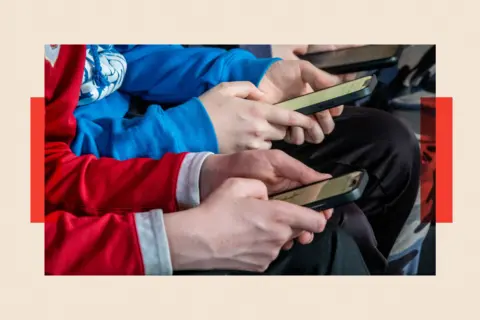
Parents are encouraged to talk to teenagers about what they see on their social media feeds
Prof Van Der Linden advises parents with teenagers to talk about what's actually popping up on their social media feeds. That includes explaining the "incentives and motivations" of people posting in ways that try to "polarise schools and communities". He also advises parents to be wary of "forwarding posts" and "accidentally amplify[ing] their reach".
According to Marc Burrows: "Once a meme climbs out of a TikTok video and into the physical realm it ends up like Margot Robbie in the Barbie movie when she first comes to the real world - completely out of context, trying to operate with an entirely different set of rules that aren't at all applicable anymore."
He describes red v blue as like that but far less fun because of the issues involved. "You end up in this bizarre space where the reaction to the thing becomes the thing, and the original meme is just sitting there in the background, meaningless to everyone except the people who made it."
Top images credit: Getty Images

BBC InDepth is the home on the website and app for the best analysis, with fresh perspectives that challenge assumptions and deep reporting on the biggest issues of the day. Emma Barnett and John Simpson bring their pick of the most thought-provoking deep reads and analysis, every Saturday. Sign up for the newsletter here