.png)
 1 month ago
44
1 month ago
44
Pallab GhoshScience Correspondent

 BBC
BBC
When the Nobel Prize in Physics was announced in Stockholm in October 2013, the world was watching.
Among the names read out was Prof Peter Higgs, the British theorist who, nearly half a century earlier, had predicted the existence of a particle believed to hold the cosmos together – the Higgs boson.
The announcement, broadcast live from Sweden, was what many scientists had hoped for since a year earlier, when experiments at CERN had finally confirmed Higgs's theory by discovering the Higgs boson – hailed as one of the biggest discoveries in a generation.
At the time Higgs, who has since passed away, said in a statement: "I hope this recognition of fundamental science will help raise awareness of the value of blue-sky research."
Blue-sky research asks questions to understand the universe, rather than design new products. It is what British science excels at, leading to the discovery of the electron, the structure of DNA and the development of the first computer. All of them were without any practical application when they were developed or discovered, but each of them has since formed the basis of technologies that created multi-billion pound industries and transformed our world.
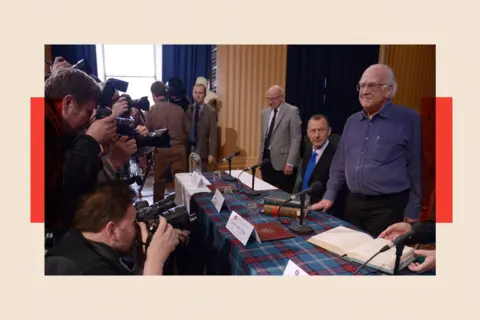 Getty Images
Peter Higgs was jointly awarded the Nobel Prize in Physics with Francois Englert in 2013
But now, Britain is preparing to cancel its contribution to one of the Large Hadron Collider's next major upgrades. It is one of several proposed cuts of UK involvement across various major particle physics and astronomy projects, which could see Britain's scientists reduce or even end their involvement in the most exciting international research collaborations probing the nature of our Universe.
For some, it is as if Higgs's words, celebrated back in 2013, were never uttered.
Behind the story is a row that has seen the science minister, Lord Vallance, and the head of Britain's scientific research funding agency accused of diverting money away from blue sky research towards government scientific priorities to help grow the economy. BBC News has a leaked document that suggests this has happened. Vallance and those leading UK science funding have continued to deny this.
And it cuts to an issue that lies at the heart of science: to what extent should researchers focus on so-called 'blue-sky research' (which has no specific purpose other than solving the Universe's great mysteries), as opposed to 'applied' research, which has clearer real-world implications in mind?
You need both and you can't have one without the other, according to Dr Simon Williams, a theoretical physicist at Durham University. His research is the bluest of blue-sky: he uses quantum computers to predict how sub-atomic particles behave. His original aim was pure scientific understanding - but as it happens, his work is also now used by a British-based company.
He thinks that cutting original blue-sky research isn't just bad for scientists - it also harms the businesses that use it. "If the research is removed from the country, then I have a strong belief that the industry will be removed from the country," he says.
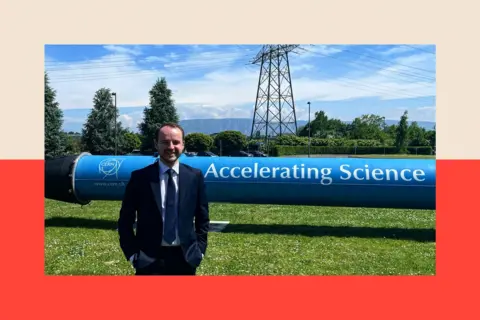 Simon Williams
Dr Simon Williams is a theoretical physicist at Durham University
Williams says he is among 30 young physicists who now can't get a grant to continue working in the UK this year because of cuts to funding. Many of them are the brightest scientists in their fields and may be forced to seek research jobs overseas or leave research altogether to make a living.
"You're killing the tree by removing the roots," he told MPs at a special hearing of the House of Commons Science Innovation and Technology select committee earlier this month. The committee is investigating the scale and impact of the proposed cuts announced earlier this year.
Williams and other physicists worry the physics budget has been cut because a reorganisation in the system of funding science has shifted money away from blue-sky to applied research.
Earlier this year, the government body that funds science, the UK Research and Innovation Agency (UKRI), imposed a new 'bucket' system, under which money will now be put into three buckets: one for blue-sky research, the second for government priorities such as AI and quantum computing, and the third for helping businesses develop new products. It is the latter two that count as 'applied research'; these are the buckets the government thinks will drive economic growth.
At the same time, in February a 30% cut (of £162 million) to funding for particle physics and astronomy research was announced by the Science and Technology Facilities Council (STFC). Its head Prof Michele Dougherty told MPs earlier this month the cut was necessary because the Council had previously started projects it had no money for, referring to "an overabundance of ambition". The problem, she said, was exacerbated by inflation and currency fluctuations.
But a senior scientist with previous involvement in the STFC flatly denies this and suggests it is a fig leaf for moving funds away from particle physics and astronomy.
"We always had the money for these projects," he told me.
"I do not understand how we ended up with a 30% cut in the particle physics and astronomy budget unless at some point there must have been a choice to reduce that aspect of the budget." In other words, a diversion of funds from bucket one to bucket two.
And away from its public suggestion that the cuts were necessary because projects were started without funding, the BBC has discovered that internally the STFC believes there has been a deliberate funding shift.
Minutes of STFC's governing council, which are not publicly available, talk of the Council's head of strategy describing "a major shift of funding from curiosity-driven research to priority areas and targeted programmes".
I asked the head of UKRI, Prof Sir Ian Chapman, whether money had been diverted from curiosity driven research towards applied research. "No, that is not a UKRI position," Chapman told me categorically. "Across the piece, we are protecting curiosity driven research". When asked about the statement by his head of strategy, Chapman said it was a "mis-statement".
Chapman and the Science Minister, Lord Vallance, have consistently and firmly insisted that curiosity driven science is protected and still growing in cash terms.
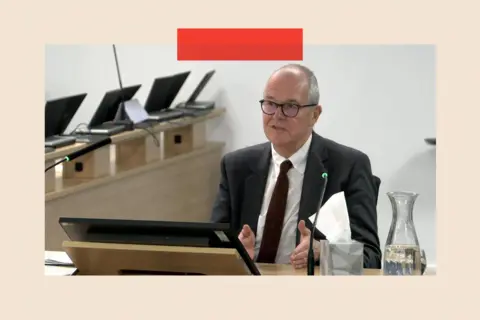 PA
PA
Lord Vallance has firmly insisted that curiosity driven science is protected and still growing
But their problem is that they can't prove it because of the historically opaque nature of UKRI's accounting system. Chi Onwurah MP, chair of the Science Innovation and Technology Select Committee, discovered this when she asked Chapman for a comparison of blue-sky spending before and after the reorganisation at a select committee hearing. He at first said it was not possible, then when pressed agreed to provide a written breakdown, which did not satisfy Onwurah.
"The committee was very disappointed to learn that we couldn't actually track how that funding was changing.
"(The breakdown) doesn't give us the level of detail we really need to be able to say, for example, is curiosity-driven research in particle or nuclear physics being cut or not."
Adding to the mistrust is that just over 60% of bucket one funding - for blue-sky research - goes directly to universities, who can then spend it how they like. Although much of it is spent on basic research, it is also used for plugging general institutional shortfalls – everything from staff costs, public engagement work, and turning research into real world products and services.
Vallance told MPs on the Science Select Committee on Tuesday that the cuts that led to Williams and others not being able to get a job was a "mistake" and that the government was urgently trying to release funding to solve the problem, or at the very least have twice as much funding next year. But proposed cuts to other physics experiments, he said, were part of a prioritisation process.

Chi Onwurah MP: "The committee was very disappointed to learn that we couldn't actually track how that funding was changing"
"It is not right to portray this as a massive cut to things. It's not," he said. "It's about managing a budget responsibly". He added that the UK was and would continue to be the second biggest funder of particle physics experiments at CERN.
Scotland's Astronomer Royal, Catherine Heymans, speaking for the UK community of astronomers, told the science select committee that the proposed cuts were "genuinely catastrophic and will be devastating for the UK."
She, along with a particle physicist, told MPs most of the potential cuts would lead to British scientists having to greatly reduce their involvement or withdraw altogether from some of the world's most important international astronomy and particle physics experiments.
Those experiments seek to answer some of the biggest questions in science. These include learning how the Universe began and how it will end, finding the first ever signs of life on planets orbiting distant stars, detecting black holes that ripple space time, mapping newborn planets around distant stars and analysing their atmospheres for signs of life. All of these are experiments in which, historically, the UK played a leading role. But now, British scientists could be largely locked out of them in the future, if the STFC does not pay its way.
Prof Jon Butterworth of University College London, described the level of cuts as "existentially threatening" to UK particle physics.
But there are those who strongly support the reorganisation. Among them is Dr Stuart Wainwright OBE, chief executive of the UK Centre for Ecology & Hydrology and Group Director of the UK National Research Organisations, representing around 40 national research labs.
"I think it's right that UKRI and Ian (Chapman) are trying to bring a focus on doing amazing discovery science, but also working more with government and businesses, and getting that funding working together to do more to support the major government priorities we're facing, and also drive commercialisation and innovation.
"So the UKRI changes for us, if done correctly, will enable that great discovery science, [and] enable academia to do even more with our capabilities."
Few would disagree with Wainwright, even those affected by the physics cuts. It is the "if done correctly," part which is the bone of contention, according to one of the country's most respected and influential scientists.
Nobel Prize winner Sir Paul Nurse believes the introduction of the bucket system has happened too quickly and with insufficient consultation.
"I think it's definitely been rushed," he told me. "Some of the problems that have arisen could have been avoided if things had just been taken more slowly, in a more considered way."
The priority now, he says, is to find a way through the current crisis.
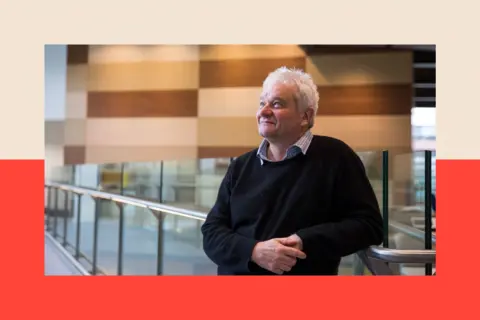 Getty Images
Sir Paul Nurse says the introduction of the bucket system has happened too quickly
"If we had to put more money in in the short-term I would just do it. We need to stop before we tear each other's hearts out, pause, think about it, consult, and work out together what should be done next."
Chapman says he wants his reforms to protect and nurture curiosity driven research, while also benefiting society and growing the economy.
"I'm a physicist, I'm a scientist, I care deeply about the field. I'm the last person who wants to do any damage to it. I really hope that in time, this transition to the buckets model makes it very clear what we're trying to achieve."
What is agreed by all is that a way out of the current crisis in physics funding is urgently needed, so that UKRI can kick on with its plans to translate Britain's brilliant blue-sky research into economic benefits to create new breakthroughs, new jobs and a better society.
Top image credit: CERN/PA Wire

BBC InDepth is the home on the website and app for the best analysis, with fresh perspectives that challenge assumptions and deep reporting on the biggest issues of the day. Emma Barnett and John Simpson bring their pick of the most thought-provoking deep reads and analysis, every Saturday. Sign up for the newsletter here