.png)
 5 hours ago
3
5 hours ago
3
Jessica ParkerBerlin correspondent

 Reuters
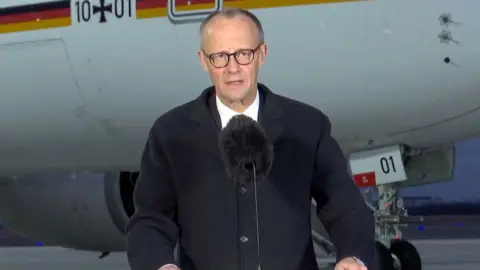
Friedrich Merz spoke to media before leaving for Beijing
Germany's chancellor has touched down in China as German businesses sound the alarm about a yawning trade imbalance.
Imports into Germany from China were more than double the value of those exported back last year – according to federal statistics.
"We want a partnership with China that is balanced, reliable, regulated and fair," said Friedrich Merz, before leaving for Beijing.
Merz is also expected to press China to use its influence with Moscow to help end the war in Ukraine. However, the huge trade gap looms large over these talks as the chancellor takes along a sizeable business delegation.
Behind that headline is a stark and worrying imbalance for Germany, the EU's largest economy.
In 2025, goods worth €170.6 billion (£148.8bn; $200.9bn) came from China into Germany - an 8.8% annual increase - while German exports to China fell by 9.7% to €81.3 billion.
The trade relationship with China "is eroding the core of German industry, especially in the car, machinery and chemicals sectors," warns Jürgen Matthes at the German Economic Institute (IW).
Matthes, the IW's head of International Economic Policy, believes distortions are chiefly down to "massive" Chinese subsidies and currency under-valuation.
Chinese price advantages "cannot just come from more innovation and efficiency," he told the BBC.
Beijing has previously said its subsidy policies are transparent and fully consistent with international trade rules.
While, in response to past allegations of unfairly controlling its currency's value, it's said it's committed to implementing a floating exchange rate regime, based on market supply and demand, but managed where necessary.
The bloating trade deficit, that's hitting the EU as a whole, is being dubbed the latest "China shock".
A trend partly caused by the pandemic and Russia's full-scale invasion of Ukraine which led to rising production costs in Europe - according to Bruegel.
"During the same period, China entered a prolonged deflationary phase, stemming from over-investment in manufacturing, creating the overcapacity we see today."
It's left leaders weighing how best to offset the impact of cheap Chinese goods.
That's as the continent's already been rocked by the turbulence of US President Donald Trump's tariff policies.
"No one in Europe wants a two front trade war with the world's two superpowers," says Noah Barkin, a visiting senior fellow at the German Marshall Fund.
Europe does have leverage, says Barkin, who's also a senior adviser at the Rhodium Group: "China needs somewhere to sell its goods. It has a real problem with over-capacity."
But the arrival of these goods is sparking acute angst in Germany – the traditional engine of Europe but one that's been stuttering, economically, for years.
Notably, its once mighty car industry is shedding jobs in what's become a bumpy transition to electric vehicles; a field China dominates.
Business groups in Germany are urging Merz to send a clear signal during what will be his inaugural trip to China as chancellor.
He must address problems including "distortions" in competition and export controls on critical rare earths – according to the Federation of German Industries.
Merz's instincts, as a free-trade trans-Atlanticist, are clashing with current global realities.
"France is behind a protect agenda while Germany is more sceptical," says the GMF's Barkin.
The EU has launched numerous anti-dumping cases against China while there are proposals to boost domestic production and curb foreign dependencies.
"I think where the Commission struggles is classic trade defence tools like tariffs," says Barkin. "Unlike the US, which can use tariffs much more flexibly."
For Berlin, the headache spells yet another strategic defeat for its past approach of "change through trade" with countries like China and Russia.
Former long-serving Chancellor Angel Merkel faced frequent accusations of brushing aside human rights concerns in favour of deepening economic ties with Beijing.
Such deep ties - and dependencies - are now not easily discarded.
Ahead of boarding the plane on Tuesday night, Merz said Germany would continue its broader de-risking policy but that, "it would be a mistake for us to seek to decouple ourselves from China".