.png)
 1 month ago
76
1 month ago
76
Two years ago, when sixth-tier Maidstone won at Ipswich to reach the fifth round of the FA Cup for the first time, their manager, George Elokobi, distilled the unique, enduring impact of an FA Cup giantkilling into five syllables: “This binds us for life.”
The same bond, only even more powerful, will be in evidence on the south coast in the next week. All connected with Southampton hope to celebrate the 50th anniversary of their only FA Cup final triumph having reached another final.
There are cosmetic parallels between Southampton’s semi-final against Manchester City and the euphoric win over Manchester United in the 1976 final. Fifty years ago, Southampton were sixth in the old Division Two and given no chance against United, third in Division One. This year Southampton are fourth in the Championship and face the Premier League leaders.
Bobby Charlton’s prediction before the 1976 final – “I am confident United will win by at least three goals, and feel it could well be six” – went down in infamy. But the gap between England’s top two divisions has grown so much that most people give Southampton even less chance now than then. In 1976, the odds on Southampton winning in 90 minutes were 5-1; for Saturday’s game they are between 9-1 and 12-1.
The timing of the semi-final could hardly be more evocative: next Friday is the 50th anniversary of the greatest moment in the club’s history. “For a Saints fan, ’76 stands as an absolute highlight,” says Tim Manns, who wrote Tie a Yellow Ribbon, the story of Southampton’s historic Cup run. “Everything about it was magical. It was a beautiful day; it was the start of May but it was blisteringly hot. The club had had only been in two FA Cup finals – 1900 and 1902, which they lost – so in living memory it was a one-off. The atmosphere around the city built and built and built. It was just wonderful.”
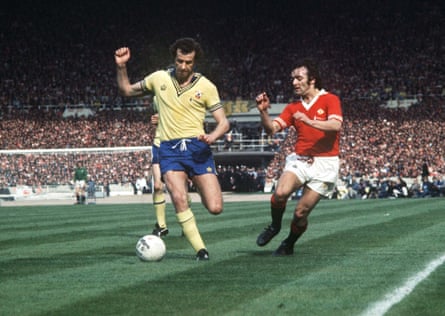
The Cup run is central to the identity of the city of Southampton, never mind the club, an idyllic moment in time held dear even by those who weren’t born when it happened. Younger generations appreciate the elegant commemorative kit Southampton have worn in every round of this season’s competition.
Southampton had no idea they would be in another FA Cup semi-final when they planned next week’s celebrations. An anniversary dinner on Monday is followed by two nights of The 76 Experience. It includes Q&As, a screening of the game – and the chance to board the same open‑top bus, recently restored, that crawled round Southampton in front of 175,000 people after they won the FA Cup. Their manager, Lawrie McMenemy, said it was “the biggest turnout in the history of Southampton for any event, ever”.
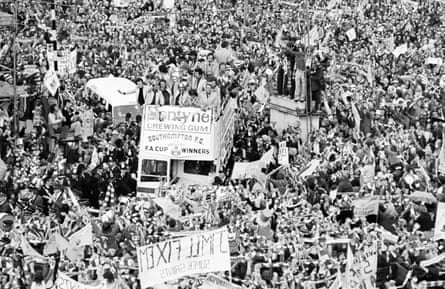
For the players, it is a rare chance to meet in person and kick around old times. Many still live close to Southampton but the midfielder Nick Holmes is flying over from the US. Eight of the XI, aged between 71 and 82, should be there. The goalscorer Bobby Stokes was only 44 when he died of bronchial pneumonia; Peter Osgood was 59 when he died in 2006, two months before the 30th anniversary; Mel Blyth passed in 2024.
In some ways, the wonder of Southampton’s triumph has grown over time. “It becomes a bit surreal,” says Paul Gilchrist, a tireless midfielder who helped shut down Gordon Hill, United’s flamboyant left-winger, in the final. “You look back and think: ‘I can’t have done that, it must have been someone else!’”
Gilchrist scored a spectacular overhead kick when Southampton demolished West Brom in a fifth‑round replay, a match in which Mick Channon – an England regular despite playing in the second tier – scored a hat-trick. Gilchrist also put Southampton ahead against Crystal Palace in the semi-final at Stamford Bridge, pinging a drive into the corner after exchanging passes with Osgood. “All I saw was the back of the net bulge out and the crowd behind the goal go mad,” he says. “I thought: ‘Jesus, it’s gone in!’”
David Peach, a full-back who finished his career with more than 80 goals, scored his first penalty for the club to complete a 2-0 victory. “I always fancied myself,” he chirped on The Big Match after the game. “I’ve got the best left foot in the country anyway!”
Palace, though a third-tier side, were going places under the shy, retiring, cigar-smoking, fedora-wearing Malcolm Allison. Before the game Allison playfully predicted a 4-0 win to the TV cameras. He also had a bet with Blyth, the centre-back who had joined Southampton from Palace, about the result. Blyth’s stake was £50, Allison’s his beloved fedora.
Tim Manns takes up the story. “Mel said they were all celebrating after the game when the dressing room door opened and a hat flew in, whizzed past everybody and landed on the floor. Mel died a couple of years ago but the last time I spoke to him he said it was still in the attic.”
In the 1970s Wembley was a mythical place, but the two semi-final goalscorers had been there before. Peach was a ballboy at the 1966 World Cup final and Gilchrist was a Manchester United fan in his youth and watched them beat Benfica in the 1968 European Cup final. Southampton had Wembley experience on the field, too – certainly more than United, a young team who had charmed the nation with some coruscating football on their return to Division One.
In 1976, an Anyone But United culture was a thing of the future. Tommy Docherty’s team were so beloved for their style that the leader column of this paper said: “Manchester must win. A loss will be a disaster … Football will win if they win.”
Football won regardless, not least because Southampton’s victory brooked no argument. This was no smash-and-grab, more a slow burner in which a stunning upset became progressively likely. All season United’s football had been exhilaratingly fearless, but the weight of the occasion – even the referee Clive Thomas called the FA Cup final “the most glamorous soccer spectacle in the world” – and the cool excellence of Southampton wore them down.
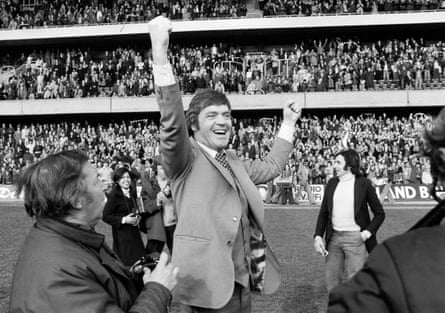
Not even Claude AI can say categorically whether Stokes, a boyhood Portsmouth fan, was offside when he ran on to Jim McCalliog’s excellent pass to score the most famous goal in Southampton’s history. When Channon was asked about it in 2017, he replied on behalf of an entire city: “Who gives a fuck?” For years, McMenemy and Martin Buchan – the United captain in the 1976 final, and the man who probably played Stokes onside – went through the same pantomime routine at the annual Professional Footballers’ Association dinner. As they walked past one another, without making eye contact, Buchan would say: ‘He was.’ McMenemy would reply: ‘He wasn’t.’”
Southampton returned to Wembley for the Charity Shield in August 1976, but that was the last time the Cup final XI started together. McMenemy was intent on promotion and began to reshape the team. When Southampton’s defence of the Cup ended in a fifth-round replay at – yes – Old Trafford, only six of the Wembley team were in the side. Gilchrist was among those cast aside without sentiment. “It didn’t end up as we hoped, put it that way,” he says. “But it doesn’t tarnish the memory of 76, not at all.”
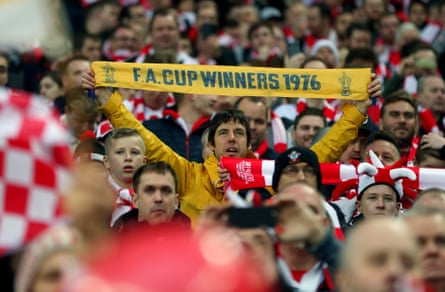
Gilchrist was stunned by the reception he and some of the other 1976 team received at a recent Fanzone event at St Mary’s. “When we walked on stage, they went absolutely bananas! We couldn’t believe it. It was incredible.”
While the reunions are the most vivid reminders, nostalgia can strike any time, any place. “I was walking into a pub in my village this week,” begins Gilchrist, “when a man came up to me and said: ‘You broke my heart.’ I went: ‘Sorry?’ And he said: ‘You broke my heart – Stamford Bridge. I’m a Crystal Palace supporter and I was there.’ And then he started laughing. We didn’t exchange blows or anything like that.”
Gilchrist will be back in his local for Saturday’s semi-final, hoping to watch another generation of Southampton players achieve something that binds them for life.