.png)
 9 hours ago
3
9 hours ago
3
3 hours ago
Mark Lobeland Liv McMahon,Technology reporter

 Dentsu
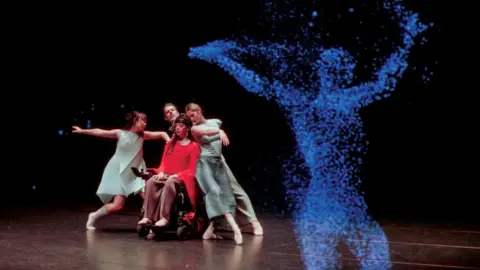
Breanna Olson's live performance in Amsterdam saw her guide the movements of a mixed-reality avatar with her brainwaves, through using an EEG-based device, alongside other dancers
A ballerina with Amyotrophic Lateral Sclerosis (ALS) says she was able to dance again after her brainwaves were used to power an avatar live on-stage in Amsterdam.
Breanna Olson, a mother of three, found out two and a half years ago she had ALS, the most common form of motor neurone disease (MND) and which, with no known cure, weakens muscles and over time affects speech, swallowing and breathing.
However, using sensors to measure the electrical activity transmitted from her brain, her motor signals could be converted into an digital avatar.
In an interview with BBC News, Breanna said it was "exhilarating" and "magical" to see herself, in virtual form, take to the stage again.
Breanna lives in Tacoma, Washington state, in the US and has trained in ballet, contemporary, and jazz dance since childhood.
MND affects nerves in the brain and spinal cord, controlling muscle movement. As these weaken and stiffen over time it can affect walking, talking, eating and breathing.
"I never dreamed that I would be able to dance on stage again," she said.
"It was just a beautiful and memorable moment I will remember for the rest of my life."
The performance, held at the OBA Theatre in Amsterdam in December, was described at the time as the "first of its kind".
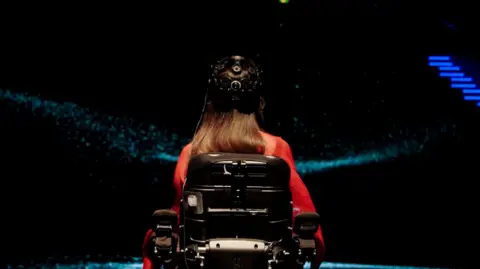
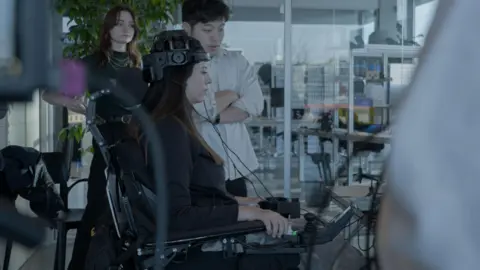
It saw Breanna use an electroencephalogram (or EEG) headset, developed by Japanese tech firm Dentsu Lab in collaboration with data company NTT, to capture her brain activity and specific motor signals associated with imagining certain dance movements.
A brainwave interface translating these signals into computer instructions then allowed her to convey which of these movements she wanted her mixed-reality avatar to dance in real-time.
 Dentsu
Breanna said receiving a standing ovation in Amsterdam when she performed in front of a live audience was "incredible"
It forms part of a wider landscape in which scientists are exploring technological solutions to help people with deterioration of physical or mental abilities enjoy their hobbies and participate in physical environments.
Breanna said after exploring solutions allowing her to determine the movements of a dancing avatar, she believes such technology "definitely has a place for those with disabilities".
'A new way of expression'
 Dentsu
Dentsu Lab researchers say they created a new brain computer interface for the Waves of Will project in which Breanna took part
Breanna told the BBC she got to know the "unique" but "quite challenging" technology during the project.
"You have to isolate your muscles and the noise around you... and really focus inward," she said.
But despite its challenges, Breanna said the experience had helped re-establish a sense of expression and connection eroded by her condition.
"This is a new way of expression," she said. "To be able to move in a new way and a different way is just freeing."
The project, called Waves of Will, is part of a wider initiative which aims to explore how innovation and technology can help restore personal expression, identity and participation for those living with motor-degenerative diseases such as ALS.
"There are many brainwave technologies and research all over the world, but most of them are very expensive and not accessible to everyone," Dentsu Lab chief creative officer Naoki Tanaka told the BBC.
"This is exactly why we started Waves of Will - to make a new brainwave interface."
Mariko Nakamura of NTT said she believed the tech could be developed for other devices like wheelchairs or remote controls.
 Dentsu
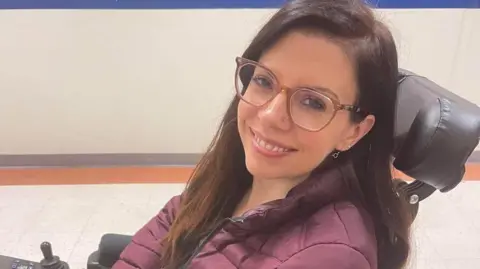
Breanna hopes her experience will help people with disabilities be viewed "less as sick people or that something is wrong with us, but more like we have value and talents and wisdom"
Breanna also wants to leave her mark on the world, telling the BBC she wants to be able to help others with ALS and give them "hope".
Her experience, she said, has shown her just how powerful the mind can be.
"We can do more than we think we can," she said.