.png)
 1 month ago
37
1 month ago
37
Simon Jack,Business editorand Oliver Smith,Business producer
Watch: 'AI rejects some applications in less than two minutes'
"It's robotic. It's brutal," says Bhuvana Chilukuri - a third-year business student who has applied for more than 100 jobs and has been rejected for every one.
"There are moments where I applied and I got a rejection less than two minutes later, which is really horrible," says the 20-year-old.
She is convinced that very few, if any, of her applications are ever seen by a human as firms are increasingly using Artificial Intelligence (AI) to hire new staff.
"The first step is AI screening your CV. You can get rejected pretty quickly at that stage. Then the next process would maybe be an AI video interview," says Bhuvuna.
Despite several work experience and internship stints she has so far failed to line up a job for when she graduates from Queen Mary University in London this summer.
Her frustration is shared by many people of her age, for whom the first rung on the career ladder can seem out of reach.
Job vacancies have almost halved since the post-pandemic peak while higher costs for employers and strengthened rights for new hires have made firms more reluctant to recruit.
And when they do they're increasingly turning to AI to help them sift through the vast volume of applications. Some 89% of UK recruiters say they are planning to use more AI in the hiring process this year, according to recent data from Linked In.
For Bhuvana that means logging on to recruitment portals which fire questions at her before she video records her answers staring at her own reflection.
"I do tend to feel like a robot, because you're just seeing yourself on screen, and answering questions for almost 20 minutes. You become sort of monotone. You don't speak to anyone, and it takes away your personality. It's quite sad," she says.

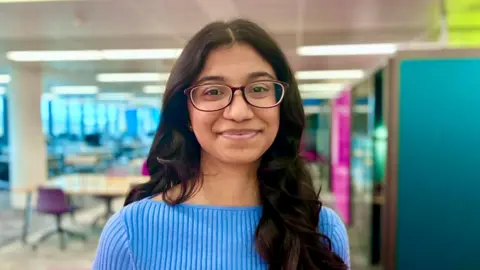
Bhuvana Chilukuri is convinced many job applications are never seen by a human
The boss of one of the world's biggest recruitment specialists acknowledged the interview by AI process can be demoralising.
"People need to send, on average, 200 applications to get a job offer," says Denis Machual CEO of Adecco which uses AI in candidate pre-screening.
"What AI brings is scale. Before, you would reach out to 50 people, and out of that you will take one, so you will have 49 people frustrated. Now, if you reach out to 500 candidates, you create 499 people frustrated," he says.
Bhuvana says she understands why companies are using AI in the recruitment process and why some candidates are fighting back by using it themselves.
"They're getting floods of applications. So I don't blame them. But it's coming to a point where students are becoming lazy. They're like 'if you're going to screen with AI, I'm going to apply with AI. And they use AI to write their CVs. I don't blame them either. Everyone's trying to figure it out," she says.
Law firm Mishcon de Reya is one of the many firms turning to AI after it received 5,000 applications for 35 roles in its last round of hiring.
"We've got more legal graduates, we've got fewer graduate roles, and we've got more candidates using AI to write more applications," says Tom Wickstead, early careers manager at the company.
"So for us as an employer, we've got this explosion of applications, and it's harder to tell the difference between those applications," he says.
They're trialling an AI chatbot– developed by graduate careers advisors Bright Network that screens candidates at the early stages of the process and asks a series of questions in real time. The tool will even highlight parts of an application that may have been written by AI.
Wickstead insists the feedback they've had from candidates so far is positive and says AI recruitment tools could make the process fairer overall.
"I just don't think that any recruitment process is free from bias," he says. "So what AI has a potential to do is be far more consistent, far more fair than the old process."
He stressed that human recruiters would still interview candidates later in the process and take the final decision on a hire.
"What we're exploring is whether AI can come up with the same decisions, or even better, more consistent decisions than humans can," he says.
Machines are no match for humans as far as Bhuvana is concerned.
"I don't trust the AI, I think I'll always trust a person. But it's hard to get the opportunity to see the person," she says.
Adecco's Denis Machuel says AI and humans need to work together to get the best outcome for prospective employees and hiring companies.
"What needs to happen is to inject the AI smartness at the right moment in the process, so that you compliment the efficiency of AI with the judgement and human touch of people," he says. "That's the combination that will break this arms race."