.png)
 1 month ago
40
1 month ago
40

 Getty Images
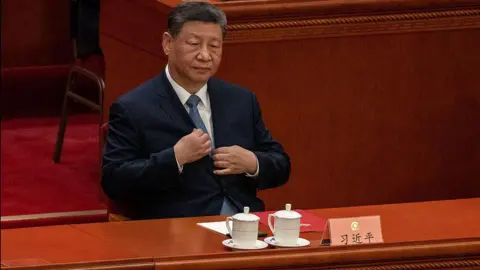
China's biggest political gathering - the National People's Congress or NPC - is due to end on Thursday.
Its extensive authority includes making laws, amending the constitution and approving state budgets. But it effectively functions as a rubber-stamp parliament, approving decisions made behind closed doors by the top echelons of the Chinese Communist Party.
Still, the meetings of the NPC and the Chinese People's Political Consultative Conference (CPPCC) - also known as the "two sessions" - are watched closely as they signal the priorities of the world's second-largest economy.
Our correspondents give us their biggest takeaways.
China wants to show it is a beacon of stability
By Laura Bicker, China correspondent
China's push to be the world's leading superpower depends largely on one key thing - President Xi Jinping's ability to manage his economy.
To achieve this, Xi appears to be seeking more certainty as he tries to balance the books in a very uncertain world dominated by an unpredictable US president and a war in the Middle East.
His policies to try to encourage Chinese people to spend more money are aimed at stabilising a stuttering domestic economy.
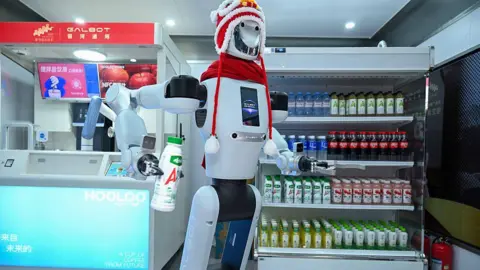
His push for technological supremacy is a bid to win the future and get others to come to China's door for the latest factory robots or AI models.
His continuing push toward increasing China's production of renewable energy will allow the country to be more self-reliant. It no longer needs as much oil and gas from other countries including Iran.
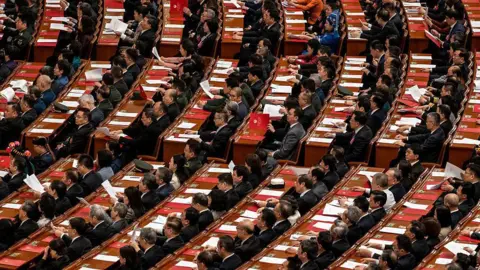
And then of course there is the choreography of such a major political event, from the practised pitch of the band, to the diligence of delegates who sit and listen to speeches and even turn pages in perfect unison.
The quiet, heavily controlled and carefully scripted statecraft in the Great Hall of the People stands in contrast to a fiery White House which has rattled allies and shaken markets with its strikes on Iran.
The Chinese Communist Party is trying to show that it is a beacon of stability that is in the business of fixing its economy and future.
Xi will feel China is already in a strong position after fighting back against US tariffs in a trade war that ultimately ended in a truce. China's trade dominance is also attracting back former wary customers including the UK and Canada.
The geopolitical landscape is shifting, and Xi may see an opportunity for China to rise, as his rival in Washington is distracted.
But he will also know much depends on how his country navigates its own economic challenges in the years to come.
 Getty Images
The NPC is quiet, heavily controlled, and carefully scripted
China sees technology as key to its future
By Suranjana Tewari, Asia Business correspondent
Beijing is betting big on technology and innovation to drive China's next phase of economic growth.
The country's 15th Five-Year Plan sets out a roadmap to accelerate scientific breakthroughs and embed artificial intelligence (AI) across the economy. Technology is now seen not just as an economic priority but as a strategic one, as tensions with the US intensify.
Research and development spending on technology is set to rise by about 7%. Officials have launched an "AI+" plan to integrate AI into manufacturing, logistics, healthcare and education.
China is also investing heavily in semiconductors, robotics, biotechnology, quantum computing, and emerging fields such as 6G communications and brain-computer interfaces.
For decades, China's growth was powered by property and infrastructure projects. Now, policymakers are shifting the focus to technology and industrial upgrading. Leaders have set a GDP growth target of 4.5 to 5% - the lowest since 1991 - signalling expectations of slower expansion.
Analysts say the plan could struggle unless household spending picks up. Consumer demand in China is low compared with other major economies, and the property downturn has eroded wealth and confidence.
To help, the government plans to expand childcare and eldercare services and enforce paid leave, measures aimed at easing financial pressures and encouraging spending.
Leaders have also signalled a willingness to borrow more to fund infrastructure, social welfare, and industrial projects - a departure from past caution over rising debt levels.
There are risks though. State-backed investment has already led to much criticism, and overcapacity in industries such as electric vehicles. It has also triggered price wars at home and trade tensions abroad.
Experts warn that technology alone may not deliver the high-quality growth Beijing is hoping for if consumers remain hesitant about spending.
For now, Beijing seems to be confident that AI, emerging industries, and innovation can power the economy's next phase.
But success may ultimately depend on whether ordinary Chinese households feel secure enough to spend.
 Getty Images
Beijing is betting big on technology
China unveils plans to boost spending - but details are scant
By Stephen McDonell, China correspondent
For years economists have been calling on China to improve the overall health and long-term sustainability of its economy by increasing domestic consumption and weaning itself off a heavy reliance on the export of manufactured goods.
So the rhetoric from leaders at this NPC who pledged to "vigorously stimulate consumer demand" will be welcomed.
But many analysts are questioning if the proposed measures are enough to actually make a difference.
Chinese people traditionally prefer to save for a rainy day rather than spend. And now, with the value of family homes falling and high levels of youth unemployment, they are even more reluctant to do so.
So how do you get Chinese consumers to buy more?
One way could be to boost incomes. NPC spokesman Lou Qinjian said there were plans to be implemented to achieve this in the future. But he gave no details.
One specific measure that was announced was an increase in government spending on childcare. This type of support can give people more disposable income which, in theory, might free them up to buy the household goods they need.
Minimum retirement benefits for rural and non-working urban residents have been raised, but only by the equivalent of $3 (£2.24) per month, which has been ridiculed on Chinese social media as virtually nothing.
Most of the measures that were announced, for example to boost housing support for first-time married couples, refining parental leave or continuing trade-in programmes swapping old household equipment for new items, did not give any details.
Officials could argue that the NPC is about setting the tone and the specifics of household budget support will follow.
But, without the detail, it is hard to know if any of these plans will actually improve consumption in a significant way.