.png)
 1 day ago
9
1 day ago
9
The new England coach, Brian McDermott, has a job on his hands. The man he replaced, Shaun Wane, must have watched the Challenge Cup final on Saturday from the padded seats at Wembley and thought he had dodged a bullet. The prospect of facing the NRL’s finest in the stifling heat of New South Wales at the World Cup later this year was a daunting thought even before we saw England players struggle at Wembley in 30-degree heat.
Just before the interval, Junior Nsemba must have set a stadium record for how long it takes to walk 20 yards and get back onside. He was clearly saving himself for an epic second-half performance. Clever lad. Nsemba was not so clever when he joined Sam Walters in dumping Bill Leyland on his head seconds before the hooter. He is fortunate to escape a ban given that Walters, who was shown red, has been handed a seven-match suspension.
The Challenge Cup final remains an annual opportunity for our game to raise its hand, wave to the media and sporting establishment, and say: “We’re still here, you know, and as exhilarating, innovative and terrifically belligerent as ever.” It is a rare platform for young players to showcase their talent to a wider sporting public, and several Wigan academy products did just that in their 40-10 win against Hull KR. We will be seeing far more of them – and hopefully at the World Cup later this year.
While we waited for the Hull KR halfback Mikey Lewis to ignite, it was Wigan’s diminutive standoff Jack Farrimond who announced himself on the big stage, receiving the Lance Todd Trophy from Shaun Edwards. Last May, Farrimond scored in his sole appearance for London Broncos in front of a three-figure gate at Rosslyn Park. On Saturday, the 20-year-old linked up beautifully with his outside centre, Adam Keighran. He looks set to follow Rob Burrow, Sean Long and Andy Gregory in the mini-maestro mould.
Lewis was overshadowed in the battle of the halves by the metronomic Harry Smith, who was an England regular under Wane. But, with McDermott sticking with George Williams as captain, there is serious competition among the halves. McDermott is also a fan of Leeds magician Jake O’Connor, who was ghosted by Wane, so the World Cup may come too soon for Farrimond. McDermott will monitor him closely; he could be just an injury away from getting the nod. Given the heat at the tournament, young legs will be welcome.
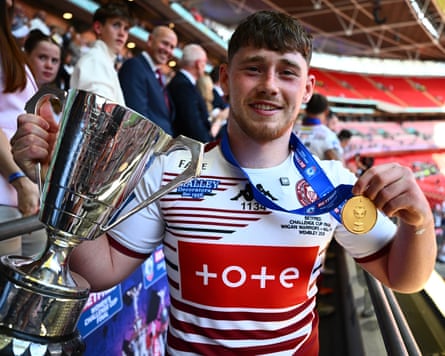
Two years ago, Zach Eckersley was the player thrown into the spotlight by Matty Peet at Wembley. Now Eckersley looks like a seasoned Super League winger and his versatility should see him on the plane to Perth, where England begin their World Cup campaign against Tonga. Noah Hodkinson, another fledgling winger, shone at Wembley, playing his eighth senior game like it was his 80th. Given their abundance of young talent, Wigan look set for a decade on top.
The way Wigan thrashed St Helens in the women’s final gave pointers to the approach England should take in the women’s World Cup, which will run in parallel to the men’s and wheelchair tournaments in Australia, Papua New Guinea and New Zealand. As second row forward Eva Hunter flew away to score Wigan’s second try, there were flashbacks to Martin Offiah in 1994 as the great man watched on from the Royal Box. Hunter, who is just 20 years old, went on to score three more tries – the first quadruple in a women’s final for a decade, surely nailing down her World Cup place.
While their 54-6 victory suggests that no one will lay a glove on Wigan, let alone stop them repeating a clean sweep, it may have heartened England coach Stuart Barrow. As he prepares to name his squad for next month’s international against France, it was the veterans in the St Helens ranks who melted in the heat, and the young Wigan players who rose to the occasion. Barrow will have to build his team around the Wigan players. There is no shame in that: some of the best men’s Great Britain teams of the past were exactly that.
After the women’s match, Emily Rudge and Jodie Cunningham – two St Helens players who are retiring at the end of the year – hobbled down the Royal Box steps, stopping to burst into tears and console each other while their teammate, Amy Hardcastle, classily thanked spectators for their polite applause. They all knew their time at the top was over.
The Wigan teenager Jenna Foubister won the player of the match award and her captain Olivia Wilson danced down the steps with the cup in one hand and a cold drink in the other. In Farrimond, Eckersley, Hodkinson, Hunter and Foubister, we have seen England’s future. And it’s in cherry-and-white.
Foreign quota
The Wigan fans travelling to Paris next weekend will see plenty of familiar names when the Super XIII Championship final between Carcassonne and Pia raises the curtain at the Catalans Dragons’ 20th anniversary match. The next Super XIII season will start after the World Cup on 5 December, but the federation’s plan to switch to a March-to-September season from 2028 has been rejected by clubs.
Super XIII’s biggest-spenders Carcassonne, led by Morgan Escare and Lucas Albert, beat Albi, the reigning champions, in one semi-final, while Super League veterans Hakim Miloudi, Théo Fages and Ethan Natoli helped Pia see off Limoux in the other.
Clubcall: Bedford Tigers
For many years, Friday Night Lights was a great event at London Skolars on Challenge Cup final eve. Bedford resurrected the concept for their rearranged game last Friday in the National Conference Southern. Local rivals North Herts Crusaders included two former Super League forwards: player-coach Joe Mbu, soon to turn 43, and 38-year-old Lamont Bryan. Both made their Super League debuts for London against Leeds: Bryan 18 years ago, Mbu way back in 2003. That considered, North Herts did well to restrict Bedford to a 36-6 win, watched by 200 fans. Ambitious Bedford have told the RFL they are still keen to join the semi-pro ranks if they want more than a new Featherstone entity next year.
Goal-line drop-out
It means more at Wembley. That’s the slogan that greets the press as they enter the media lounge at the national stadium. And Saturday proved it. Yes, Challenge Cup attendances are gradually declining, but when 5,000 is a decent attendance for some top-flight teams, there can never be “only” 56,383 watching a club match.
During the same sweltering afternoon, just 9,493 attended the Aviva Stadium in Dublin to watch Leinster’s quarter-final in the United Rugby Championship. And Wembley was far emptier for the Women’s FA Cup final on Sunday, with 43,917 in attendance to see Manchester City beat Brighton 4-0. Did anyone say Irish rugby union or women’s football were in crisis? Thought not.
Given the huge amount of NRL merchandise worn at Wembley, RL Commercial should consider partnering with the league when they renegotiate their Wembley deal for 2028 onwards. Host an NRL season-opening double-header in March, or make it a triple-header with the Challenge Cup in May. Just do something.
Fifth and last
Another historic element to Wigan’s win: never before in 140 years have the previous season’s best two teams met in a Challenge Cup final. The only previous final between the reigning league champions and runners-up was in 1902, when Broughton Rangers clinched the league title in March before the Challenge Cup was played as an end-of-season tournament. In 1972, 1954 and 1903, the cup finalists met again in the championship decider a few days later. Don’t be surprised if we get Wigan v Hull KR again at Old Trafford on 3 October.
Follow No Helmets Required on Facebook