.png)
 1 month ago
49
1 month ago
49
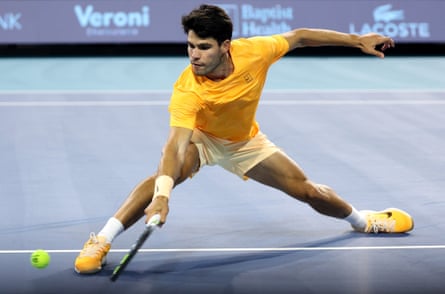
As Carlos Alcaraz worked through his service motion midway through his opening match at the Miami Open, a scream pierced the night-time air. One of the 16,000 spectators breathlessly cheering Alcaraz’s demise had attempted to distract the Spaniard just before he struck the ball.
In a spectacular atmosphere unlike many other Masters 1000 second round matches in recent memory, Alcaraz maturely navigated both a passionate, adversarial crowd and a prodigious teenage opponent in Joao Fonseca to reach the third round of the Miami Open with a 6-4, 6-4 win.
This meeting had been greatly anticipated ever since Fonseca began to emerge on the tour. Still just 19 years old, Fonseca has risen rapidly up the rankings, outpacing many legendary players with some of his early achievements, such as an ATP 500 title in Basel last year.
Excitement for a meeting with Alcaraz was further heightened by Fonseca’s excellent performance against Jannik Sinner at Indian Wells last week, where he lost in two high quality tiebreak sets. But here Alcaraz, a 22-year-old elder statesman, was clinical. He handled Fonseca effortlessly, breaking early in both sets, serving well and using his variety of shots and defence to separate himself from his opponent. While the Brazilian is already one of the most destructive shotmakers in the game, his forehand off the charts, Fonseca’s return of serve, movement and shot selection are all areas of his game that still need to improve.
“When I played the best tennis player in the world when I was coming out,” said Alcaraz, “it did really help me a lot and to my team, too. Those matches gave me the feedback to know what I should improve in the practices. I’m pretty sure he and his team talk about that and then go into the practices and see what he should improve and how he should deal with some situations.
“He reminds me a lot [of me] when I was his age and just coming up. I would say he should choose the better option. Sometimes he missed a few shots or sometimes he missed a lot of easy balls because he doesn’t choose the right shots, the right ball in certain situations. I’m pretty sure he’s going to get it.”
Fonseca attracts massive audiences filled with Brazilian fans around the world, but the Latin population in Miami naturally makes the tournament one of his strongholds. The atmosphere was stupendous from the very first point. By the end of the match, however, Alcaraz’s performance had completely silenced them. Still, he refused to find satisfaction in ruining dreams with his racket.
“I would like to say it wasn’t against me, it was supporting him,” said Alcaraz. “So I think that’s a big difference, which I would say they were respectful, I would say most of the match, just supporting him when they have to. So it was great and I just enjoyed the atmosphere so much that I just lived in the second round of a Masters 1000.
“I think it was incredible to be honest. I didn’t want to silence anybody. I just wanted to just [be] doing my stuff, doing my job and trying to play my best because I know Joao, what he’s able to do in a tennis course. So I just try to be focused, try not to hear anything from the crowd, and just going forward all the time. I’m proud that I was able to do it, but at the same time, I just had so much fun with such a great atmosphere out there.”
Elsewhere, the world No 1 and Indian Wells champion Aryna Sabalenka began her pursuit of the Sunshine Double with a hardfought 7-6 (5), 6-4 second round win over Ann Li of the United States. Sabalenka was joined by Elena Rybakina, seeded third but ranked No 2 as of this week, who eased through her first match with a 6-3, 6-3 victory over her fellow Kazakhstani Yulia Putintseva.