.png)
 5 hours ago
8
5 hours ago
8
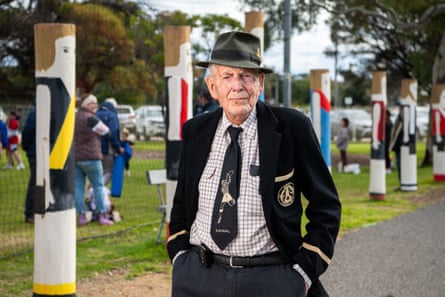
Norm Vallance is having a day out at Ouyen’s Blackburn Park in north-west Victoria during Heritage Round – held every season to honour one of the clubs in Ouyen United’s creation story. The 101-year-old moves through the crowd, resplendent in blazer and tie, and poses for photographs in front of the ground’s famous totem poles with the steely gaze of a 300-game AFL veteran.
But Vallance only ever played one game, for the locality of Kiamal, which is now home to three people, some Mallee scrub and a cluster of abandoned grain silos. “I wasn’t much of a footballer, but I did a lot of mowing,” says Vallance, who still lives on Dingo Tank Road, just up from Kiamal’s old home ground, nine kilometres north of Ouyen.
In 1981, a lack of players forced Kiamal to merge with arch-rivals Tiega, to form Ouyen Rovers. This was part of the gradual contraction of country football everywhere throughout the second half of the 20th century, but nowhere was this more pronounced than in Victoria’s Mallee region.
Australia’s rural-urban drift forced mortal sporting enemies to join forces, diluting proud identities, and creating calamity for commentators. Ganmain Grong Grong Matong in the Riverina, Devon-Welshpool-Won Wron-Woodside in South Gippsland and Tempy-Gorya-Patchewollock (TGP) in the Mallee.
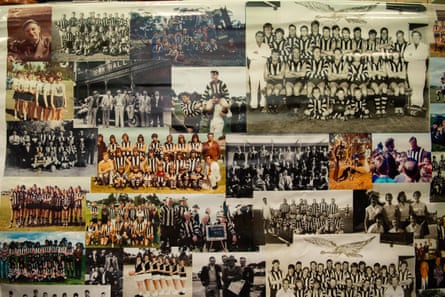
TGP eventually merged with Ouyen Rovers in 1998 to create Ouyen United, which subsequently merged with Walpeup-Underbool when AFL Victoria Country dissolved the Mallee League in 2015. This created Ouyen United Kangas – almost certainly Australia’s most merged football club.
Where there were once 43, only one remains.
From boom to bust – and dust
The Mallee region in north-west Victoria was the last in the state to be settled, in part due to New South Wales surveyor general Maj Thomas Mitchell’s dismissal of it as a “worthless wasteland completely unsuitable for agriculture”.
By 1910, surveyors had set out 640-acre holdings (one square mile), and the railway was completed from Melbourne to Mildura, and west to the South Australian border, converging at Ouyen.
Mallee was derived from the Indigenous word mali, which the Woi Wurrung and Wemba Wemba language groups used to describe the area’s multi-stemmed, shrubby eucalyptus. To farm their blocks, settlers had to “grub out” the bulbous woody base (lignotuber) of these eucalypts, often by hand. This was back-breaking work, in one of the hottest parts of Australia, but bumper crops in these early seasons prompted a rush on land and families flooded in.
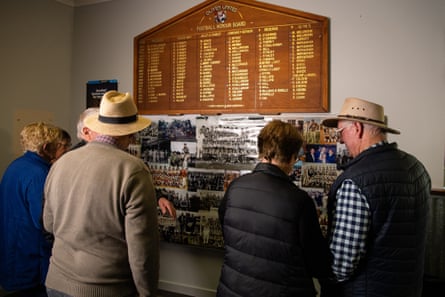
Schools opened in countless localities; Bronzewing (1923), Wymlet (1927), Kulwin (1929) and Trinita (1930). Community halls were built and football clubs established. In 1929, clubs around Ouyen contested the Central Mallee Football League, North West Mallee Football League, Ouyen District Football Association, the Patchewollock and District Football Association, and the Walpeup and District Football Association.
Football helped make farm life bearable, as long as it rained. When it didn’t, the folly of European farming methods in Australia’s arid landscape was exposed and, on occasion, the Mallee dust coated Melbourne’s skyscrapers.
The Ouyen and North West Express reported a blinding dust storm across the Mallee on the morning of the Ouyen District’s Association 1929 grand final between Ouyen and Bronzewing. Six weeks later, Wall Street crashed, heralding the start of the Depression. The land became unviable, better machinery reduced the need for labour, and families began to drift back to the cities.
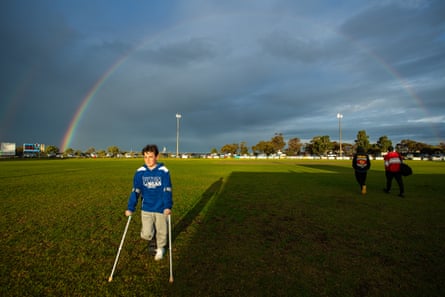
Kiamal legend Walter “Spot” Munro watches his grandson Ethan trudge off an unusually soggy Blackburn Park after Ouyen’s eight-point loss to Robinvale Euston in the Sunraysia Football Netball League.
A lot has changed since Walter’s grandfather Peter Macbeth Munro began farming near Kiamal in 1915 and raised nine children in a one-room shack with an earthen floor, but not the importance of rain. Growers now tell you that they farm moisture first, and then perhaps lentils, rather than wheat.
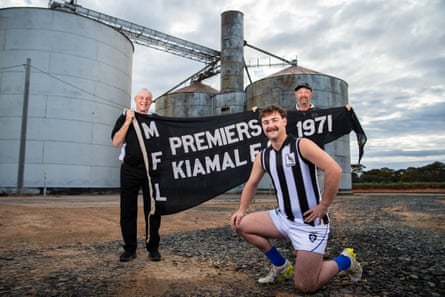
“Farmers are saying this is the best start to a growing season in 100 years,” Walter says, recalling the three-cornered jacks and saffron thistles on the “natural” ground at Kiamal. “There was no diving for marks at pre-season training. You’d rip the skin off your body.”
Walter won four Kiamal best and fairests, and featured in the club’s 1971 Mallee League grand final victory over Tiega. In all, 21 Munros played for Kiamal, before Walter’s sons Deane, Jarrod and Grant made huge contributions to the Ouyen clubs which absorbed it. These dynastic associations between families and football clubs were replicated right across the Mallee, and almost two-thirds of Ouyen’s current senior players can trace their lineage back to the teams of its creation story.
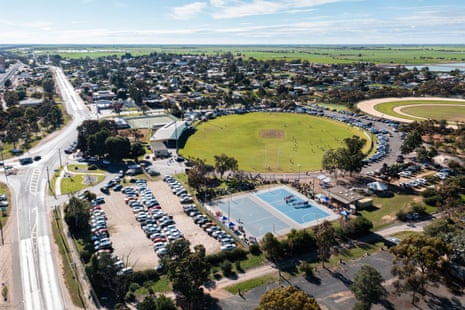
It’s what prompted former Ouyen United president Fel Cua to create Heritage Round in 2024. “Those 40-odd clubs that have made us – we just want to keep the people connected to those clubs a part of what Ouyen is today,” he says, while preparing the senior team’s one-off Kiamal jumpers for the Heritage Round match.
Smash and grab in the big smoke
Andrew Willsmore played 440 games for Walpeup-Underbool, and was an integral part of the negotiations when the club merged with Ouyen United in 2015.
“Look, it was difficult … Sometimes brutal,” he says, while waiting to watch his son Dallas play seniors. “But, after six months, we came to the agreement: our strip, their name, five [home] games in Ouyen, three at Underbool.”
Ouyen had entered the Mildura-based Sunraysia League once before, in 1979. They were soundly beaten, and retreated back to the Mallee, but the 2016 adventure would prove very different.
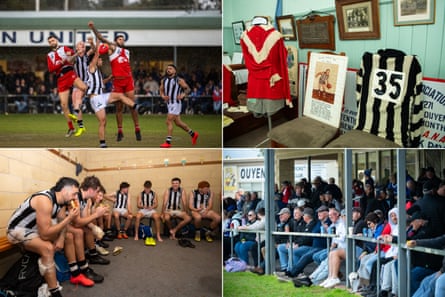
“When we rocked up for the first game that year, they ran out of food, grog, everything, before the seniors even started,” says current Ouyen United president Mick Pole. “They were like, ‘Where are you all coming from?’”
To the shock of the Mildura establishment, the last club in the northern Mallee weren’t just competitive, they were flying. The Kangas defeated Mildura Demons in the grand final to pull off one of the most remarkable premierships in the history of Victorian country football.
“That success, it was just extraordinary, and crucial in cementing the merger,” says Willsmore, Ouyen’s vice-president. “We’ve had some lean years since, but we have this influx of younger locals coming back, building houses, getting married, having kids. The future looks bright.”
The nine wooden poles which stand behind the forward pocket at Blackburn Park represent the clubs that have merged to form Ouyen United since the second world war. They were painted by Ouyen Secondary College students, who consulted Kiamal veteran Ron Vine on the exact colours and jumper design of each team.
Portrait-session complete, Vallance passes the black-and-white striped Kiamal pole as he strides back to the clubrooms to rejoin his Magpie brethren. “That link to the past can’t fade. If it does, we’re buggered,” Pole says. “We’re very aware nurturing that is what will keep us alive as a club.”