.png)
 1 month ago
71
1 month ago
71
2 hours ago
Marie-Louise Connolly,Health correspondentand Amy Stewart,BBC News NI

 Muckamore Abbey Inquiry
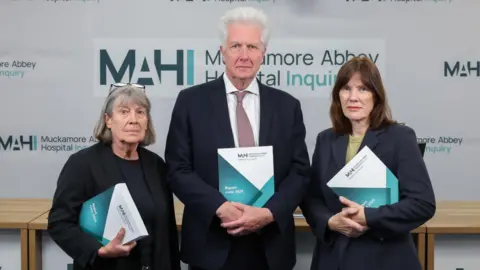
Inquiry panel: Professor Glynis Murphy, Chair Tom Kark KC and Dr Elaine Maxwell
A number of long-term patients at a hospital for vulnerable adults suffered physical abuse, including black eyes, broken bones, bruising and excessive restraint.
The long-awaited final report into the abuse at Muckamore Abbey Hospital has been published.
Chaired by Tom Kark KC, the public inquiry ran for three years from June 2022, hearing oral evidence from 181 witnesses and more than 300 statements.
The report into what happened inside the hospital found "deviance" was so normalised that working below par became acceptable.
The report also makes it clear that abuse did not involve every patient nor every member of staff, nor a majority of the staff.
But many patients had their lives made "miserable" by systematic bullying by certain members of staff whose job it was to look after them.
What did the inquiry say about the Belfast Trust?
In light of the "adversarial approach" taken during the process the inquiry touched on how "difficult a task" individual families attempting to challenge the trust must have been on occasions.
Speaking after the report was published chairman of the Belfast Trust Stuart Elborn, said it takes "full responsibility" for people being failed on many levels over many years.
The trust offered "an unreserved apology".
Chief executive Jennifer Welsh said she is deeply sorry for everything that patients suffered and for the lasting impact of "such appalling behaviour".
Northern Ireland's Health Minister Mike Nesbitt said patients were let down and extended an unconditional apology.
The Police Service of Northern Ireland (PSNI) has said its Muckamore investigation is the biggest criminal adult safeguarding case of its kind in the UK.
At more than 700 pages long, the report which lists 106 recommendations, proposes a comprehensive programme of reform in response to a profound catalogue of failures, widespread abuse, systemic failings of leadership and the mishandling of the review of critical CCTV evidence.
The critical findings include:
- Ineffective external inspection failed to uncover the abuse and the system failed to function as a meaningful safety net
- A long-term policy beginning in 2001 to move all patients with Learning Disabilities and Autism from hospital settings into community based care was not matched by necessary investment
- Prior to 2017, incidents of peer-on-peer and patient on staff assaults increased even as the patient population was diminishing, indicating a rise in intensity and potential danger
- Safeguarding arrangements did not provide effective protection for vulnerable adults
- Systems and structures in place were wholly inadequate to manage the scale of abuse uncovered through CCTV review in 2017
- Evidence from CCTV footage taken from inside the hospital captured patients clinging to wheelchairs, being spat at and so heavily medicated that they'd become "zombified"
- There was also evidence that hygiene and personal care was lacking
Kark said he hoped the publication of this report, while it cannot undo the harm suffered, will serve as a turning point.
He said what happened at Muckamore Abbey Hospital can never be repeated.
The Inquiry's report has been formally submitted to the Minister of Health.
"Implementation must begin immediately and monitored rigorously," said Kark, adding that the lessons are "stark".
"This cannot be allowed to happen again. There should be no delay, no dilution, and no side-stepping in the delivery of the recommendations," he said.
 PA Media
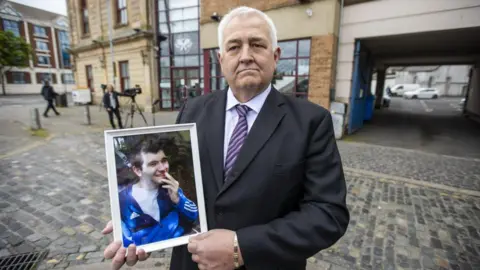
Glynn Brown's son Aaron was among those physically abused in the hospital
Glynn Brown, who was instrumental in getting the police to investigate initial allegations of abuse which involved his son, said it had been a "long and torturous road" spanning several years.
At first it was thought the CCTV cameras were switched off but after Brown pursued the matter it emerged the cameras were in fact turned on and captured hours of abuse.
"I did it for my son," he said. "I would like to think when I am dead the system will be radically better. That's all I can hope for."
Brown's son, Aaron, was among those whose physical abuse was captured on CCTV.
Speaking after he told reporters being vindicated is not the same as getting justice, he called for support, treatment and counselling to be provided to survivors of the abuse and to families.
He also called for financial redress that "reflects the gravity and duration of what was suffered".
What recommendations have been made?
These include changes to care plans for those with a learning disability, considering CCTV in some areas of care settings and for adult safeguarding to become a statutory duty, alongside the introduction of a legal Duty of Candour.
It also said it should be made easier to prosecute organisations who fail to prevent their employees causing harm to a patient.
On complaints, the report said procedures should be clearer and more accessible.
There were also recommendations around medication audits, closer monitoring of restraint and restrictive practices, and said seclusion should be used only in exceptional circumstances.
It recommended more effective inspections, including potentially using CCTV when a concern has been raised, and to spend more time talking to patients and families.
Analysis: 'Difficult reading'
The findings are shocking and are testament to why what happened inside Muckamore is regarded as the biggest criminal adult safeguarding case in the UK.
Tom Kark found there was a closed culture and a lack of reporting of what was happening between staff and patients.
Warning signs from as far back as 2012 within the hospital's Ennis Ward were missed after an incident triggered several arrests among staff, resulting in a prosecution.
While that case should have led to questions and further investigations, the inquiry found it didn't and instead some managers stood back and turned a blind eye to what was going on.
Chapter one of the report is difficult reading where the inquiry outlines examples of where and how patients were maltreated.
 PA Media
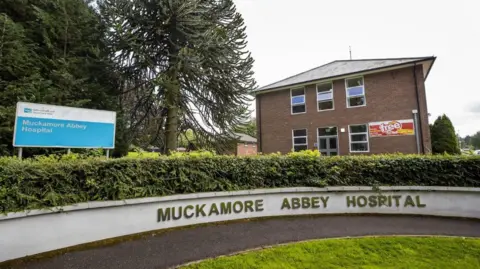
Muckamore Abbey Hospital in County Antrim opened in 1949
Separately, the Public Prosecution Service (PPS) have to date directed prosecution for 58 people who are at various stages in the judicial process.
Of those, three people have been prosecuted, two cautioned and one case dismissed.
Out of the 192 staff at Muckamore and who were investigated by the Belfast Health Trust, 19 have been dismissed, nine have received final warnings, 11 formal warning, one has received a verbal warning with 37 others being recommended for disciplinary action.