.png)
 15 hours ago
7
15 hours ago
7
21 minutes ago
Bethany Bell,in Germanyand Kristina Völk

 Alamy
Alamy
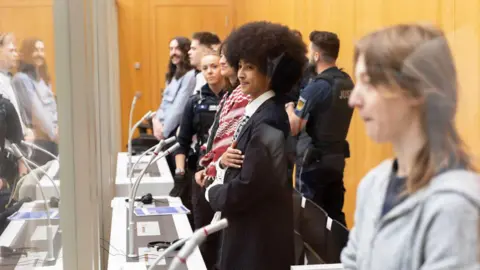
Hannah "Zo" Hailu (C) is one of the two British citizens on trial in Germany
Controversy has broken out in Germany over the trial of five pro-Palestinian activists, who are charged with belonging to a criminal organisation and destroying about €1m (£870,000) worth of property at the site of an Israel-based defence firm in Germany's Ulm.
The case of the so-called Ulm 5 has sparked a debate in Germany - a long-standing supporter of Israel - about how to deal with pro-Palestinian protesters, and could set a precedent for the future.
The five activists, from the UK, Spain, Ireland and Germany, are being tried in a high-security court at Stammheim prison in Stuttgart and have been in pre-trial detention since September.
They are linked to Palestine Action Germany, and the prosecution and defence have clashed in court over whether they should be tried as members of a criminal organisation.
Public prosecutors argue that Palestine Action Germany constitutes a "criminal organisation" as the purpose of the activities was directed at committing "serious criminal offences". This legal basis has also been accepted in recent decisions taken in similar cases.
However, the activists' defence lawyers say the the main offence they have committed is property damage. They say the charges are disproportionate and their clients' "fair trial rights were being violated", an argument the prosecutors deny.
In September last year, the five activists broke into the Ulm premises of Elbit Systems, one of Israel's largest arms manufacturers, with branches in several countries including the UK. They were arrested shortly afterwards and posted videos of their actions on social media.
The activists can be seen wearing signs saying "Palestine Action" and shouting: "Germany finances, Elbit Systems produces, Israel bombs." The video also shows them spray-painting "Baby Killers" on the walls.
Prosecutors have accused them of smashing screens, PCs, sensitive measuring equipment, and electronic devices.
The five have also been charged with using symbols of Hamas, the Palestinian militant group, which is proscribed as a "terrorist organisation" in Germany.
 Getty Images
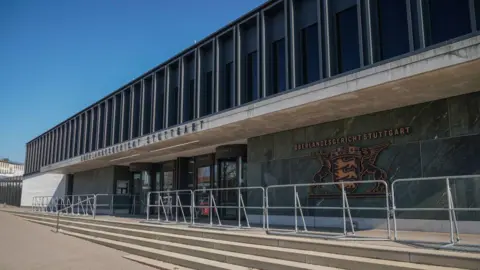
The trial is being heard at the higher regional court in Stuttgart-Stammheim
Their court case at Stammheim prison was also the venue of a 1970s trial against militants from the deadly left-wing Red Army Faction, and their lawyers argue that gives the impression their clients are "dangerous individuals", and risks convicting them without a trial.
Prosecutors have told the BBC they did not request any "special detention conditions".
Other aspects of the case have also caused controversy.
The charge of membership of a criminal organisation comes under section 129 of the German Criminal Code which has become controversial in recent years.
Increasingly it has been used against protest movements such as climate group Last Generation, and Yasmin Khuder of Amnesty International finds it "highly problematic" in the Stammheim trial.
"This case creates a risk that measures actually intended to combat organised crimes are now being used against political protest," she said, arguing the five activists were exercising their freedom of expression under Germany's constitution.
The German case coincided with a UK trial earlier this month where four Palestine Action activists were convicted in the UK of criminal damage, after breaking into an Elbit Systems factory near Bristol in 2024.
There have been extensive protests in the UK by Palestine Action. In July 2025 it was proscribed as a terrorist group.
The break-in happened before that, and the activists were charged in relation to damage to property.
One of the activists was also found guilty of inflicting grievous bodily harm.
The ban is contested in the UK. In February, the High Court ruled that the terrorist group designation was unlawful, and the UK government is appealing against the decision.
Khuder said that the UK designation "applied explicitly to Palestine Action UK and had no international usage". She added: "We are also deeply concerned by the repeated references, in this case, to the UK ban within the German proceedings."
In 2023, the German government banned various slogans as "symbols of Hamas", and it has increasingly monitored pro-Palestine protesters, but it has not designated Palestine Action a terrorist organisation.
Although there have been some convictions in Germany over the use of banned phrases and symbols, in most cases the courts decide on an individual basis, as they were not banned by law.
 "Ulm 5"
The so-called "Ulm 5" include (from L-R): Daniel Tatlow-Devally, Zo Hailu, Crow Tricks, Vi Kovarbasic and Leandra Rollo
The five have now been in custody for eight months, and activists and human rights groups have criticised the conditions at Stammheim. Their families say German authorities are trying to make an example of them.
Kit Tricks, whose 25-year-old sibling Crow Walt Tricks who is on trial, told the BBC Crow was alone in a cell for 22 hours a day.
"The UN considers [this] solitary confinement," said Tricks, insisting that Crow and the others had "not harmed anybody".
The Public Prosecutor's Office in Stuttgart told the BBC it had "not requested any special conditions of detention in these proceedings", and that the restrictions were standard under German law.
However Nicky Robertson, the mother of 25-year-old British citizen Hannah Hailu, known as Zo, said she was "absolutely disgusted and outraged" by the treatment of her daughter, especially when she was brought into court in handcuffs.
"What we are looking for is a fair trial," she said, "and what we have seen so far is not very fair."
Robertson is looking for support from the UK government, and says she has contacted her MP and written to the UK ambassador in Berlin. The British Embassy in Berlin confirmed that it was" providing support to two British nationals detained in Germany and was in contact with the local authorities".
Joel Crisetig, an analyst at Armed Conflict Location & Event Data says Germany's very different approach to the case stems from its Nazi past and a "never again" doctrine since the Holocaust in World War Two that has shaped its politics and society.
He pointed to former Chancellor Angela Merkel famous statement that "Israeli security is Germany's 'reason of state'", where Germany's government and society take special responsibility toward the State of Israel and the protection of Jewish life worldwide.
For these historical reasons "the pro-Palestinian movement is much weaker in Germany than countries like Britain or France", he said.
His research shows that in the past year Germany has had half as many pro-Palestinian demonstrations compared with its neighbour France, and significantly fewer than the UK.
Berlin's response to the pro-Palestinian movement and demonstrations is also "harsher" than other countries, Crisetig believes.
"These types of actions are very shocking to the German public, property destruction on an Israeli firm," he told the BBC. These factors had led to authorities taking the Ulm incident "as seriously as a terror case", Crisetig added.
The trial itself had a chaotic start in late April, with supporters of the five defendants chanting and shouting" Free Palestine"; defence lawyers refused to sit down, because their clients were behind glass.
The case continues, and if found guilty the Ulm 5 face up to five years in prison.