.png)
 16 hours ago
1
16 hours ago
1
Sir Chris Hoy arrives a couple of minutes late and the apologies roll from him. I don’t have a chance to tell the six‑time Olympic sprint cycling champion that waiting an hour for a star interviewee is more common. Hoy is already deep into a story about how he and his wife, Sarra, were walking here when an unknown man stopped him on the street in Glasgow.
The stranger had recently been diagnosed with prostate cancer and he wanted to share what had happened to him and, I suspect, find new strength by talking to a compassionate public figure. Hoy has lived a full life with stage 4 cancer for nearly three years. He has also worked tirelessly to highlight the fact that prostate cancer affects more men in this country than any other cancer while, at the same time, to offer a tangible sense of hope when there is horror for men, and their families, after a terminal diagnosis.
Hearing a discreet account of this encounter, it sounds as if the 50‑year‑old Hoy helped the man at a raw and vulnerable moment. “It’s so isolating when you get a cancer diagnosis,” Hoy says. “You’re suddenly on borrowed time. You’re observing the world and not living in it – because it’s for other people. But then you realise you’re not special and it’s very common, sadly. I want to make sure that anyone in a similar situation will realise they’re not alone.
“I also want to raise awareness that 10,000 men a year get the news that they have stage 4 prostate cancer. A lot of it comes down to a lack of awareness so we need to get men to understand the risk.”
In September 2023, Hoy saw his physiotherapist about a nagging pain in his shoulder. Without any other symptoms he assumed he had strained a muscle while lifting weights. The physio sent him for a scan, which identified a tumour in his shoulder. Two days later, a second scan brought shattering news. The primary cancer was in his prostate and had spread to his pelvis, hip, spine, ribs and shoulder. “Just like that,” Hoy wrote in his memoir, “I learn how I die.”
His life-expectancy was said to be between two and four years. I ask Hoy how he is feeling now. “I’m doing really well, thank you,” he says. “As well as can be expected, really.”
How often is he tested? “On average, between every three and six months. But if there’s an area of activity you might have it more frequently. You have blood tests regularly and there’re periods where you’re in and out of the hospital. The regular blood tests are horrible because it’s like the clock is ticking. At some point that afternoon or the next day, you’ll get that email.
“I remember when I was about to walk on stage for a talk. It was one of these ‘An Evening With …’ events. It had sold out and I was just about to go out in front of a packed audience. I shouldn’t have done it, but I checked my phone and the results were there. The PSA [prostate-specific antigen] had gone back up. It was like: ‘Oh God.’ And then: ‘Put your phone down, put a smile on and do it.’”
Hoy makes a grimace before smiling more wryly. “In a way the concentration of being on stage helped.”
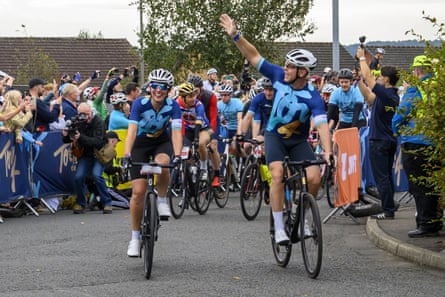
When did this happen? “Probably last summer. Even the Tour de 4 [the charity bike ride in Scotland which Hoy led for the first time in September last year] was difficult. The treatment at that point had started to fail so I was changing to a different treatment. Only with hindsight do you realise [the difficulties].
“For me, the worst is when you walk into the consultant’s room. You’re immediately trying to read their body language. Is it good news? Is it bad news? Let’s get to the punchline. So it’s why I’ve switched to Zoom for these meetings about my results. You can switch it off and you’re in your sanctuary, your home. You don’t have to be in the hospital, walking past strangers, having that long drive home.”
He seems able to live in the moment better than most people, but does the fact that he is approaching the end of his third year of a supposedly limited life‑expectancy play on his mind? “A little, but not really because these are average statistics you get in the very early days. You have to remember the people outliving those statistics can’t be added to the data yet.
“But not everybody is as lucky as me to respond to treatment. Sadly, you have people like Dermot Murnaghan [the television journalist who died from prostate cancer last month]. I’d been confident and hopeful he and I would do the Tour de 4 for many years to come. So that was a big blow, a huge shock when I got the message from his family saying the time was coming.”
Hoy continues to live with real vitality – even if he endured a serious accident on his mountain bike in November. He was racing down a trail in south Wales when, at speed, he misjudged a steep jump. Hoy still shudders at the memory.
He was warned that if surgery was unsuccessful his leg might have to be amputated, but Hoy plays down the situation now. “It’s shocking at the time, but they have to tell you what could happen from a legal perspective. It wasn’t a little fracture of the leg. It was a full reconstruction of the tibial plateau. A friend of mine who’s a doctor saw the X-rays and said: ‘Oh. That’s the kind of X-ray you’ll see when someone’s parachute hasn’t deployed.”
Hoy describes his post-op recovery as “a miserable, incredibly difficult time”, saying: “I was keeping my head above water and everything was going OK and then you have this freak accident. You have a lot of time sat around thinking, which you don’t want to be doing.”
He looks down at his right leg and says: “It’s just metalwork from here [just below his knee] down to here [near the ankle]. It’s not what I needed and yet the irony is that mountain biking gives me so much physically, mentally and socially. Being out in the fresh air and being in the moment is so good for me.”
after newsletter promotion
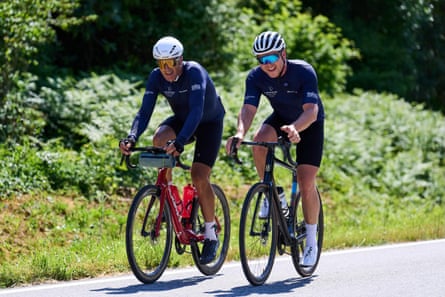
Hoy was soon back on his bike and last month, despite another injury to his “good” leg, he cycled across Spain with riders including his teenage hero Miguel Induráin, a five-time Tour de France winner. “I was on holiday in Greece and feeling great. I had this big charity ride across Spain coming up, coast-to-coast, with Miguel and others. Amazing. I was sitting cross-legged on a paddle board with my son for quite a long time, just watching the sunrise.
“When I stepped off the paddleboard, my weight shifted, and there was sharp pain: ‘Oh. That didn’t feel good.” It was a torn meniscus and there was this little piece floating about in the knee.
“It was four days before I went out to Spain but so many people were coming I couldn’t say: ‘I’ve got a knee injury, I’m not coming.’ I thought I’ll take my bike and see what I can do. I was hobbling through the airport using my carry-on case as a crutch, thinking: ‘This is ridiculous, I can’t even walk.’ But on the bike you never fully extend your knee. So, tentatively, I was like: ‘This doesn’t feel too bad.’ And long story short, I managed to get through the week and we raised £200,000 and had an amazing experience.”
He somehow rode alongside the mighty Induráin with a torn meniscus? “Yes. He’s not your average 62-year-old. He still does these crazy 10-hour rides and he’s as fit as a butcher’s dog. It was a huge honour to be with him.”
Such drive, against all odds, stands in stark contrast to the laxity that epitomises the failure of successive governments to take coherent action against prostate cancer. “I can’t see how the government are not coming up with some form of proactive decision,” he says. “They say that the risk of testing every man, and the number of men who would have elevated PSA levels, would then lead to too many being unnecessarily treated, and then having to deal with the consequences of surgery or treatment. To me, that’s a treatment issue, not a screening issue … I don’t know why we don’t [have a screening system]. It just doesn’t make sense.”
Hoy has other pressing concerns. Sarra was diagnosed with multiple sclerosis two months after he heard he had stage 4 cancer. But, worrying about him, she kept the news from her husband for almost a month. “She’s incredible,” Hoy says. “She’s receiving treatment and doing really well. Sarra took up cycling to do the Tour de 4 and she’s physically fitter than she’s ever been. She’s adamant that [MS] won’t get in the way. She’s doing all she can to support me and the family.”
How are their children, 11‑year‑old Callum and eight‑year‑old Chloe? “Kids’ concept of time is very different to ours and they know how to live in the moment. They were more concerned when I broke my leg than about my cancer diagnosis, because they could see me in pain. I was unable to get up.
“Cancer is an abstract concept for kids and we’ve tried not to allow it to change family life too much. They understand the situation but, equally, they’re living in the here and now.”
Next month, with Tour de 4, he and Sarra hope to raise even more than the £3.1m they made last year for cancer research. Hoy is inspired by the rapid progress being made in medical science in terms of treating, and potentially, finding a cure for the disease. “From what I’ve been told by people at the forefront of new treatments, this is the most exciting time for prostate cancer drug development in the last 25 years. They’ve seen a real upturn in new treatments and new therapies.”
This additional source of hope means Hoy is still full of ambition. He has just completed work as a pundit for TNT at the Commonwealth Games in Glasgow, where the cycling was held at the velodrome named after him.
“I also have ambitions to help decision-makers do something proactive. A change of prime minister, with Andy Burnham, might help. I’ve met him a couple of times and he’s good friends with [the former GB cyclist] Chris Boardman. I would love to speak to Andy and see what he thinks we could do.
“I have all kinds of goals and the biggest are raising as much money as we can for these amazing charities, changing perceptions of what is possible during a stage 4 diagnosis and also trying to one day have some proactive gateway to screen men – so less men die of prostate cancer as a result of my diagnosis. That would be quite something.”