.png)
 7 hours ago
5
7 hours ago
5
In the spring of 2011, I went to the MCC library at Lord’s – the world’s largest collection of printed material on cricket. I was near the start of a PhD on the history of women’s cricket and I wanted source material: this, surely, would be where I would find it?
Nope. When the MCC’s Neil Robinson took me to the section of the shelves on women’s cricket, I found that it consisted of three books, one of which was the autobiography of Rachael Heyhoe Flint, published in 1978. As for the MCC archives? The store cupboard was bare.
I decided, there and then, that one day I would write a book on the history of women’s cricket and it would appear in that section of the library. A decade later, Covid hit, and finally, thanks to lockdown, I found the time. That book became The Women in Whites: A History of Women’s Cricket in England (out on 1 June). It is my earnest hope the MCC will acquire a copy at the earliest opportunity.
In 2011, I was faced with the trickiest of questions: how do you write a history book without any source material? England’s double-World Cup winning year, 2009, had grabbed attention, but I simply didn’t believe Charlotte Edwards (or the ECB) had invented women’s cricket. I was right.
By the time the ECB finally came to the party, in 1998, the Women’s Cricket Association (WCA) had been running women’s cricket for more than 70 years. The first women’s Tests took place in Australia in the winter of 1934-35; more than 140 women had represented England between then and my visit to Lord’s.
I became a detective, tracking some of them down and persuading them to be interviewed – these women who had lived and breathed cricket, even in the face of ridicule. One interview was conducted while sitting in a golf buggy, being shushed each time I asked a question when someone was about to take a swing. Heyhoe Flint showed her usual generosity by inviting me, an unknown young researcher, to tea on the terrace at the House of Lords. Enid Bakewell spoke to me for three and a half hours; eventually I had to leave or I would have missed the last train home.
Many of their stories revolved around the permanently impoverished financial status of the WCA. The England batter Chris Watmough described writing hundreds of letters begging for financial support for their 1968-69 tour to Australia and New Zealand. One of the companies who responded was the lingerie brand Berlei and so it came to pass England travelled to Australia that winter wearing sponsored bras.
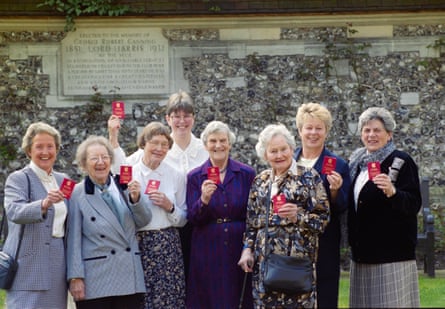
Ruth Prideaux, who coached England to glory in the 1993 World Cup final at Lord’s, wanted to run a proper training programme in the lead-up to the tournament, but had so little money available to her that the players ended up sleeping on her living room floor on blow-up mattresses and doing their workouts by running along the shingle of Eastbourne beach. Norma Izard told me about the time, in July 1998, when she borrowed a wok from the MCC kitchens in order to burn a miniature bat signed by the England and Australia teams and thus create the first Women’s Ashes trophy.
One day, I struck gold. “You need to go and see the Women’s Cricket Association archive,” somebody told me. “It’s somewhere up in Lancashire.” “Somewhere” turned out to be a tiny hamlet about eight miles east of Blackpool and the records referred to were being kept in a former cowshed. The England player Carole Cornthwaite (nee Hodges), who scored a hundred for England against Australia at Guildford in the 1993 World Cup, had retired after that tournament, married a farmer and agreed to take possession of the boxes.
I spent two weeks there one summer, traipsing the six-mile round-trip every day from a B&B in the nearest village. In among garden furniture and rusty pieces of farming equipment, I found untold historical treasures: minute books dating all the way back to the year the WCA formed, 1926, scrapbooks, letters, tour diaries, newspaper cuttings.
Slowly, I started to piece together the trajectory of the women’s game and gain an insight into some of its key characters. There was Betty Archdale, captain on that tour to Australia, who had such a distinctive captaincy style (and haircut) that the players nicknamed her “Hitler”. There was Myrtle Maclagan, daughter of an army officer, who looked down on the Australians for their working-class roots and wrote that the men she met in Perth “smelt foul”. On the plus side, she did take seven for 10 in the first women’s Test at Brisbane, and scored the first Test hundred in women’s cricket at the SCG a few weeks later.
There was the WCA founder, Marjorie Pollard, described by teammates as “a nuisance and an old know-all”, whose diehard attitude to correct dress – “trousers are beyond the pale” – meant women played international cricket in skirts until 1997.
These pioneers were long gone by the time I stumbled across their diaries and photographs and many of those I interviewed for my PhD have also died. But my hope is that they will live on through this book, as their stories and achievements become more widely known. As we celebrate the riches of the present – a fully professional women’s game in England and Wales – and dare to dream of another England triumph at Lord’s, it is only right we remember those who came before.
A short postscript: nowadays, if you go to the MCC Library and ask to see their women’s cricket collection you will not have the same experience I did. In 2017, MCC acquired the WCA archive in its entirety and those boxes made their way from the farm in Lancashire down to Lord’s (via a brief sojourn in Taunton). A relief for archivists everywhere and a challenge to other researchers: why not check it out for yourself? We could probably do with a few more books on women’s cricket.
The Women in Whites: A History of Women’s Cricket in England is available now for pre-order.
-
This is an extract from the Guardian’s weekly cricket email, The Spin. To subscribe, just visit this page and follow the instructions.