.png)
 9 hours ago
1
9 hours ago
1
Twice a day Joseph Joffre, France’s military supremo during the first world war, would stop whatever he was doing and sit down to eat. No matter how perilous the situation at the front, or how many maps and generals required his attention, lunch and dinner remained fixed points in his day.
To most people, this sounds ridiculous. But to anyone who loves cricket, Joffre was simply a man who understood the importance of an interval.
Cricket is the only major sport capable of building towards unbearable tension and then stopping because the kettle has boiled. A batter can be stranded on 99, a bowler can be on a hat-trick, a match can be balancing on its sharpest point. No matter. Lunch is lunch. Tea is tea. These are immovable pillars around which the game must bend. It is therefore a shame France never embraced it.
“Imagine how good it would be to have a Test series on mainland Europe,” says Tommy Banks, a chef with two Michelin stars who once dreamed of becoming a professional cricketer. He pictures pastries for breakfast, beef bourguignon at lunch, millefeuille at tea and enough wine to make a five-day match require a sixth for digestion. “Captains would declare for an eclair,” he says, joking.
Not that cricket’s traditional strongholds have struggled to feed themselves. The game carries the scent of the places where it is played: biryani across South Asia, jerk chicken in the Caribbean, meat pies in Australia, braai smoke drifting across South African grounds and cakes and sandwiches in England. Banks calls it “the only sport where a cup of tea is seen as a performance-enhancing drink”.
Banks grew up in North Yorkshire bowling seam-up and batting aggressively. He imagined a future on the field until, at 18, ulcerative colitis led to three major operations. His playing ambitions disappeared and the obsessive energy he had devoted to cricket was redirected into kitchens.
He returned to the game through food, creating hospitality menus at Lord’s. Even after several seasons working there, he gets goose bumps when he walks through the gates. “For a kid who grew up a world away from Lord’s, it was beyond my wildest dreams. Now to be able to work there and be part of it is just wicked.”
Cricket and cooking, Banks believes, rely on the same qualities: composure, accumulation and countless small decisions made well. A successful service is like building an innings. One spectacular shot or perfectly cooked component is not enough. “Food is all about depth. Every single thing has to be made with love and care.” A dazzling but insubstantial innings, he says, “is like a nicely cooked steak without proper seasoning”.
But the connection runs deeper than technique. Food and cricket draw meaning from the people, places and memories attached to them.
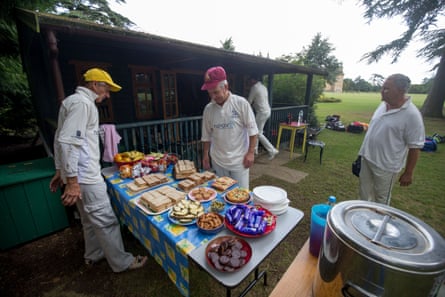
That idea sits at the heart of Taste of Cricket, an England and Wales Cricket Board cookbook assembled by Jo Pocket, the organisation’s head of campaigns. It challenges the familiar image of the English cricket tea as an endless procession of sausage rolls and Victoria sponge. Those foods remain, but now share the table with a broader portrait of Britain.
At one Welsh club, Pocket encountered leek bhajis, placing a national emblem inside a familiar Indian dish. In Devon, volunteers welcomed Afghan refugees into the cricket community and asked families to contribute food.
“As soon as we started to chip away at what was happening, particularly in the grassroots game, it was a far cry from cucumber sandwiches and scones,” Pocket says. “There was such a wealth of different cultures creating ingenious dishes and merging cultures as well.”
The recipes reveal how the sport and the country around it have changed. Isa Guha contributed a Bengali prawn curry inherited from her mother, who used to prepare cricket teas. Other players spoke about mothers making pies, grandmothers bringing brownies and recipes passed through families. Pocket says she had never seen England players more animated than when asked what they ate at cricket as children.
“Food is such a great leveller,” she says. However fiercely the teams have competed, lunch or tea brings players, umpires, volunteers and spectators around the same table.
Cricketers often carry this relationship beyond the boundary. Matthew Hayden published cookbooks after treating tours as culinary exploration. Matthew Hoggard now runs a barbecue school. Kumar Sangakkara and Mahela Jayawardene helped to establish Ministry of Crab in Colombo, turning Sri Lankan seafood into an expression of national identity.
The modern professional’s relationship with eating is more complicated. Nutritionists, recovery plans and measured fuel have replaced the overflowing dressing room spread. Keshav Maharaj, South Africa’s premier spinner, has joked that retirement will finally allow him to gorge on his mother’s cooking again. For some players, freedom is imagined as a second helping.
My own cricket memories are similarly edible. My first recollection of the Wanderers in Johannesburg is the smell of boerewors rather than a Jacques Kallis cover drive. There were doughnuts, cooler boxes, biltong and, as I grew older, vodka-soaked watermelons. Later came Lord’s lunches, Edgbaston buffets and the inevitable touring weight gain.
The scorecards blur. What the day felt and tasted like remains. Perhaps that is why cricket has always understood what Joffre knew. A meal is not an interruption to the important business of the day. Sometimes it is the thing that gives the day its meaning.
Taste of Cricket is available to purchase at the ECB shop – all profits are shared between Chance to Shine, the ACE Programme, Lord’s Taverners, South Asian Cricket Academy and the MCC Foundation.
-
This is an extract from the Guardian’s weekly cricket email, The Spin. To subscribe, just visit this page and follow the instructions.