.png)
 4 hours ago
1
4 hours ago
1
“This is the only rule I’m going to have for yous all season: ‘team first’,” says Gary Caldwell. The Wigan head coach’s Scottish accent booms over the gentle hum of a projector in a darkened classroom at the club’s Christopher Park training ground. “That is the one thing that we cannot ever go against,” he says, pointing to a slide on screen. “The team is the most important aspect of everything we do.”
Three rows of professional athletes listen intently, keen to learn not only what the day holds, but about the 10 months ahead.
Some shall see it through to next May, others may leave before the 2026-27 League One campaign begins on 14 August, and new faces will be added.
It is pre-season and before the interminable football carousel begins spinning, there is much work ahead.
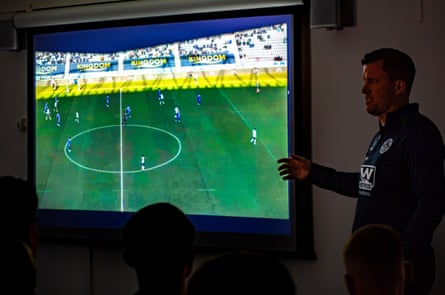
The meeting is short, just long enough for Caldwell to zip through a handful of tactical points. As he speaks, the head of performance analysis, Lauren Jones, plays clips from their “best practice bank”.
Because she, Caldwell, and the first-team coach, David Perkins, joined from Exeter only in February (the physio, Michael McBride, and goalkeeping coach, Kevin Miller, followed this summer), the bank is small, but growing.
There are myriad general football clips that Caldwell could use, but he values “the lads seeing players in Wigan shirts doing what we’re asking of them”.
Perkins relays the day’s plan – a 1.5km time trial, several drills, some out-of-possession shape work and an afternoon weights session – before the class is dismissed and told to reassemble on the grass 45 minutes later.
There is no idling, though, the entire squad soon beginning self‑led pre-activation (in old money, warming up).
Bodies are strewn across the in-house gym with bands, benches and foam rollers used as aids to contort muscles and limbs.
Wigan’s facility is, by modern standards, modest but functional. A printed sign sets out the simple rules: £50 fines for anyone with a phone, wearing sliders or sulking.
When the centre-back James Carragher discovers the Guardian will be joining the morning’s run, a sanction of double that amount is declared should anyone not beat the guest journalist. At 10.55am, the strength and conditioning lead, Matthew Barrow, explains that the run consists of 15 pitch lengths with 14 turns. “Your choice lads – boots or trainers, but I recommend boots so you don’t lose time on the turn.”
“I’m glad I’m not doing it,” Caldwell says, laughing. “It’s a maximal test and anything like that involves people pushing themselves.”
It is not the squad’s first testing of pre-season. Their first day back involved a series of body and strength tests “designed to provide us with a benchmark”, Caldwell says. “If they get injured, we know where we need to get them back to.”
But the days of players reporting back overweight are long gone, with only a small number a smidge above their optimum numbers during body composition testing. “That will all have been gone with the first week or so,” Caldwell says.
Running for running’s sake is also past practice. Instead, Barrow and the sports scientist Jack Craigie will use the run data to get each individual’s maximum aerobic speed. “From that, we individualise all the running they’ll do,” Craigie says. “For example, if we have a volume session planned, rather than giving a generic number of lengths, we set individual distances based on their results. That way they all get the same stimulus.”
By 11am, the players are jogging through a warm-up lap. According to the sign-in sheet outside the staff offices, some arrived on site three hours ago. The physio hub just off the gym has had a steady stream of visitors, a mix of prevention and cure. Breakfast was enjoyed in a canteen acting as a social space for staff and players.
It marks a leisurely start when measured against some mornings. With no tour plans, Caldwell is finding alternative ways to avoid monotony. Several 6am meets precede 3.5km runs to a partner gym for intense, Hyrox-style workouts. With players working in trios, staff are as interested in attitude and demeanour as fitness.
“We’re taking the group out of their comfort zone to see how they react under a bit of pressure,” Caldwell says. “We can look at the energy someone brings at 6am when others are tired. That will help us know who is going to pick the group up when we’re a little fatigued.”
after newsletter promotion
Those sessions also promote Caldwell’s “team first” ethos. “When you’re ‘off’ you still have a role to play,” he says. “Are you helping your pal get in and out of the straps on the rower more quickly? We want to see how they react in that situation. Come November, when it is cold and we’re struggling in a game, we can remind them of these sessions.”
A late-morning run feels tame by comparison, albeit after several pitch lengths that naive notion is dispelled. No one loses £100 to the club kitty.
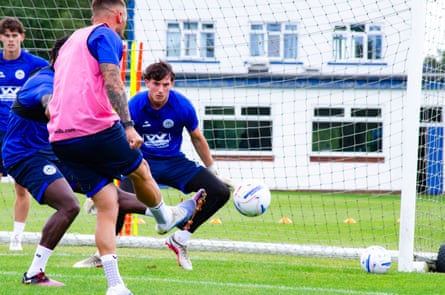
Soon the footballs are out and the group is split into two groups for a series of drills. The energy is impressive, with Max Power, who recently rejoined Wigan for a third spell, among the tone setters.
In one exercise he encourages a junior teammate to make a pass, only for a defender to block the space. Rather than get frustrated or dish out abuse, Power immediately finds another opportunity to tee up a similar ball and praises a successful outcome. “The better the player, the less stick they give people, I find,” says one staff member. “They want everyone to improve.”
The staff’s challenge is to manage the intensity, building towards a peak. Caldwell avoids directly asking players to hold back, but with a drone monitoring everything and GPS data available in real time, sessions can be adjusted accordingly. Sometimes it is as simple as moving cones in a few yards.
For one drill, tape on the grass creates a dozen boxes, within which three banks of four must work to create and find gaps. “Football is sometimes about the chaos,” Caldwell says, grinning. “If we give them more space, they will use it.”
Building towards a peak is also Wigan’s aim. Supporters want a return to the relatively recent success, which is natural after eight seasons as an established Premier League side. That ended in 2013 – the year they lifted the FA Cup at Wembley with Caldwell in the squad.
Four Championship relegations and three League One promotions have followed, including in Caldwell’s first full season in management. That was 2015-16 and the third-tier title was claimed.
Caldwell’s immediate challenge last season was avoiding relegation from League One, and patience is required for the next step.
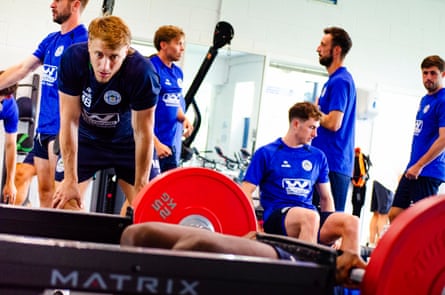
After lunch, the day concludes in the gym with a short, sharp, upper body strength session. In one corner, pull-ups, in another perfectly formed jackknives.
“Once the season begins, training loads are consistent around games,” Barrow says. “But with the time in here now we can really chase that hypertrophy.”
Pre-season was once, in effect, punishment for a summer well enjoyed, but in 2026 is a meticulous, data-driven, foundation-building exercise.
The payoff will become known only next May.